Published by Best Fitness Routine. Editorial standards · Report a correction. Educational guidance; no individual clinical review is claimed unless a qualified reviewer is named.
Train the movement between shots
Pickleball footwork drills teach you to arrive at a useful position and stop with enough control to play the next ball. The aim is not simply moving your feet as quickly as possible. Recreational players often benefit from shorter steps, a clearer ready position and learning when to reset between movements. Footwork practice can be done without a ball first, making it easier to notice balance and spacing before a rally divides your attention.
Start with drills that match movements you already understand. Fast backward running, jumping changes of direction and unpredictable partner cues are not necessary beginning exercises. If you have balance difficulties, a recent lower-limb injury or symptoms during walking, seek advice before trying court drills. Fitness practice is also separate from learning rules and tactics; ask a coach to explain positioning for your playing format. This guide describes manageable movement examples rather than guaranteeing a particular style of play is best for every player.
Prepare a clear area and suitable footwear
Choose a dry, level court or a similarly stable practice area. Inspect the route, including where you will stop, and remove loose balls. Keep enough space from fences and other players to finish each movement safely. Court lines can provide distance references without adding objects. Practice during an available court booking or in a permitted adjoining area; do not run drills through active games or crowded sidelines.
Compare court shoes (paid link) for a comfortable fit and traction on your specific surface. Shoes designed only for forward running may feel different during sideways movement, but a product category alone cannot determine individual suitability. Try slow direction changes before playing in new footwear. If the floor is damp or the shoes slide, fix the conditions instead of compensating with more cautious steps indefinitely. Appropriate shoes support the practice environment; they do not replace controlled movement, supervision when needed or gradual progression.
Establish a relaxed ready position
Stand with feet comfortably apart and knees softly bent, keeping your torso over a stable base. Hold your paddle in a familiar ready position without gripping harder than needed. You should be able to breathe and look forward without feeling locked into a deep squat. Try standing tall, moving into readiness, pausing and returning to standing a few times. This lets you identify a posture you can reproduce without unnecessary strain.
Avoid copying an extremely low position because it looks athletic. If maintaining the posture tires your thighs immediately, make it shallower. Ready position is a starting point for movement, not a pose you must freeze through every rally. A brief recording using a phone tripod (paid link) can show whether you lean excessively or narrow your feet when concentrating. Place the tripod completely outside the movement area and follow the facility's filming rules. Video can aid learning, but it cannot diagnose a painful movement or establish medical readiness.
Drill one: small side steps and a settled stop
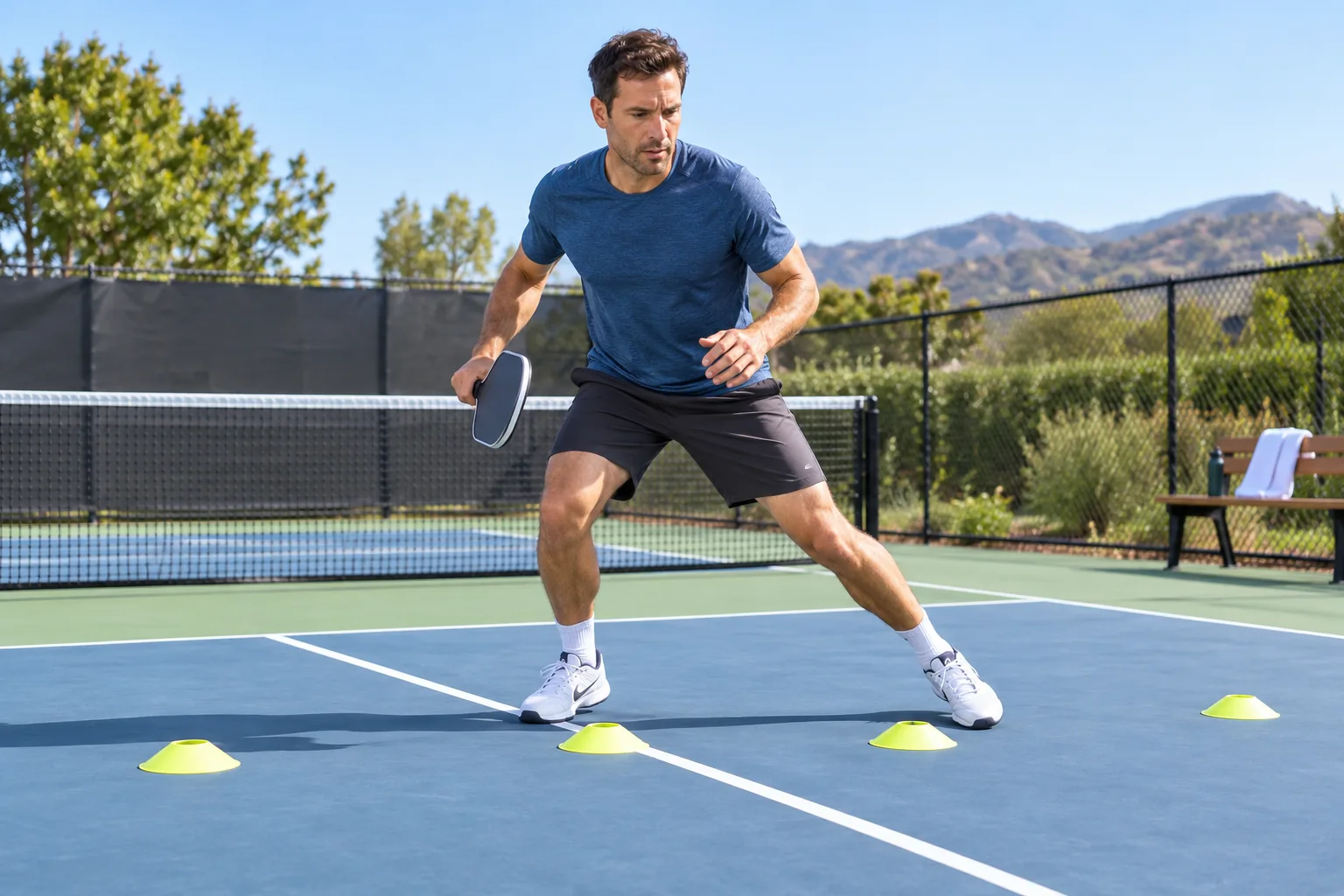
Place two flat training markers (paid link) a short comfortable distance apart, or use nearby court lines. Start in the middle, step sideways toward one reference and stop with your weight settled. Return slowly, then move in the opposite direction. During this introductory drill, keep the feet from crossing and avoid hopping to correct your balance. Two or three repetitions per side may be plenty while learning. The exact distance matters less than being able to stop reliably.
Pay attention to what happens after your outward step. If you need another hurried step or a large trunk lean to stay upright, shorten the distance and reduce speed. Flat markers should sit outside the landing path rather than under your foot. Rest after a short bout and check whether the next effort looks similar. This is controlled skill practice, not an endurance test. A coach may later teach different steps for specific shots, but first build an uncomplicated pattern that feels predictable.
Drill two: approach and stop without a lunge
From a clear starting point, take two or three easy forward steps and stop at a visible reference. Use small adjustments to settle into a comfortable position rather than reaching the final distance with an exaggerated stride. Pause, stand comfortably and walk back to the start. Repeat at walking speed before using a faster approach. Keep your eyes on the area ahead, not continuously on your shoes.
This drill can help you notice the tendency to hurry toward the ball and remain in motion while trying to make contact. The purpose is learning to finish the approach under control; it does not mean every real shot occurs from complete stillness. Avoid adding a low paddle reach until the stepping pattern is easy. If knee discomfort appears when stopping, reduce demand and seek guidance instead of repeatedly practicing a movement that changes your gait. Move the reference closer whenever control depends on a last-second recovery step.
Drill three: turn and walk rather than retreat blindly
Following a lob involves more than simply backing up. Learn the appropriate turn-and-move technique with an instructor, especially if you have previously stumbled while retreating. For an initial fitness drill, practice a slow quarter turn on a clear surface and then walk a few steps along the new direction. Stop, reset and repeat to the other side. Keep the movement unhurried and do not twist sharply on a planted foot.
Do not introduce an overhead ball during early practice. Looking upward and responding to the ball increases the coordination demand and can distract from obstacles. A partner can help observe spacing, but should not unexpectedly throw cues or make you race. If turning provokes dizziness, instability or pain, stop and get appropriate advice. Safe recreational play includes knowing when to let a difficult ball go. Reaching every ball is not a fitness goal worth losing awareness of your body or the court.
Organize short bouts with full attention
An initial session might use one round of each drill after your usual warm-up. Take a short practice bout, rest and then continue only while movement remains controlled. A interval timer (paid link) can provide a gentle reminder to pause, but avoid a rapid-beep challenge that encourages rushed repetitions. Keep the speed easy enough to explain the movement while doing it. Add practice frequency cautiously around your actual games and other training.
After several familiar sessions, change only one feature: distance, pace, repetitions or complexity. More demanding partner cues belong after predictable movement is well established. If your steps get sloppier over successive rounds, the answer may be more rest or fewer repetitions rather than greater determination. Our pickleball warm-up provides a way to prepare first, while the balance guide offers lower-demand practice when maintaining a steady base is the main challenge.
Connect drills to cooperative ball practice
Once a simple movement is reliable, introduce a cooperative partner and a pickleball paddle (paid link). Start with a gentle feed to a known location and agree on the direction before each attempt. Move, settle and make comfortable contact. Return to the starting point without treating the drill as a point. Your partner should keep the feed consistent so you can evaluate movement rather than compensate for unpredictable placement.
Gradually expand the practice only when both movement and contact remain manageable. Stop the bout before the quality drops markedly. Competitive games contain more decisions and cannot be replicated by a simple drill, so do not assume success in practice establishes readiness for a long tournament. Notice whether you recover to a useful position after contact, not just whether the ball lands in. Keep the focus narrow enough that you can describe one thing you learned when the session ends.
Use a movement checkpoint for progression
A useful checkpoint is being able to repeat several approaches and side steps with a settled finish, comfortable breathing and no symptoms that alter your motion. You do not need a fixed number of seconds or a leaderboard result. If one direction consistently feels unstable, ask for coaching or clinical advice as appropriate rather than forcing symmetry with extra speed. Video may reveal a pattern, but a recording alone cannot tell you why it occurs.
Keep the next court session realistic. Hard footwork practice followed immediately by extended games can create more total demand than either activity appears to involve separately. When you are learning, short calm practice before a manageable session may be enough. Record a simple cue such as smaller final steps or look ahead, then revisit it next time. Better footwork usually develops through repeated attentive practice, with sensible strength and balance support, instead of a single exhausting drill performed at maximum pace.
Practical Options at a Glance
| Situation | Practical option | What to consider |
|---|---|---|
| New side movement | Short planned steps | Stop without crossing or hurried corrections. |
| Overhead-ball practice | Learn turns with an instructor | Do not retreat blindly. |
| Adding a ball | Predictable gentle feeds | Keep movement controlled before speed. |
Frequently Asked Questions
No. Speed increases the challenge and can hide poor stopping or spacing. Learn predictable short movements at a pace where you can settle comfortably before progressing. If you repeatedly stumble or need extra hurried steps, reduce distance or speed and seek instruction as appropriate. A drill performed quickly is not useful simply because it looks like competition. Court skill also involves decision-making, so introduce ball and partner demands gradually rather than making an early fitness drill unpredictable.
This guide does not use blind backward running as a beginner exercise. Learn turning and movement for overhead balls with an instructor in a clear space, using a level appropriate to your balance and experience. Looking upward and reacting to a ball changes the demand. Do not add those tasks to a slow turn drill without preparation. In actual play, letting an awkward ball go can be the sensible choice. Persistent dizziness or instability with turns needs assessment rather than more repeated attempts.
You can rehearse simple ready positions and small planned steps in a sufficiently clear, stable area. Match footwear to the surface and keep furniture, rugs and loose objects away from the route. Do not imitate a full-speed game in a small room. Distances may need to be much shorter, and a stable support may be appropriate. Court practice still matters because space, surface and ball tracking differ. A home drill should build controlled movement, not claim to reproduce every playing situation.
Safety and Personal Needs
Stop activity and seek appropriate help for chest pain, faintness or severe unexpected breathlessness. Pain that changes movement, unexplained swelling, new weakness or recurrent instability needs assessment before progression. Follow individual guidance for health conditions, pregnancy, recent surgery or an injury. The routines are adjustable educational examples, not clinical rehabilitation plans or guarantees against injury.
This is general educational information. Individual needs vary with health, medications, fitness and training experience.
Sources and Further Reading
- Hospital for Special Surgery: Pickleball Preparation and Exercises
- American Council on Exercise: Pickleball Fitness Research