Published by Best Fitness Routine. Editorial standards · Report a correction. Educational guidance; no individual clinical review is claimed unless a qualified reviewer is named.
Make stability the starting point
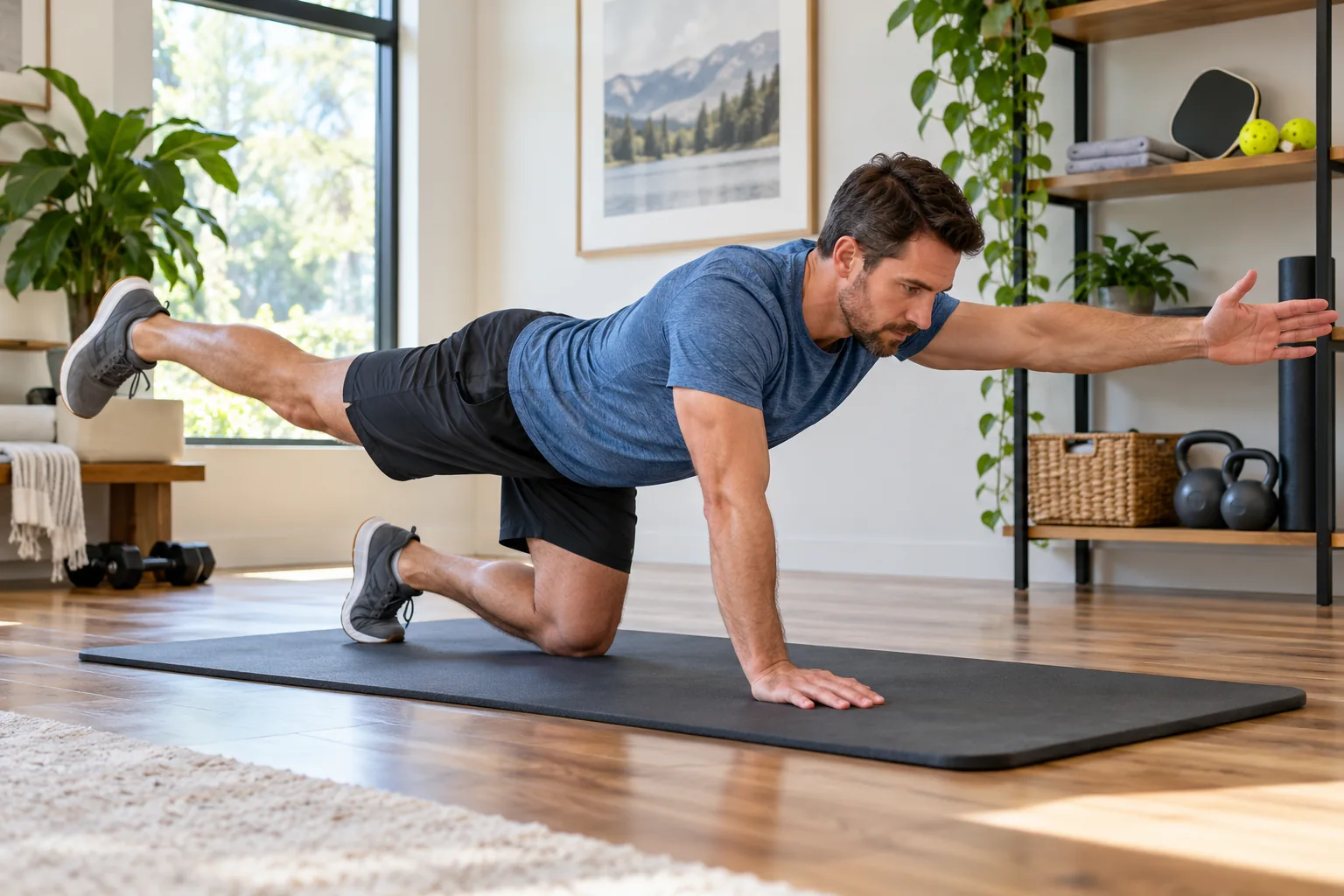
Balance exercises for pickleball should help you practice managing your body over a steady base. Recreational play involves reaching, stepping and changing direction while watching the ball, but beginner balance practice can remove those distractions. Start with simple supported positions and clear stopping points. Making an exercise look difficult is not the objective. A useful challenge is one you can control without grabbing wildly for support or placing yourself where a fall would cause injury.
Your present ability matters more than an age label. Some younger players have balance concerns, while many older players move confidently. If you have fallen recently, experience unexplained dizziness or feel unstable during ordinary walking, seek assessment before using a general program. Significant vision, nerve or medication-related issues may also need individualized guidance. This guide offers examples for gradual fitness practice; it cannot identify the cause of instability or replace a fall-risk evaluation.
Set up support before testing yourself
Use a level, nonslip surface with a stable counter or rail within easy reach. Check that the support will not move when you touch it. A lightweight chair that slides across the floor is not a reliable handhold. Clear cables, rugs and loose equipment from the surrounding area. Keep a comfortable amount of light and choose a quiet practice time when you do not need to watch children, pets or an active court simultaneously.
For court activity, compare court shoes (paid link) for fit and traction suited to the actual surface. During home practice, use footwear that allows a secure stance and avoids slipping. Do not add unstable pads, stacked cushions or wobble devices as the automatic starting point. Solid ground already offers meaningful practice when the task is chosen appropriately. Put safety arrangements in place before moving into a narrower stance; support should be an available option throughout the exercise rather than something you reach for only after losing control.
Begin with a supported weight shift
Stand facing the support with feet comfortably apart and fingertips available. Shift a little weight toward one foot while keeping both feet on the floor, then return to the middle. Repeat toward the other side. Use a small range and avoid swinging your shoulders or forcing the movement to its limit. The purpose is noticing how weight moves while you maintain a settled position, not transferring everything onto one leg immediately.
Try a few slow repetitions, pausing in the middle between shifts. Keep breathing and your gaze on a steady point ahead. If you feel an urge to grasp the support forcefully, reduce the range. Comfortable supported practice counts as practice; releasing the hands is not an obligation. Stop when dizziness or symptoms appear. Once the movement is familiar, a slightly longer pause may provide enough progression without changing foot position or asking you to look around while balancing.
Use a staggered stance before single-leg practice
Place one foot a little ahead of the other, with enough side-to-side width to feel secure. Keep support within reach and distribute weight comfortably. Hold briefly, return to your usual stance and switch sides. The distance between your feet can be adjusted. A modest stagger may be a better first challenge than placing heel directly in front of toe, especially if that narrow arrangement feels unstable.
Use a interval timer (paid link) only for short manageable holds, with an easy way to stop the exercise. A ten-second example is a convenient starting reference, not a target everyone must achieve without support. Focus on whether the position remains calm throughout. If you repeatedly step out, widen the base or shorten the hold. Avoid closing your eyes or balancing while standing on an elevated surface. Removing visual information greatly changes the task and is unnecessary for a beginning recreational routine.
Practice a low step and controlled return
On clear level ground, take a small forward step, settle your weight and step back to your original position. Keep the support accessible. Repeat to each side with enough rest to maintain control. Start with ordinary step length rather than an exaggerated lunge. A line or flat training markers (paid link) can provide a reference, but put loose markers outside your landing area so they do not become a slip or trip hazard.
This movement connects standing balance with the small adjustments needed on court. Notice the return as carefully as the outward step. If you rush backward or need several extra steps to recover, reduce distance and slow down. Practice near a stable support even when the first few attempts feel easy. Do not add a paddle reach until the stepping pattern is predictable. Learn more challenging turns with a coach, and seek clinical advice when one side has unexplained weakness or a new loss of control.
Introduce single-leg loading only when appropriate
If the earlier positions are comfortable, lightly shift more weight onto one leg while the other foot remains available for support. You can begin by lifting only the heel of the lighter foot or by resting its toes on the floor. This partial support option avoids turning every practice bout into a prolonged one-leg challenge. Keep the rail within reach and use a short hold before switching sides.
A full single-leg stance is optional, and it should happen on stable ground with a clear surrounding area. Do not pursue a personal record when control is deteriorating. Some asymmetry is common, but a persistent difference that affects daily activity deserves assessment rather than repeated testing to failure. The exercise is not a diagnosis of athletic readiness. You may continue benefiting from supported weight shifts and step practice even if a free single-leg hold does not suit your current condition.
Add a paddle task without adding unpredictable balls
When stable standing and small steps are familiar, hold a pickleball paddle (paid link) in your usual ready position during a simple weight shift. Keep the movement range modest and your grip relaxed. This adds a small attentional task while removing the uncertainty of a flying ball. If the paddle position makes you lean or narrow your feet, return to unloaded practice and reestablish a comfortable base.
Later, an instructor can combine movement with predictable gentle feeds. Avoid surprise throws during home balance exercises or practicing with a ball near furniture. The court version should include enough space, a suitable partner and an agreed stopping point. Doing well in a static exercise does not guarantee that quick rallies will be equally manageable. Our footwork drills offer a separate bridge from steady positions to controlled court movement, beginning with planned steps rather than reaction challenges.
Progress one feature while keeping the others familiar
Balance difficulty can change through stance width, support, hold duration, movement range or attention. Change only one of those at a time. For example, keep your feet in the same position while using a lighter fingertip touch, rather than simultaneously narrowing the stance and turning your head. The result should still look controlled. If a progression creates repeated near-falls, it is too large for useful independent practice.
Record the variation and amount of support in a training journal (paid link). A note such as staggered stance with fingertips for a short hold is more informative than simply writing balance completed. The log can help you repeat a successful setup after travel or a busy week. Review fatigue as well: practice done after several games may feel very different from practice early in the day. Our fitness after 50 guide explains how balance can fit alongside strength, walking and recreational play.
Keep the exercise connected to everyday function
Useful progress may show up as a calmer first step, a more controlled stop or less uncertainty when reaching within a comfortable range. These changes do not need a dramatic exercise variation. Keep practice brief enough to remain attentive, and stop before repeated corrections become the main feature. Balance training works alongside adequate strength, appropriate vision care and the management of underlying conditions; it is not the only factor affecting stability.
Let the court plan reflect your actual ability. If a particular movement remains unreliable, adjust play and ask a coach about safer positioning instead of trying to overcome it by chasing more balls. New dizziness, unexplained falls, numbness or weakness needs appropriate medical attention. Independent fitness practice should make recreational activity feel more manageable, with support available where needed. The aim is confidence grounded in repeatable control, rather than the appearance of difficulty or a promise that falls can never happen.
Practical Options at a Glance
| Situation | Practical option | What to consider |
|---|---|---|
| Starting practice | Stable surface and support | Keep assistance within reach. |
| Staggered stance | Comfortable width and brief hold | Do not remove vision or support automatically. |
| Progression | Change one feature | Control matters more than difficulty. |
Frequently Asked Questions
No. Supported positions and controlled steps on stable ground can provide useful practice. Unstable equipment increases the challenge and may create unnecessary risk for a beginner. Start with a dependable rail or counter nearby and a task that remains calm and controlled. Change support, stance or duration gradually, one feature at a time. A board purchase cannot diagnose or fix the causes of instability. Seek assessment for recent falls, unexplained dizziness or a new change in ordinary walking.
This guide keeps visual information available during independent beginner practice. Closing the eyes changes the task substantially and is not required to make it worthwhile. Maintain a stable support and a clear surrounding area. If a clinician or trained professional prescribes a different exercise, follow their individualized instructions and supervision requirements. Do not copy a difficult variation because a simple stance looks easy. Progress is the ability to repeat controlled movement, not the removal of every source of support.
Reduce the challenge and note whether the difference also affects ordinary activity. Some differences occur during learning, but new weakness, altered sensation, recurring loss of control or falls deserve appropriate assessment. Do not repeatedly test the weaker side to failure. Keep support available and use a level you can manage while seeking guidance as needed. A general fitness article cannot identify the cause. Once you understand the relevant limitations, a professional can help select a suitable exercise and progression.
Safety and Personal Needs
Stop activity and seek appropriate help for chest pain, faintness or severe unexpected breathlessness. Pain that changes movement, unexplained swelling, new weakness or recurrent instability needs assessment before progression. Follow individual guidance for health conditions, pregnancy, recent surgery or an injury. The routines are adjustable educational examples, not clinical rehabilitation plans or guarantees against injury.
This is general educational information. Individual needs vary with health, medications, fitness and training experience.
Sources and Further Reading
- CDC: Activity Guidance for Older Adults
- Hospital for Special Surgery: Pickleball Preparation and Exercises