Why the Farmer's Carry Is So Functional
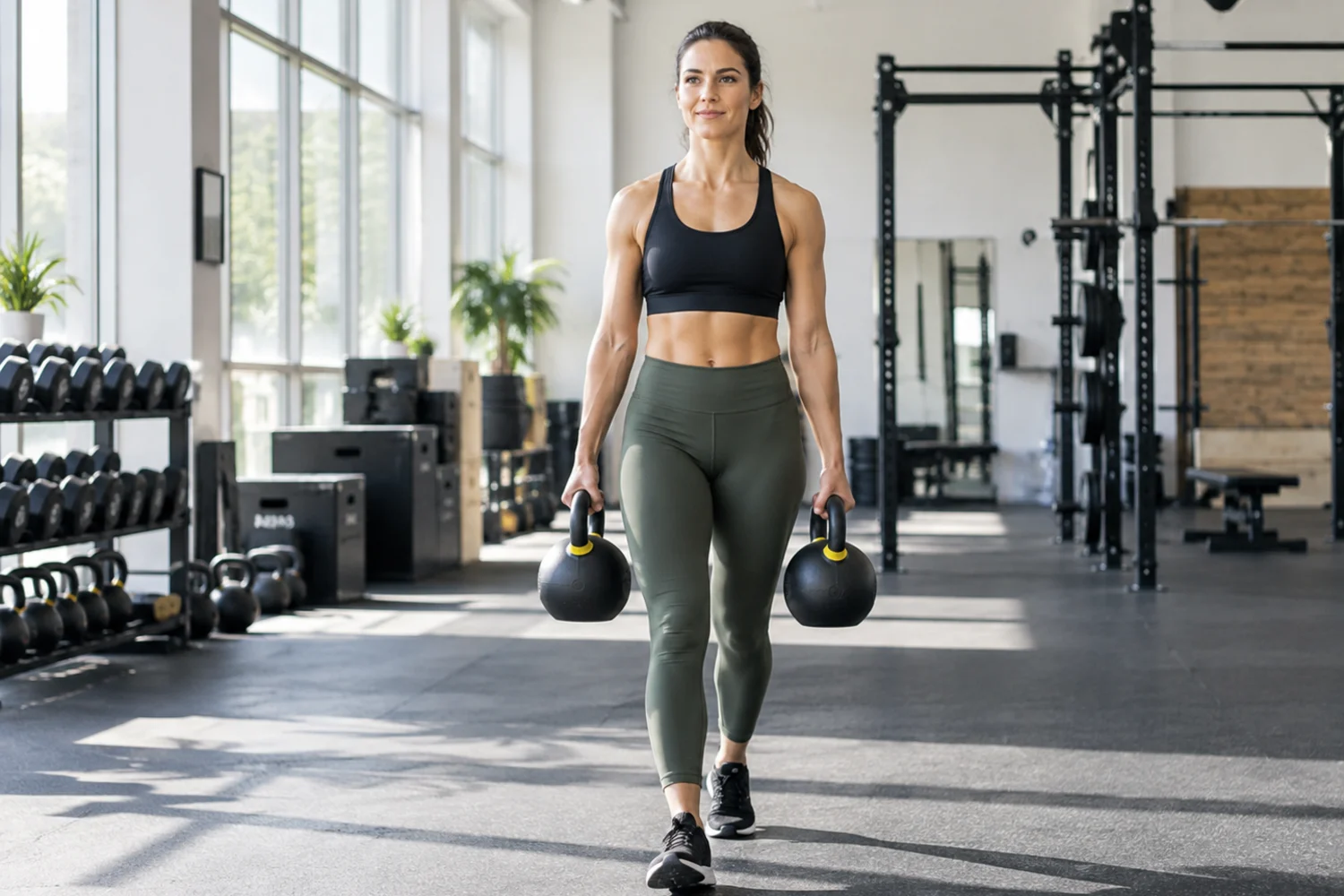
Picking up two heavy objects and walking with them sounds almost too simple to count as training. That simplicity is exactly why the farmer's carry is so useful. It asks your hands to grip, your shoulders to stay organized, your trunk to resist unwanted movement and your legs to keep producing steady steps while you carry a load. In other words, it resembles many tasks you already perform outside the gym.
Grocery bags, luggage, buckets, toolboxes and boxes all require some version of loaded walking. A farmer's carry lets you practice that pattern in a controlled setting where you can choose the weight, distance and speed. It fits naturally in a functional fitness routine because the goal is not just to move weight once; it is to maintain useful posture and control while moving through space.
The exercise can also complement basic movements such as squats, hinges and sit-to-stand training. You do not need specialized equipment. Dumbbells and kettlebells work well, and many gyms also have farmer handles. The best option is simply the one you can hold securely and carry without your posture falling apart.
Farmer's Carry Benefits
The main farmer's carry benefits come from combining strength with locomotion. Unlike a static hold, you have to stabilize the load while your body repeatedly shifts from one foot to the other. That changes the challenge from simply “holding on” to controlling your whole body under load.
1. Builds a stronger grip
Your fingers, hands and forearms have to maintain tension from the first step to the last. Grip is often the limiting factor, especially as the load gets heavier or the carry lasts longer. That makes the farmer's carry a practical addition if you want stronger hands for lifting, recreation or everyday tasks. If grip is a priority for you, our guide to grip strength and healthy aging explains why grip can also be a useful marker of overall physical capacity.
2. Trains the core without floor exercises
Your abdominal and back muscles work to keep the torso steady while the weights pull downward. A 2024 study comparing loaded carries and holds found greater activation of several trunk muscles during the farmer's carry than during an intensity-matched farmer's hold. That does not make carries a replacement for all core work, but it helps explain why they feel so demanding through the midsection.
For a broader approach, combine loaded carries with a core stability and posture routine that also trains controlled bracing, anti-rotation and hip stability.
3. Develops shoulder and upper-back endurance
Although your arms hang at your sides, the shoulders are not passive. The muscles around the shoulder blades and upper back help keep the load from pulling you into a rounded, collapsed position. The goal is not to shrug as hard as possible. Think “tall and controlled” while letting the arms stay long.
4. Adds lower-body work without another squat set
Every step requires the hips and legs to support your body plus the external load. The farmer's walk is not a substitute for squats, lunges or hinges, but it adds useful time under load while you move. That can be valuable when you want more total-body work without turning every exercise into a complicated lift.
5. Challenges balance and coordination
Walking with weight changes how your body manages each step. You have to keep the feet moving smoothly while preventing the weights from swinging. If balance is a weak point, start light and use a clear walking lane. You can pair carries with our balance exercises for adults rather than making the carry itself unnecessarily unstable.
What Muscles Does the Farmer's Carry Work?
The farmer's carry is best thought of as an integrated full-body exercise rather than a single-muscle movement. The hands and forearms maintain the grip. The shoulders and upper back help control the weights. The abdominal wall and spinal muscles stabilize the trunk. The glutes, quadriceps, hamstrings and calves help you walk and support the load.
Research on loaded carries supports the idea that the trunk is doing meaningful work. The National Strength and Conditioning Association also uses loaded carries as a progression for developing hip and trunk stability, with an emphasis on an upright torso and controlled walking. What you feel most will depend on the weight, distance, handle shape, walking speed and your individual weak points.
How to Do a Farmer's Carry With Proper Form
- Choose two secure weights. Place a dumbbell or kettlebell on each side so you can pick them up without twisting.
- Set your feet. Stand about hip-width apart and brace lightly before you lift.
- Pick the weights up with control. Hinge and bend the knees as needed, then stand tall instead of yanking the load from the floor.
- Let the arms hang naturally. Keep the weights close to your sides without pressing them into your legs.
- Walk with short, steady steps. Look ahead, keep your rib cage stacked over your pelvis and avoid rushing.
- Finish under control. Stop before your grip completely fails, then lower the weights with the same care you used to pick them up.
How Heavy Should a Farmer's Carry Be?
There is no single correct weight. A useful beginner load is one you can carry for the planned time or distance while keeping your posture, grip and steps consistent. If your shoulders tilt, the weights swing wildly, your feet start crossing or you have to sprint to finish, the load is probably too heavy for that set.
Start lighter than you think you need and build gradually. One simple progression is to carry for 20 to 30 seconds, rest until your grip and breathing feel ready, and repeat for two to four rounds. Another option is a short walking distance, such as one clear lane in your gym. The number itself is less important than repeating the same setup so you can judge progress.
When you can finish every round with clean technique, add a small amount of weight or a little more distance—not both at once. ACE uses this same general idea in its loaded-carry progressions: increase challenge gradually rather than changing every variable at the same time.
Farmer's Carry Progressions From Beginner to Advanced
Level 1: Light dumbbell carry
Use two light dumbbells and focus on smooth steps, secure grip and a tall torso. This is a good starting point if loaded carries are new to you.
Level 2: Moderate farmer's carry
Increase the load enough that your grip and trunk have to work, but stop the set before posture changes. Keep the walking distance predictable.
Level 3: Longer carry
Keep the same weight and extend the time or distance slightly. This shifts the challenge toward muscular endurance.
Level 4: Heavier farmer's carry
Use a heavier load for a shorter distance. Heavy carries require more attention to the pickup, walking lane and safe set-down.
Level 5: Suitcase carry
Carry weight on one side only. The uneven load increases the demand on the trunk because you have to resist leaning toward the weight. Start lighter than your two-handed farmer's carry.
Level 6: Mixed functional circuit
Place the carry between simple movements such as a controlled sit-to-stand, step-up or bodyweight squat. Keep the circuit simple enough that fatigue does not turn the carry into sloppy walking.
Farmer's Carry vs. Suitcase Carry
A farmer's carry uses equal or similar loads in both hands. A suitcase carry uses one side at a time. Both train grip and loaded walking, but the unilateral suitcase version adds a stronger side-bending challenge to the trunk. Research comparing bilateral and unilateral carries shows different trunk-muscle activation patterns, which is one reason both variations can have a place in a program.
For most beginners, the two-handed farmer's carry is easier to learn because the load is more symmetrical. Once you can walk tall and steady, the suitcase carry is a logical progression. If your balance is limited, keep the path short and uncluttered and master the bilateral version first.
A Simple Farmer's Carry Workout
| Round | Carry | Rest | Focus |
|---|---|---|---|
| 1 | 20–30 seconds | 60–90 seconds | Easy setup and tall posture |
| 2 | 20–30 seconds | 60–90 seconds | Quiet, controlled steps |
| 3 | 20–30 seconds | 60–90 seconds | Grip without shoulder shrugging |
| Optional 4 | 20–30 seconds | As needed | Stop before form breaks |
Do this after your main strength work or as part of a short full-body session. Two or three carry sessions per week can be plenty for general fitness, depending on the rest of your program. If your hands are already fatigued from deadlifts, rows or pulling exercises, reduce the carry volume so your grip can recover.
If you are building a broader strength base, pair carries with the principles in our strength training guide for adults. Mobility also matters when your gait or pickup position feels restricted; a short hip mobility routine for stiff hips can help you practice comfortable lower-body positions before training.
Common Farmer's Carry Mistakes
- Starting too heavy: A carry that turns into a rushed survival walk is harder to control and harder to repeat well.
- Leaning backward: Keep the ribs stacked instead of arching the low back to “counterbalance” the load.
- Letting the weights swing: Shorten the stride and slow down until the load stays close to your sides.
- Shrugging constantly: Keep the shoulders stable, but do not force them toward your ears.
- Holding your breath for the whole set: Brace, but continue breathing during longer carries.
- Ignoring the pickup and set-down: The exercise begins before the first step and ends only after the weights are safely on the floor.
Who Can Benefit From Farmer's Carries?
Healthy adults who want practical full-body strength can use loaded carries. They can be especially useful for people who want to improve grip, add trunk work without another floor exercise, or practice carrying objects with better control. Recreational lifters can use them as accessory work, while beginners can start with light weights and short distances.
They are not mandatory. If gripping weights causes pain, you have a recent hand, wrist, shoulder or back injury, or you feel unsteady while walking under load, choose another exercise and get individualized guidance when appropriate. Functional training should make everyday movement more capable, not force you through a variation that does not suit your body.
Safety Tips Before You Carry
Use a clear, dry walking path and footwear that gives you reliable traction. Keep other equipment out of the lane. If you need to turn around, slow down and use several small steps rather than twisting quickly with heavy weights.
Stop if you feel sharp pain, sudden numbness, dizziness, chest pain or a loss of balance. Mild muscular fatigue is expected, but pain is not a sign that a carry is “working better.” If a heavier load changes your walking pattern dramatically, reduce it and rebuild from a level you can control.
Warm up with a few easy walking and mobility drills before heavy carries. If your ankles or hips feel restricted, the ankle mobility exercises for squats and our daily mobility routine are useful options.
Frequently Asked Questions
It trains the grip and forearms directly while also challenging the shoulders, upper back, trunk, hips and legs. Because you are walking, the body has to coordinate those areas rather than isolating one muscle.
Use a load that feels challenging but still allows a tall posture, quiet steps and a secure grip for the whole set. Add weight only when the current load looks and feels controlled.
Start with a short distance or about 20 to 30 seconds. Repeat for two to four rounds with enough rest to restore your grip. Progress distance gradually.
Yes. Loaded walking requires the trunk to resist unwanted motion while the legs keep moving. Research has measured meaningful activation of the abdominal and back muscles during farmer's carries.
Yes. Both can work well. Choose handles that feel secure and weights that do not interfere with your legs as you walk.
Key Takeaways
- The farmer's carry combines grip, trunk stability, posture and walking under load.
- Good form matters more than carrying the heaviest possible weight.
- Start with short, controlled sets and progress one variable at a time.
- Use a farmer's carry for symmetrical loaded walking and a suitcase carry when you want a stronger unilateral trunk challenge.
- Keep the walking lane clear and stop if pain, dizziness or unsafe balance develops.
Evidence-Based Resources
Related Health Articles