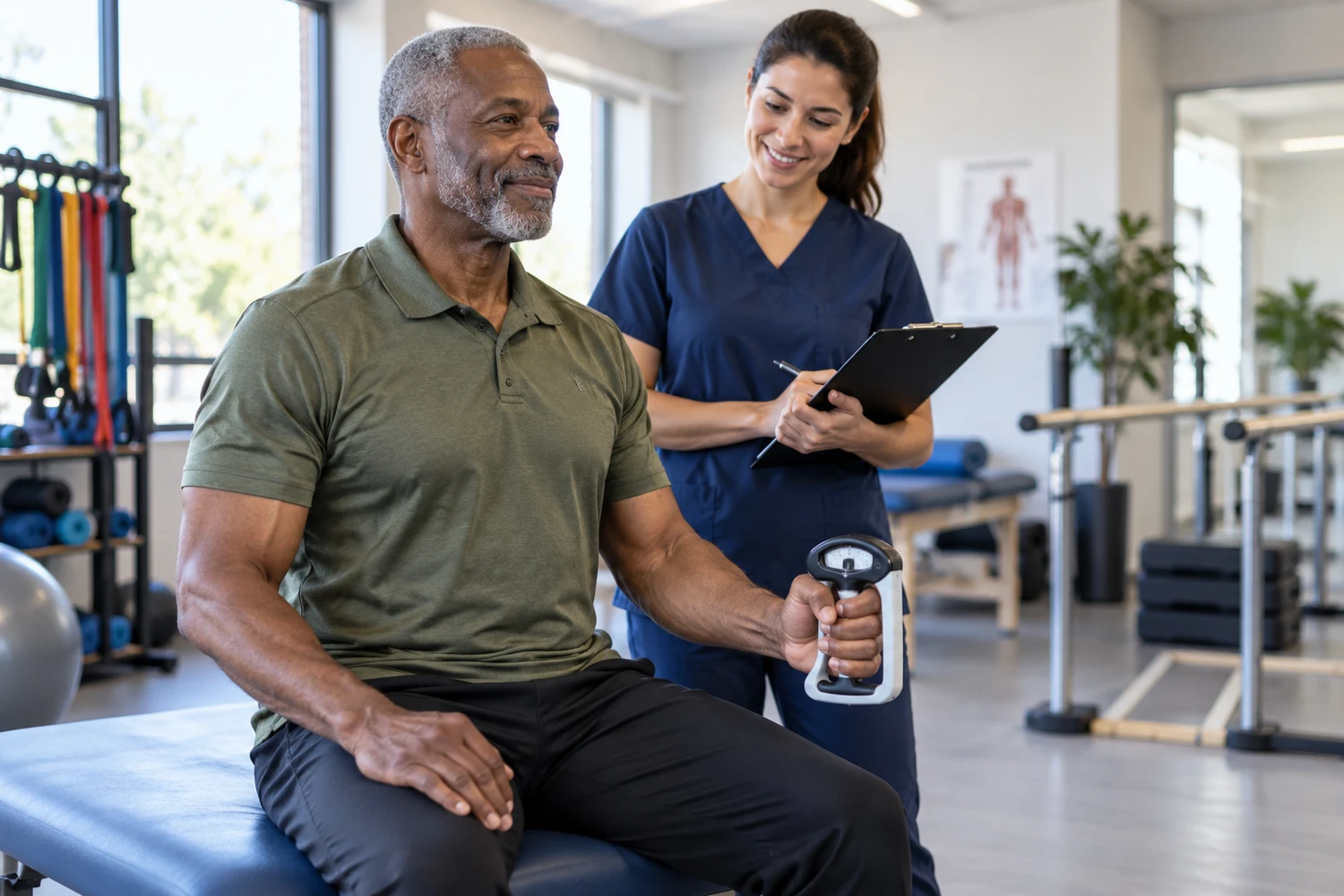
What Grip Strength Measures
Grip strength is usually measured with a handheld dynamometer. You squeeze the device as hard as possible for a few seconds, often for multiple attempts on each hand. The result is commonly reported in kilograms or pounds of force.
Although the test focuses on the hand and forearm, grip strength correlates with broader measures of muscle function because it reflects nervous-system drive, muscle quality and general physical condition.
Why Grip Strength Changes With Age
Grip strength tends to rise through early adulthood, peak in middle adulthood and then gradually decline. The rate varies widely. Physical activity, resistance training, body size, injury, arthritis, neurological disease and nutrition can all affect the result.
This means an age chart should never be treated as a diagnosis. A lower number can have many explanations, and a higher number does not guarantee excellent health.
Age-Based Norms Are Reference Points, Not Targets
Normative grip-strength tables are created from population studies and often separate results by age and sex. Different dynamometers, testing positions and populations can produce different reference ranges, so online charts may not match each other exactly.
The best use of norms is to understand context. For personal tracking, repeat the test with the same device, position and instructions so changes are more likely to reflect real progress.
Why Researchers Link Grip Strength With Healthy Aging
Low grip strength has been associated in observational studies with frailty, disability, hospitalization and mortality. That does not mean weak grip directly causes all of those outcomes. Grip is better understood as an accessible marker that may reflect broader health and muscle status. Our frailty in older adults guide explains how grip fits into a broader pattern of reduced physical reserve.
When grip strength declines alongside slower walking, weight loss, fatigue or difficulty with daily tasks, the overall pattern is more informative than the hand test alone.
How to Test Grip Strength More Consistently
If you use a dynamometer, sit or stand in a repeatable position with the elbow and wrist arranged according to the device instructions. Squeeze hard without holding your breath, rest between attempts and record the best or average value depending on the protocol.
Do not compare a home spring gripper with a clinical dynamometer as if the numbers are interchangeable. The devices may use different resistance systems and units.
Hand Pain Can Lower Grip Without Reflecting Whole-Body Fitness
Arthritis, thumb pain, tendon problems, carpal tunnel syndrome and prior fractures can reduce grip strength even when leg and trunk strength are good. That is why a painful grip test should not be used to label someone globally weak.
If hand pain is persistent, swollen or associated with numbness or weakness, address the hand problem rather than repeatedly testing through pain.
Improve Whole-Body Strength, Not Just the Squeeze
The strongest way to improve functional strength is usually a full-body resistance program. Rows, carries, deadlift variations and pulling exercises naturally train grip while also strengthening the back, hips and legs.
Our strength training for healthy aging guide explains how to train the major movement patterns without turning grip into the only goal.
Add Direct Grip Work When It Serves a Purpose
Farmer carries, dead hangs, towel holds and light hand grippers can build local endurance and force. Start conservatively, especially if you have arthritis or tendon irritation, and increase duration or resistance gradually.
Grip work should support daily function and lifting, not create enough forearm soreness that it interferes with other training. Two or three short exposures per week are often plenty.
Muscle Needs Training and Adequate Nutrition
Grip strength can decline when overall muscle mass and nutritional intake decline. Protein is particularly relevant because older adults may under-eat during illness, dieting or periods of low appetite.
See our protein after 50 guide for practical ways to support muscle without relying on extreme intake targets.
Pair Grip With Other Functional Measures
If you want a broader picture of physical function, combine grip with walking speed, repeated chair stands, balance and the ability to carry everyday loads. These tasks sample different systems and are often more relevant to independence than one isolated number.
Our fall prevention guide includes balance and lower-body strategies that complement grip testing.
A Sudden Drop Deserves More Attention Than a Stable Low Number
Gradual age-related change is different from a sudden unexplained loss of strength. New weakness on one side, difficulty holding objects, numbness, speech changes or facial drooping can be neurological warning signs and require urgent evaluation.
More gradual decline combined with weight loss, fatigue or difficulty rising from a chair can also justify medical assessment for frailty, sarcopenia or another health problem.
Practical Takeaway
Grip strength by age is a useful piece of context, not a health verdict. Use consistent testing, look at trends, and interpret the result alongside walking, balance, leg strength and everyday function.
The most valuable action is usually to maintain or improve total-body strength with progressive training, adequate nutrition and regular activity. Strong hands are helpful, but healthy aging depends on the whole system.
Grip Strength Matters Because Daily Life Is Full of Carries and Holds
Opening jars gets attention, but grip also matters for carrying shopping bags, holding a railing, moving furniture, gardening and controlling weights in the gym. When grip endurance falls, people may avoid tasks that challenge the hands and gradually reduce activity.
Training grip in useful contexts—carries, rows and holds—usually transfers better to daily life than endlessly squeezing a light hand gripper while watching television.
Train More Than One Type of Grip
Crushing grip is the squeeze measured by many dynamometers, but daily function also uses support grip, pinch grip and wrist stability. Farmer carries build support grip, plate pinches train thumb and finger force, and rows or deadlift variations challenge the hands while training larger muscle groups.
Rotate exercises rather than doing maximal squeezing every day. Hands and forearms can become irritated like any other tissue if volume rises too quickly.
Modify Grip Training Around Arthritis
Arthritis does not always mean avoiding hand exercise, but painful joints may need different equipment and range of motion. Thicker handles, neutral wrist positions and lighter loads can sometimes reduce discomfort while still training the forearms.
Persistent swelling, locking or sharp thumb pain deserves assessment. The goal is stronger function, not proving toughness by squeezing through an inflamed joint.
Use a Three-Month Trend for Personal Tracking
Grip strength changes with fatigue, time of day, recent upper-body training and motivation. Testing every day can create meaningless noise. A better approach is to test under similar conditions every eight to twelve weeks and compare the trend.
Record the device, hand, position and best value. If the same setup shows a steady decline alongside slower walking or weight loss, the pattern is worth discussing with a health professional.
A Simple Grip-Supporting Strength Session
One practical session could include a squat, a row, a press, a hip hinge and two short farmer carries. The compound exercises train the whole body while rows, hinges and carries provide repeated gripping practice. Add a few gentle wrist or finger exercises only if needed.
Progress the whole program first. A stronger back and legs often allow you to carry heavier objects, which naturally gives the hands a reason to adapt.
Interpret Grip Strength Alongside the Rest of Your Function
A grip result becomes more useful when combined with other simple observations. Can you stand from a chair without using your arms? Can you carry two grocery bags? Has your walking pace changed? Can you open containers and handle tools without pain? These questions connect the dynamometer number to real life.
If grip is low but walking, leg strength and daily tasks are strong, a local hand problem may be more important than global weakness. If grip, walking and chair-rise ability are all declining, broader assessment makes more sense.
This is why health professionals rarely interpret one functional test in isolation. The pattern across several tasks tells a more accurate story about reserve and independence.
Frequently Asked Questions
Normal ranges vary by age, sex, body size, population and testing device. Use validated reference values from the same type of dynamometer when possible.
Not necessarily. Low grip can reflect hand pain, injury or body size, but persistent low strength can also be a marker of broader muscle and functional decline.
Yes. Resistance training, carries and progressive grip exercises can improve strength at older ages when done consistently.
The dominant hand is often somewhat stronger, but the difference varies. A large new side-to-side difference can warrant assessment.
For personal tracking, every few months is usually enough. Testing daily creates noise from fatigue, pain and normal day-to-day variation.
Safety and Scope
Do not force maximal grip testing through significant hand, wrist or elbow pain. Sudden one-sided weakness, numbness, facial drooping or speech difficulty requires urgent medical evaluation.