Published by Best Fitness Routine. Editorial standards · Report a correction. Educational guidance; no individual clinical review is claimed unless a qualified reviewer is named.
A Practical Starting Point
As an Amazon Associate I earn from qualifying purchases. This guide includes paid Amazon links.
Choosing a smart ring vs smartwatch for sleep tracking starts with what you want to learn and whether you will comfortably wear the device overnight. The smaller product is not automatically the more accurate one, and the larger product does not necessarily provide better evidence just because it has a screen.
This is a comparison framework rather than a product ranking. Features, subscriptions, phone compatibility and regional availability change. Check the exact model and current documentation before buying; neither category is a shortcut to diagnosing why you sleep poorly.
Give the device one clear job
Decide whether your main purpose is noticing sleep timing, reviewing a pattern alongside your activity or discussing a particular feature with a professional. A long list of possible measurements can make a comparison look impressive without answering that question. Write down the information you would actually use and the action it might support.
If you already own a wearable, first check whether it provides enough information for that limited purpose. Our existing wearable-tracker guide offers a broader starting point. You may decide that no new device is necessary. A consumer sleep tracker also does not replace an assessment for symptoms; if the question is why you remain tired, start with our sleep-score mismatch guide rather than treating shopping as the next diagnostic step.
Compare comfortable contact, not just size
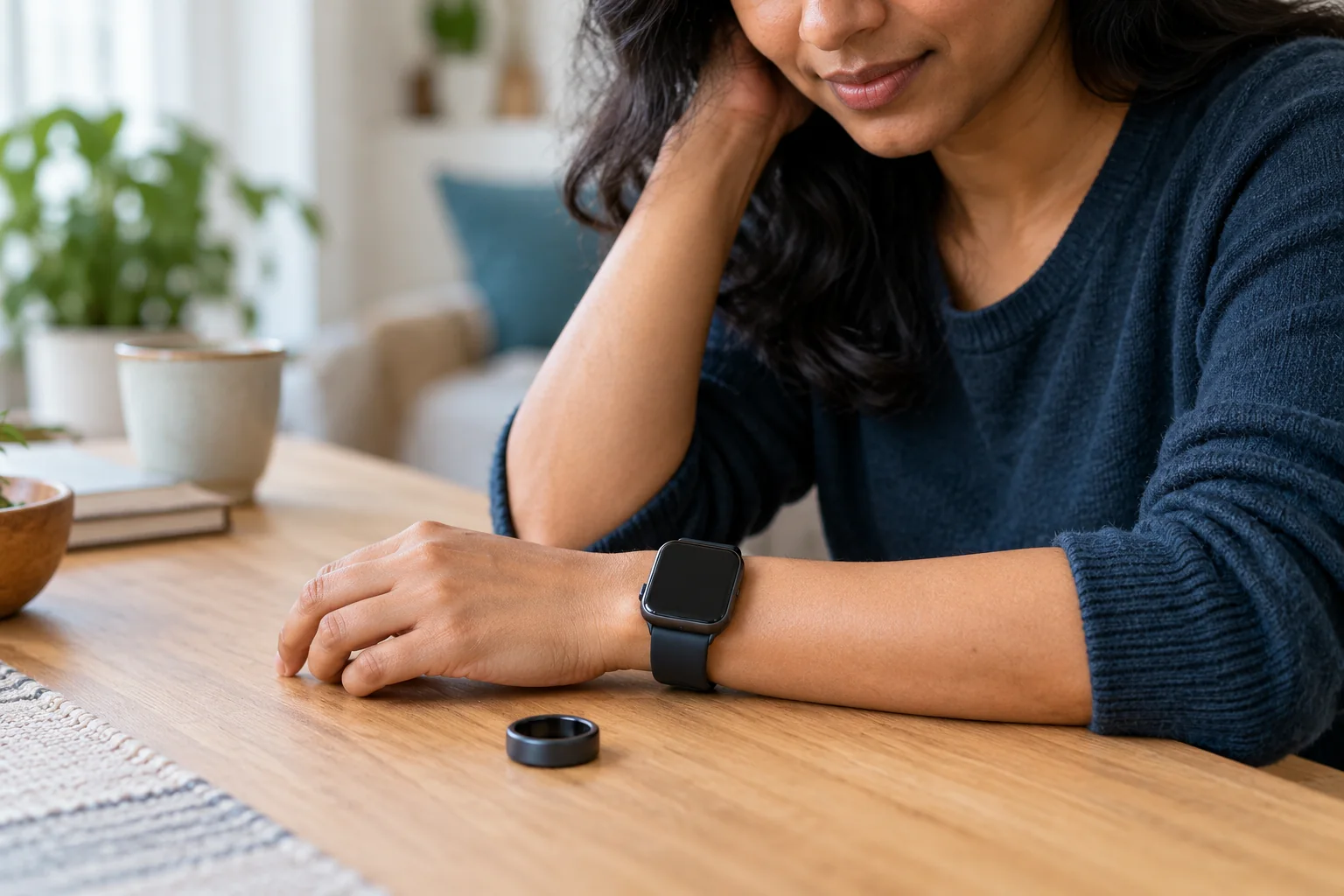
A watch uses a strap around the wrist; a ring contacts a finger. What feels acceptable during the day may feel different under bedding or when you change position. Follow the manufacturer’s fit instructions, including any model-specific sizing process. Do not assume that a familiar jewellery size or an old sizing kit applies to a different product generation.
The Oura general FAQ explains its own fit and sizing considerations. That is a manufacturer example, not a rule for all rings. Check whether a trial or return arrangement gives you a realistic way to assess comfort, and read its conditions. A tighter fit is not a guarantee of better measurement; irritation, discomfort or a device that is difficult to remove requires an appropriate response rather than an accuracy experiment.
Plan charging around the actual night
Compare how you would keep the device charged without regularly missing the period you want to observe. A long advertised battery life may depend on settings, enabled features, battery age and other conditions. Read the manufacturer’s explanation rather than using a single marketing number as a promise about your own routine.
If you travel, think about the charger you would need and where you could safely use it according to the instructions. Do not improvise incompatible charging accessories to avoid a missed night. A recorded gap is better than an unsafe setup. Also consider whether you want to view information on the device or in a phone app. Access to a screen can be convenient, but convenience does not validate the sleep estimate or make a nightly score necessary.
An optional small accessory case (paid link) can keep your existing compatible charger together with its cable; a pouch you already own may be enough.
Read accuracy claims at the model and measurement level
Ask what was tested, against which reference and in whom. A study may assess sleep-versus-wake detection, estimated duration or sleep-stage classification; those are different tasks. A study result for one task cannot be substituted for the others. Look for the exact device, algorithm version, study setting and population, including any declared funding or manufacturer relationships.
A 2024 study of three commercial wearables tested Oura Gen3, Fitbit Sense2 and Apple Watch Series8 against polysomnography in healthy adults. The study involved 35 healthy adults assessed over one laboratory night and reported funding from Oura Ring Inc. as well as institutional support. Those details belong beside its results. It does not settle the choice between every current ring and watch, or establish performance for all sleep disorders. Our sleep-tracker accuracy article explains these distinctions. Avoid turning one study into a permanent winner badge for an entire brand or device shape.
Check what you can see, export and keep private
Read which information remains available without an ongoing subscription and what the product requires from your phone. Ask whether exports contain the measurements you need or only a summary. Consider how long you can access older records and what happens if you stop paying, change phones or close the account. These details vary and may change after an update.
Make privacy part of the comparison before connecting extra apps. A health chart shared to another service may come under that service’s practices, not only the original manufacturer’s policy. Our fitness-data privacy guide offers a settings review without promising that any device is risk-free. You do not need to share sleep data with a social feed to benefit from a private, limited record.
Make a decision with a stopping point
Use a short comparison sheet: purpose, overnight comfort, charging routine, relevant evidence, accessible data and ongoing cost. Mark an unanswered point as unanswered rather than filling it with an assumption from a review. Ask the manufacturer or seller where necessary, and give more weight to information relevant to your own purpose than to the number of graphs offered.
If two options both meet the practical need, the choice may come down to comfort or convenience rather than a measurable health advantage. You can also keep your current device or buy neither. Do not promise yourself that the new purchase will improve sleep, remove fatigue or detect every problem. A tracker can provide information; the meaning and usefulness of that information still depend on the question, its limitations and your circumstances.
A plain notebook (paid link) can hold the short comparison, but a simple phone note or scrap of paper does the same job.
Practical Reading Checklist
- Define the sleep question before comparing products.
- Check the exact model’s fit and overnight comfort arrangements.
- Plan a compatible charging routine.
- Read validation at the metric, model and population level.
- Compare data access, privacy and ongoing costs before deciding.
Useful Distinctions at a Glance
| Comparison point | Question worth asking | Avoid assuming |
|---|---|---|
| Fit and comfort | Can I follow the sizing process and wear it comfortably? | A smaller object is automatically better for everyone |
| Charging | How will I charge it without unsafe accessories or repeated gaps? | Advertised maximum life describes my routine |
| Evidence | Which model, algorithm and sleep measurement were tested? | One study validates every ring or every watch |
| Data access | Which records remain accessible and who receives them? | Buying the hardware includes every future feature |
Common Misunderstandings to Avoid
Check what the number describes and whom the study included.
Confirm compatibility in the exact model’s documentation.
Keep the health question separate from the purchasing decision.
Frequently Asked Questions
No general rule establishes that. Accuracy depends on the particular device, algorithm, measurement and setting.
That depends on the product and current plan. Check which data remains accessible, rather than assuming all features are included.
Follow the manufacturer’s model-specific sizing instructions. An ordinary ring size may not correspond to the device.
Not necessarily. Identify a useful purpose first. Two estimates do not automatically resolve a disagreement or create a clinical measurement.
Scope and Personal Care
This guide provides general consumer education, not an individual medical assessment or exercise prescription. A score or normal display cannot establish that a symptom is harmless. Follow the instructions for any device notification and seek appropriate professional advice about persistent symptoms or concerns. Chest pain, fainting or severe unexpected breathlessness needs urgent appropriate help rather than another tracker reading. Relevant device features, eligibility and authorisations can vary by model, software and country; check the documentation for your exact feature.
Sources and Further Reading
- Oura: general FAQs, sizing, charging and data access
- 2024 primary study: three commercial sleep-tracking devices
Prepared by the Best Fitness Routine Editorial Team. Sources checked October 30, 2026. This source-based consumer education is provided without individual assessment or a claimed clinical review. Product documentation can change; check your exact model, software and region. Images are AI-generated illustrations.