Published by Best Fitness Routine. Editorial standards · Report a correction. Educational guidance; no individual clinical review is claimed unless a qualified reviewer is named.
A Practical Starting Point
As an Amazon Associate I earn from qualifying purchases. This guide includes paid Amazon links.
How accurate are sleep trackers? The answer depends on what is being estimated, the particular device and software, and the people and conditions used to test it. A device might be more helpful for one sleep measure than for another. A single accuracy percentage rarely answers all of those questions.
This guide helps you read a sleep-tracking claim before relying on it. It does not decide whether you have a sleep disorder or rank a current product as the most accurate. Device-specific medical notifications also need separate consideration from ordinary sleep charts.
Ask which sleep measure the claim concerns
Estimated bedtime, total sleep time, wake periods and individual stages are different outputs. A graph that places bedtime near your recollection has not thereby proved that its deep-sleep estimate is correct. Check whether a manufacturer is discussing sleep versus wake detection, stage classification or a calculated score that combines several inputs.
For an ordinary review, begin with the part you actually use. If you want help maintaining a regular routine, broad timing may be more relevant than a detailed stage chart. If you are concerned about persistent sleep problems, better-looking graphs are not a substitute for assessment. Our general tracker guide covers keeping data useful; the aim here is to understand what the particular accuracy claim does and does not describe.
Understand the reference used in validation
Polysomnography, often shortened to PSG, records multiple physiological signals during a sleep assessment, including information used to classify stages. Consumer devices generally estimate sleep from a different set of signals, such as movement and optical pulse information. Validation asks how a particular output compares with a specified reference, not whether every display is an exact copy of a sleep study.
A 2025 six-device validation study compared named consumer models with PSG. Its usefulness is in the specific devices, measures and testing conditions studied. It is not evidence that a newer product with the same brand name has identical performance. Comparing one tracker only with another tracker can answer a comparison question, but does not independently establish that either one matches the clinical reference.
Read the population and software details
Look for who took part, where the testing occurred and which device version was used. A study in healthy volunteers may not settle performance for someone with disturbed sleep or another health condition. An overnight laboratory recording and ordinary nights at home also pose different questions. More research is useful when its setting resembles the setting in which the device will be used.
Software can change how sensor information is classified. If the version is missing or old, treat the result as limited evidence rather than a permanent ranking. You need not read every statistical table to ask a sensible question: does this claim identify the model, comparison measure and people studied? If not, phrases such as clinically validated may provide less information than they first appear to.
Recognise common interpretation problems
Lying awake without much movement can be difficult for a device to distinguish from sleep. Movement or gaps in contact can complicate a record as well. The importance of these issues differs by model, so avoid applying a fixed correction such as subtracting a certain number of minutes from every night.
You can notice an obvious mismatch, such as a known reading period being shown as sleep, without concluding that the whole device is worthless. Record that example once if you need technical help. Do not repeatedly wake yourself to test the graph or compare morning screenshots before deciding how tired you are. For a mismatch between a reassuring score and daytime experience, see good sleep score but still tired. That is a different question from whether a particular classification algorithm performed well in a study.
An optional plain notebook (paid link) can hold one obvious mismatch to discuss later; avoid logging throughout the night or sacrificing sleep to complete it.
Separate a sleep chart from a medical feature
A general sleep-stage display and a feature authorised for a specific medical purpose are not the same product claim. The FDA record for Apple’s Sleep Apnea Notification Feature is an example of feature-specific authorisation. It should not be expanded into approval of every sleep score or every health interpretation on a device.
Follow the exact instructions, eligibility and availability for a feature if you use it. An ordinary sleep score cannot rule out sleep apnea, and the absence of a notification does not prove that a sleep problem is absent. Our diagnostic-claims article explains intended use in more detail. No part of this guide asks you to self-diagnose from an overnight graph.
Choose a limited role for the data
Decide what the device contributes to your situation. It might help you notice irregular timing, remember approximate nights or explain a question to a professional. It may contribute little if looking at stages causes repeated checking without changing a useful decision. You are allowed to simplify the display or take a break from tracking.
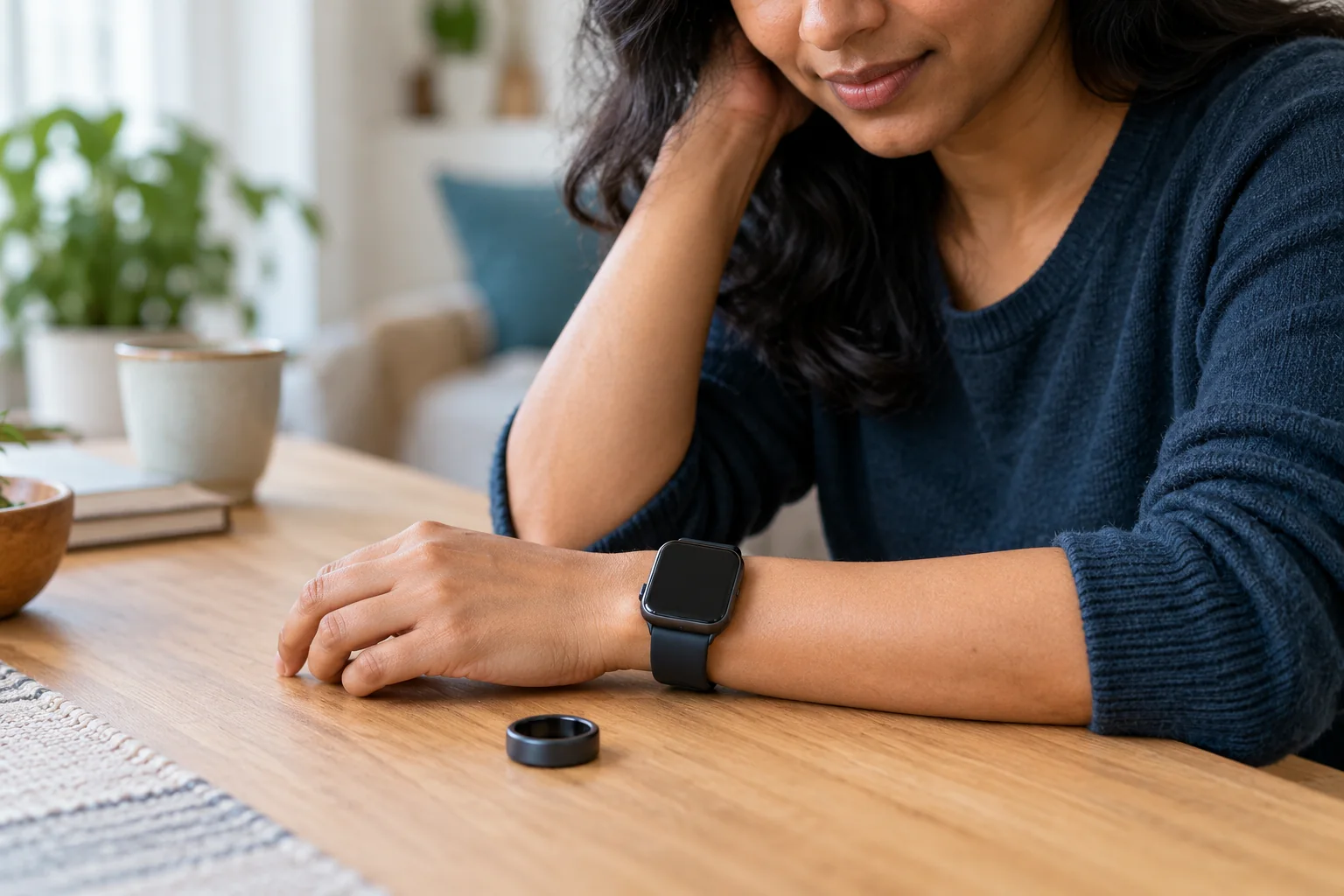
When discussing persistent sleep difficulties, describe how you feel and function as well as any device record. A clinician may ask different questions or recommend a different assessment. Keep the tracker’s model and feature name available, but do not wait for the device to produce a bad score before seeking help. If you are comparing forms of hardware rather than interpreting a graph, our smart-ring and smartwatch comparison offers a separate checklist for fit, practical use and evidence.
A document wallet (paid link) may be useful if a professional asks for a printed report; a secure digital copy or existing folder can serve the same purpose.
Practical Reading Checklist
- Identify the exact output behind the accuracy claim.
- Check whether comparison was against PSG or another reference.
- Find the model, software and study population.
- Note an obvious recording mismatch without repeatedly testing yourself.
- Give the data a limited role alongside symptoms and professional advice.
Useful Distinctions at a Glance
| Claim or display | Useful question | Limit |
|---|---|---|
| Total sleep time | How was time compared with the reference? | Does not validate every stage |
| Sleep stages | Which classifications were tested? | Colours are estimates, not direct brain recordings |
| Clinically validated | For which model, version and people? | Not a permanent endorsement of a whole brand |
| A medical notification | What is its exact authorised purpose? | Does not turn every wellness chart into a diagnostic test |
Common Misunderstandings to Avoid
Identify the particular measure and reference.
Check the actual tested version and setting.
Describe the symptoms and seek appropriate advice.
Frequently Asked Questions
Most wrist or ring consumer sleep estimates use different signals from PSG. Check the actual hardware and feature rather than assuming a stage chart is a brain recording.
No. A wellness score does not rule out a sleep disorder. Specific authorised notifications have their own instructions and limitations.
No. Error is not necessarily fixed across people, nights or devices.
You can simplify or stop optional wellness tracking if it is unhelpful. Follow any individual monitoring instructions from your healthcare team separately.
Scope and Personal Care
This guide provides general consumer education, not an individual medical assessment or exercise prescription. A score or normal display cannot establish that a symptom is harmless. Follow the instructions for any device notification and seek appropriate professional advice about persistent symptoms or concerns. Chest pain, fainting or severe unexpected breathlessness needs urgent appropriate help rather than another tracker reading. Relevant device features, eligibility and authorisations can vary by model, software and country; check the documentation for your exact feature.
Sources and Further Reading
Prepared by the Best Fitness Routine Editorial Team. Sources checked October 30, 2026. This source-based consumer education is provided without individual assessment or a claimed clinical review. Product documentation can change; check your exact model, software and region. Images are AI-generated illustrations.