What Is the Dead Bug Exercise?
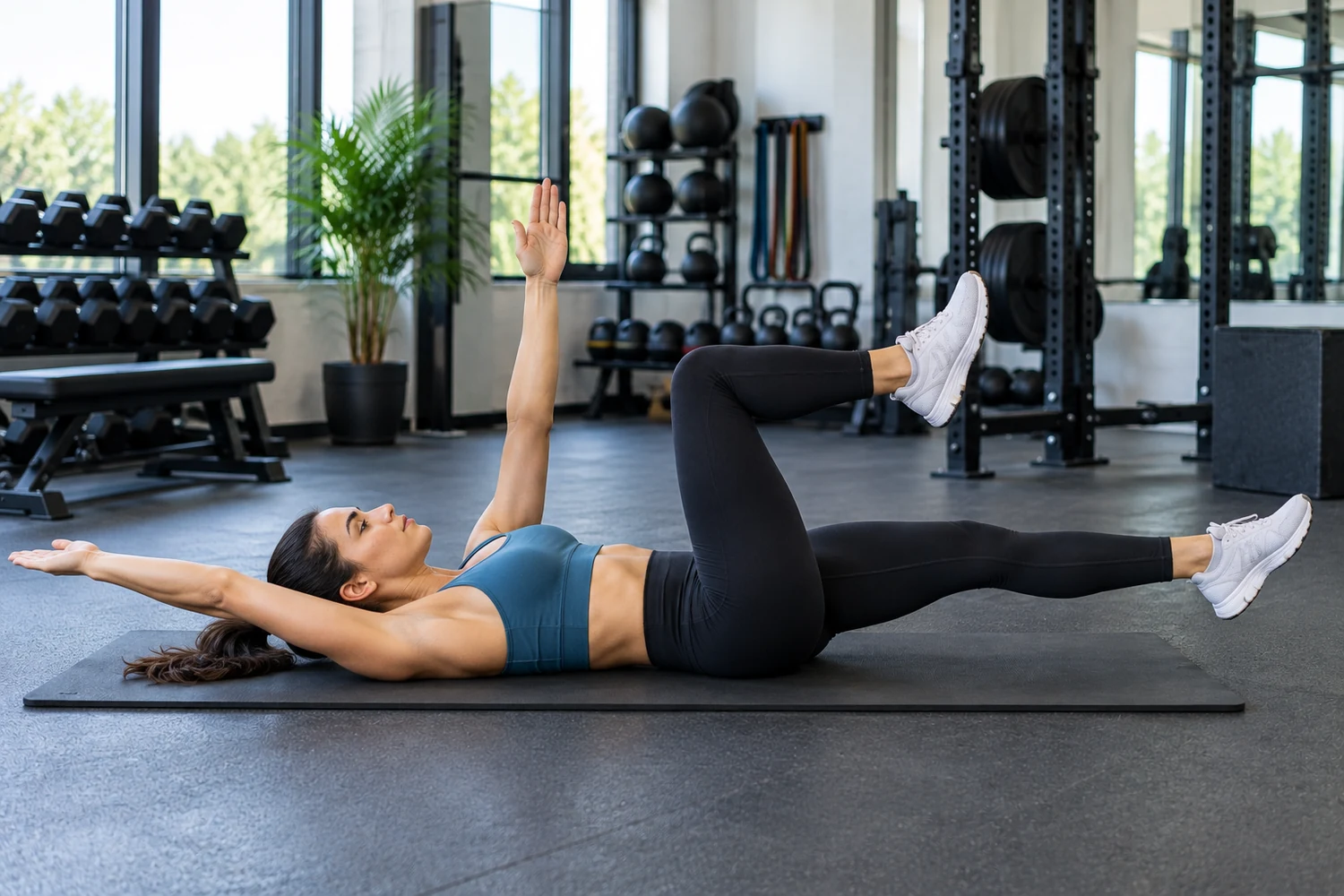
The dead bug exercise is a floor-based core movement performed while lying on your back with the hips and knees bent. From that stable position, you slowly move opposite arms and legs while keeping the trunk quiet. The challenge is not how far the limbs travel; it is whether you can keep the ribs and pelvis controlled as the leverage gets harder.
That makes the dead bug useful for people who want core training without repeated spinal flexion. It teaches the abdomen to resist extension as the arms and legs move, which is a common demand in walking, lifting and sport.
Core stability is also important during loaded movement such as the farmer’s carry. The dead bug lets you practice that control in a supported position before applying it while standing.
Dead Bug Exercise Benefits
The movement encourages the abdominal wall to maintain tension while the limbs move independently. Because you are supported on the floor, the exercise is accessible to many beginners and easy to modify. The larger goal is not a perfect-looking position; it is a movement option you can use comfortably in training and daily life. Consistency usually matters more than doing a long routine once in a while.
Opposite-arm-and-leg patterns challenge cross-body control similar to walking and running mechanics. Keeping the trunk quiet helps reduce excessive low-back arching during other exercises. When mobility and strength improve together, the body has more choices for solving everyday movement tasks.
How to Do the Dead Bug Exercise: 6 Levels
1. Heel taps
Lie on your back with hips and knees bent to about 90 degrees and arms toward the ceiling. Brace gently, then lower one heel to tap the floor without letting the lower back arch. Return and switch sides. This is a good entry point for learning pelvic control.
2. Single-arm dead bug
Keep both legs in tabletop and move only one arm overhead at a time. Stop before the ribs lift away from the floor. This reduces the total challenge while teaching you to separate arm motion from trunk motion.
3. Single-leg extension
Keep both arms vertical. Slowly extend one leg until the heel hovers above the floor, then return. The farther the leg reaches, the more leverage challenges the core. Shorten the range if the back begins to arch.
4. Opposite arm and leg
This is the classic dead bug. Extend one leg as the opposite arm reaches overhead. Pause briefly, return with control and alternate sides. Move slowly enough that the trunk position does not change as the limbs travel.
5. Band-resisted dead bug
Anchor a light band behind your head and hold it with straight arms. The band adds tension through the lats and trunk while you perform alternating leg extensions. Keep the resistance light enough that breathing remains normal.
6. Dead bug with press-out
Hold a light medicine ball or stability ball between opposite hand and knee while the other arm and leg extend. The isometric press can help you feel abdominal engagement. Use modest pressure rather than squeezing as hard as possible.
A Simple Dead Bug Core Routine
Start with two sets of six to eight controlled reps per side. Rest for 30 to 60 seconds between sets. If the last rep looks like the first, add a third set or move to the next progression. Pair dead bugs with a standing stability exercise such as a loaded carry and a lower-body movement such as the sit-to-stand exercise for a short functional circuit.
Keep the first week intentionally easy. Write down the variation, repetitions and how the movement felt. If technique remains consistent and you recover well, add only a small amount the next week. This simple approach makes progress easier to judge and reduces the temptation to change several variables at once.
Common Mistakes to Avoid
Flattening the back aggressively
You do not need to mash the spine into the floor. Aim for a comfortable neutral-to-gently-braced position with the ribs controlled.
Extending the limbs too far
Range is earned by control. Shorten the lever the moment the back arches or the ribs flare.
Holding your breath
Exhale through the hardest part and keep breathing. Breath-holding often creates more tension than you need.
Moving quickly
The exercise works because you resist movement. Slow repetitions reveal whether the trunk is actually stable.
Chasing fatigue instead of quality
Stop the set when position changes. A few precise repetitions are more useful than many sloppy ones.
Progressions and Practical Training Tips
Increase difficulty by lengthening the leg, extending the arm farther, slowing the tempo or adding light band resistance. You can also progress from the floor to standing anti-rotation and loaded-carry work. If your goal is broader movement quality, combine dead bugs with thoracic mobility and hip mobility exercises rather than treating core strength as an isolated skill.
Use the exercise as part of a complete plan rather than an isolated challenge. A balanced week can include strength, aerobic activity, mobility and recovery. The best version is the one that fits your current ability and leaves you able to practice consistently.
How the Dead Bug Transfers to Everyday Movement
A useful progression test is whether you can extend the opposite arm and leg without the ribs lifting or pelvis tipping. If not, shorten the range. Once that version is easy, progress to longer levers, a slower tempo or light resistance rather than simply doing dozens of repetitions.
For strength training, the dead bug can be used before squats, carries or presses as a low-fatigue core primer. Two controlled sets are usually enough. If you turn it into a maximal abdominal workout, you may tire the trunk before the exercises that need it. Treat quality, breathing and coordination as the priority.
The dead bug teaches a simple idea: the arms and legs should be able to move while the trunk stays organized. That same skill appears when you walk, carry groceries, lift a suitcase, push a door or reach overhead. In each case, the limbs create force while the torso manages unwanted movement. Practicing this on the floor gives you a stable place to learn the pattern before adding more complex standing exercises.
Safety Tips
The dead bug should not create sharp low-back, hip or neck pain. Keep the head supported and shorten the range if the hip flexors dominate or the lower back feels strained. If lying on your back is uncomfortable, use a seated marching variation or ask a clinician for an appropriate alternative. People with recent abdominal surgery, significant spinal symptoms or pregnancy-related restrictions should follow individualized advice.
If you are unsure whether a movement is appropriate after an injury or with a medical condition, a physical therapist or other qualified clinician can help tailor range, load and exercise selection. General fitness guidance cannot replace individual assessment.
Frequently Asked Questions
It primarily challenges the abdominal muscles, including the deeper transversus abdominis, while also using hip flexors and shoulder muscles to control the limbs.
Yes. Heel taps and arm-only versions are easy to scale, making the exercise useful for beginners who can lie comfortably on their back.
Start with six to eight controlled repetitions per side for two sets. Add reps only while you can keep the trunk position steady.
A gentle contact is fine, but you do not need to forcefully flatten the spine. The key is preventing excessive arching as the limbs extend.
They can improve trunk control and awareness, which may support better posture during movement, but posture also depends on strength, mobility and daily habits.
Key Takeaways
- Dead bug exercise work best when range and control progress together.
- Start with the easiest variation that lets you move without sharp pain or compensation.
- Progress one variable at a time—range, repetitions, time, support or resistance.
- Combine mobility with strength and balance so new range becomes useful in everyday movement.
- Stop and seek individualized guidance when symptoms include sharp pain, instability, numbness or persistent worsening.