
What VO2 Max Actually Measures
VO2 max is the maximum amount of oxygen your body can use during intense exercise, usually expressed relative to body weight in milliliters per kilogram per minute. It reflects the combined performance of the heart, lungs, blood vessels and working muscles.
A higher value generally means you can deliver and use more oxygen during hard aerobic work. That usually translates into better endurance, but the number is influenced by genetics, age, sex, training history, body composition and testing method.
Why VO2 Max Tends to Decline With Age
VO2 max commonly declines with age because maximum heart rate, stroke volume, muscle oxidative capacity and activity levels can change. The rate of decline is not fixed. Adults who remain active usually preserve more cardiorespiratory fitness than those who become sedentary.
This is why age-based charts should be treated as context rather than destiny. Your most useful comparison may be your own trend over months and years.
Use Age Norms as Reference, Not a Pass-Fail Test
Fitness laboratories often compare VO2 max with age- and sex-based normative data. Those percentiles can show whether your measured value is low, average or high for a reference population, but cutoffs differ between databases and testing systems.
A percentile does not replace medical risk assessment. Someone with an average VO2 max can still have cardiovascular risk factors, while a highly fit person can still develop heart disease.
The Most Accurate Test Uses Exercise Gas Analysis
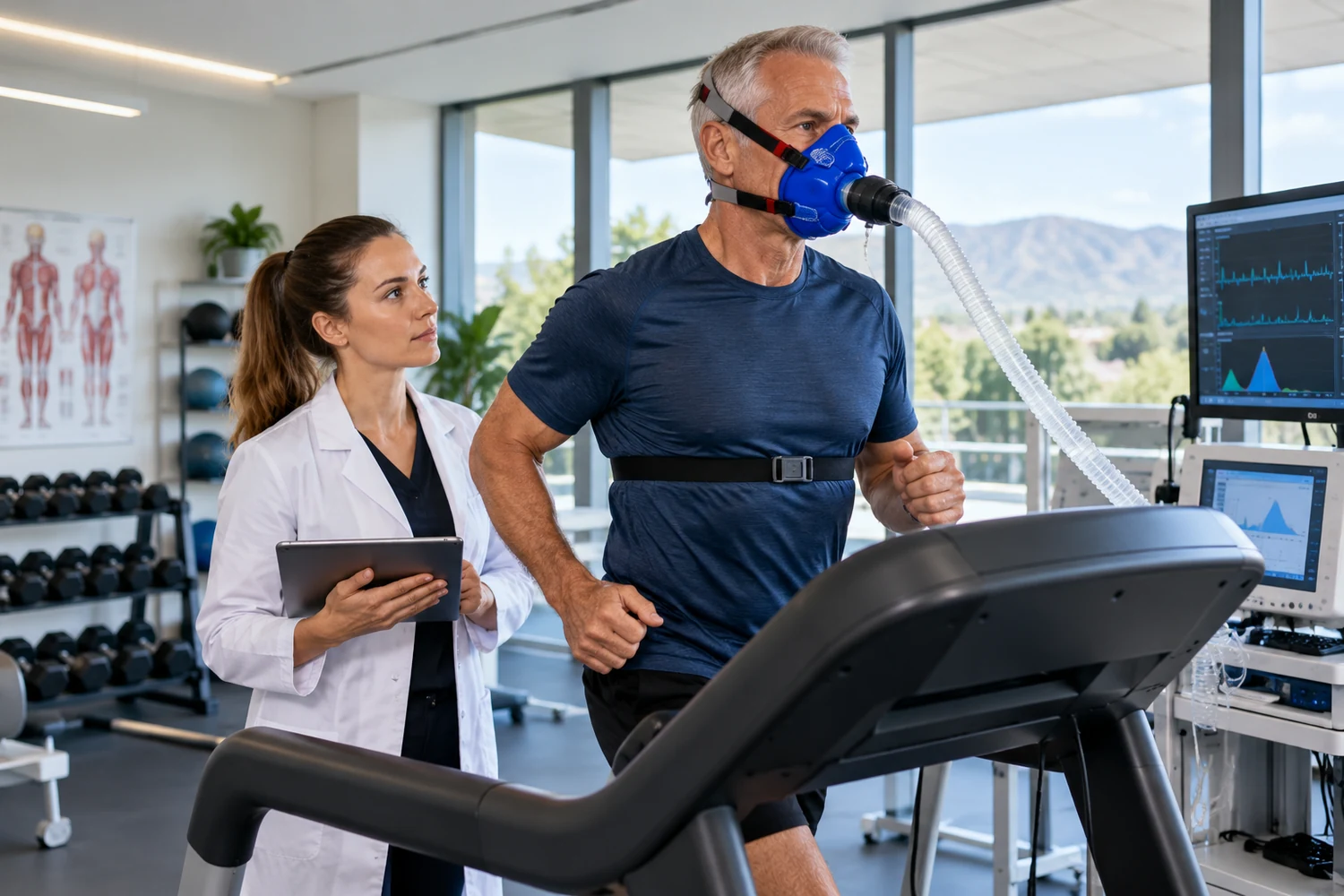
A laboratory VO2 max test usually involves progressively harder treadmill or cycling exercise while a mask measures oxygen and carbon dioxide. Heart rate, symptoms and sometimes ECG data are monitored. The test continues until a valid maximal effort or clinical stopping point is reached.
Because maximal testing is demanding, people with cardiovascular symptoms or significant medical conditions may need medical screening first. A professional can choose a submaximal alternative when maximal testing is not appropriate.
Smartwatch VO2 Max Estimates Are Useful but Imperfect
Many watches estimate VO2 max from heart rate and pace during walking or running. These estimates can be helpful for trends, but they are not equivalent to direct laboratory measurement. Heat, hills, medications, wrist heart-rate error and poor GPS data can all change the result.
Use the same device and similar conditions when tracking change. Focus on a trend over several weeks rather than reacting to one unusually high or low reading.
Why Cardiorespiratory Fitness Matters for Healthy Aging
Higher cardiorespiratory fitness is consistently associated with lower risk of cardiovascular events and premature death in large observational studies. Fitness is also practical: it determines how easily you can climb hills, carry groceries, travel and recover between bouts of activity. For the wider picture, see our healthy aging tips.
That makes aerobic fitness a functional reserve. The more capacity you have, the smaller percentage of your maximum is required for ordinary daily tasks.
Build an Aerobic Base Before Chasing Maximal Intervals
If you are returning to exercise, start with comfortable-to-moderate aerobic work you can repeat several times per week. Brisk walking, cycling, swimming and elliptical training are all effective if they raise heart rate without aggravating joints.
Our Zone 2 cardio guide shows how conversational-pace sessions can build a durable aerobic base.
Intervals Can Improve VO2 Max Efficiently
Higher-intensity intervals provide a strong stimulus for VO2 max because they require the cardiovascular system to operate near the upper end of its capacity. Intervals do not have to mean all-out sprints. Repeated hard-but-controlled efforts with easy recovery can be enough.
Start conservatively. For example, after a warm-up, alternate one to three minutes of challenging work with equal or longer easy recovery. Progress total hard time before increasing intensity further.
Strength Training Supports the Aerobic Plan
VO2 max is primarily an aerobic measure, but strong legs can improve movement economy and make hills, stairs and cycling easier. Strength training also protects muscle and bone while you increase cardio volume.
Use the principles in our cardio and strength weekly plan to combine both without making every day hard.
Heart Rate Zones Are Helpful Only When the Inputs Are Reasonable
Age-predicted maximum heart-rate formulas are rough estimates, and medications such as beta blockers can change heart-rate response. Perceived exertion and the talk test can sometimes be more useful than chasing an exact zone.
Our heart-rate zones guide explains how to use heart rate alongside perceived effort.
Measure Progress With More Than One Number
A rising VO2 max estimate is encouraging, but also track practical changes: walking pace at the same heart rate, how quickly breathing settles after a hill, whether stairs feel easier and whether you can train longer without fatigue. You can compare this with the functional perspective in our walking speed and longevity guide.
These improvements often arrive before a large change in a watch estimate. Functional progress is meaningful even when the laboratory number changes slowly.
Practical Takeaway
VO2 max by age is best used as context for your own aerobic fitness, not as a label. Fitness generally declines with age, but training can slow that decline and improve capacity at almost any starting point.
Build a consistent aerobic base, add controlled intervals when appropriate and support the plan with strength training and recovery. If you have chest pain, unexplained breathlessness, fainting or significant heart disease, seek medical guidance before maximal testing or intense intervals.
Field Tests Can Track Aerobic Progress Without a Lab
A timed walk, submaximal cycling test or a repeatable route can provide useful trend data when laboratory VO2 testing is unavailable. The key is standardization: use the same distance, similar conditions and the same effort instructions each time.
Do not convert every field test into an exact VO2 max estimate and assume it is precise. The value of a field test is often the change in performance at the same effort rather than the calculated number.
A Simple Weekly Plan to Improve Aerobic Capacity
A practical week might include two or three easy-to-moderate aerobic sessions, one controlled interval session and two strength sessions. The easier aerobic work builds volume and recovery, while intervals provide a stronger stimulus near the upper end of capacity.
Beginners should first tolerate regular moderate exercise before adding hard intervals. Add one variable at a time so you can tell whether the plan is improving fitness or simply increasing fatigue.
Medications Can Change Heart-Rate Response Without Preventing Fitness Gains
Beta blockers and some other medicines blunt heart-rate response, which can make percentage-of-maximum-heart-rate zones misleading. In those cases, perceived exertion, breathing and pace may be better tools for setting intensity.
Do not change medication to make a fitness tracker look better. Fitness should be built around your medical treatment, not the other way around.
VO2 Max Relative to Body Weight Can Change Even if Fitness Is Stable
VO2 max is often expressed relative to body weight. If body weight changes substantially, the relative number can move even when absolute oxygen use changes less. This is one reason weight loss can raise a relative VO2 max estimate without a proportional change in cardiovascular capacity.
For personal tracking, look at performance, heart-rate response and how exercise feels alongside the reported VO2 max value.
When VO2 Max Plateaus, Change the Stimulus Gradually
A plateau does not mean aging has “won.” It may mean your body has adapted to the same walking pace and duration. Add a small amount of volume, include hills, or introduce one interval session rather than turning every workout hard.
Strength, sleep and nutrition also affect training quality. A plateau is often solved by better consistency and recovery rather than by extreme intensity.
What a 12-Week VO2 Max Improvement Block Can Look Like
Weeks one through four can focus on consistency: three moderate aerobic sessions of 25 to 40 minutes plus two strength sessions. In weeks five through eight, add one interval session with four to six controlled hard efforts separated by easy recovery. Keep the other aerobic sessions comfortable.
In weeks nine through twelve, increase either the duration of the intervals or the total moderate volume slightly, but not both at once. Re-test with the same route, wearable estimate or laboratory method at the end.
If resting fatigue, joint pain or sleep worsens, reduce training stress before adding more intensity. Aerobic fitness improves from recoverable training, not from proving how hard you can suffer.
Frequently Asked Questions
A “good” value depends on age, sex and the reference database. Percentile charts are best used as context rather than a universal pass-fail score.
Yes. Aerobic training and interval training can improve cardiorespiratory fitness in middle-aged and older adults.
It is an estimate. It can be useful for trends but is less precise than direct laboratory gas analysis.
A practical plan usually includes several aerobic sessions each week, with only a portion performed at high intensity.
No. It reflects cardiorespiratory fitness but does not replace blood pressure, cholesterol, diabetes risk or clinical evaluation.
Safety and Scope
Maximal exercise testing and high-intensity intervals are not appropriate for everyone. Seek medical evaluation before hard testing if you have chest pain, fainting, unexplained shortness of breath, known cardiovascular disease or major risk factors that have not been assessed.