Published by Best Fitness Routine. Editorial standards · Report a correction. Educational guidance; no individual clinical review is claimed unless a qualified reviewer is named.
Use strength training to support a wider routine
Strength training for pickleball helps develop the capacity to produce and control force through everyday movement patterns. A useful program covers the legs, hips, trunk and upper body instead of focusing only on the paddle arm. It can support the physical demands of stepping, stopping and reaching, but it does not replace learning shot technique. Stronger muscles also do not guarantee that a player will avoid injury or win more games.
This twice-weekly example is intended as a starting structure for adults who can perform the movements comfortably. Put the sessions on separate days when possible and account for the rest of your week. Long matches, physical work and other exercise all contribute to fatigue. If you are new to resistance exercise, learn the movements with modest demand before chasing heavier loads. A qualified trainer can help you choose variations, while a clinician should guide training when injury, recent surgery or a health restriction affects your options.
Choose loads you can control from first repetition to last
Begin with body weight or a light load that lets you keep consistent technique while breathing normally. Finish most beginner sets while you could still perform a few sound repetitions. Reaching exhaustion is not required to learn the exercise. A shaky final repetition, shortened range or a breath held through strain can indicate that the set has already gone beyond the useful demand for that practice day.
If using adjustable dumbbells (paid link), choose manageable starting weights and check that adjustable components lock securely. Place them where you can pick them up without twisting around furniture. Do not leave them on the walking path between exercises. Labels such as beginner or professional cannot establish the right weight for you. Write down the load actually used, and compare future sessions with the same exercise setup rather than assuming that every model or movement makes the number directly comparable.
Session A: squat, push and pull
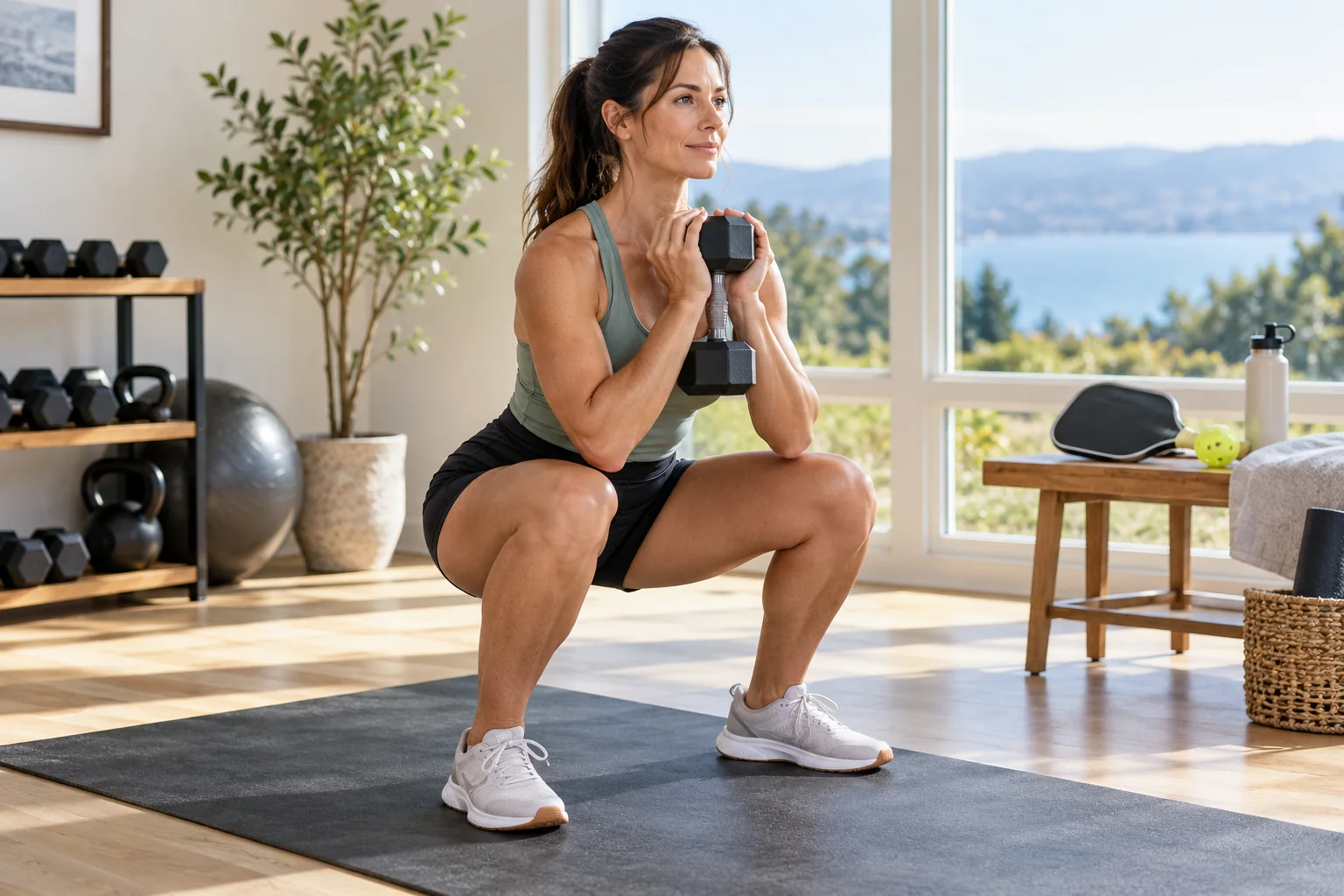
After a few minutes of easy movement, begin with a sit-to-stand or supported squat. Use one set of six to ten controlled repetitions at first. Keep your feet comfortably placed, move your hips and knees together and choose a depth that does not provoke pain. A stable chair can set a repeatable target. Once the body-weight version is familiar, a light goblet hold may add demand, but the ability to hold weight does not mean you should immediately squat deeper.
Follow with a wall or secure counter push-up, then a light pulling movement you know. For pulling, resistance bands (paid link) are an option only with a secure setup following the manufacturer's instructions. Never tie a band to an unstable chair or improvise an anchor that could release toward your face. Rest between exercises until breathing and attention settle. Initially, one careful set of each pattern may be sufficient. Repeat the same arrangement before adding a second set so you can judge the response to the first dose.
Session B: hinge, supported split stance and carry
In the second session, begin with an unloaded hip hinge. Soften your knees and move your hips backward while keeping your spine comfortable. Return by standing tall rather than leaning backward at the top. Once the pattern is reliable, a light load held close to your legs can make it more demanding. You should feel able to stop the movement at any point. Seek instruction if you repeatedly turn the hinge into a painful back bend.
Add a shallow supported split-stance squat, holding a stable rail if needed. Keep both feet grounded and lower only as far as balance and joints allow. Use fewer repetitions than the bilateral squat if this is unfamiliar. Finish with a short light carry if grip and walking are comfortable: hold a modest weight, walk along a clear route and turn carefully. The purpose is controlled movement under manageable load, not proving that you can carry the heaviest object available.
Include trunk control without forcing rotation
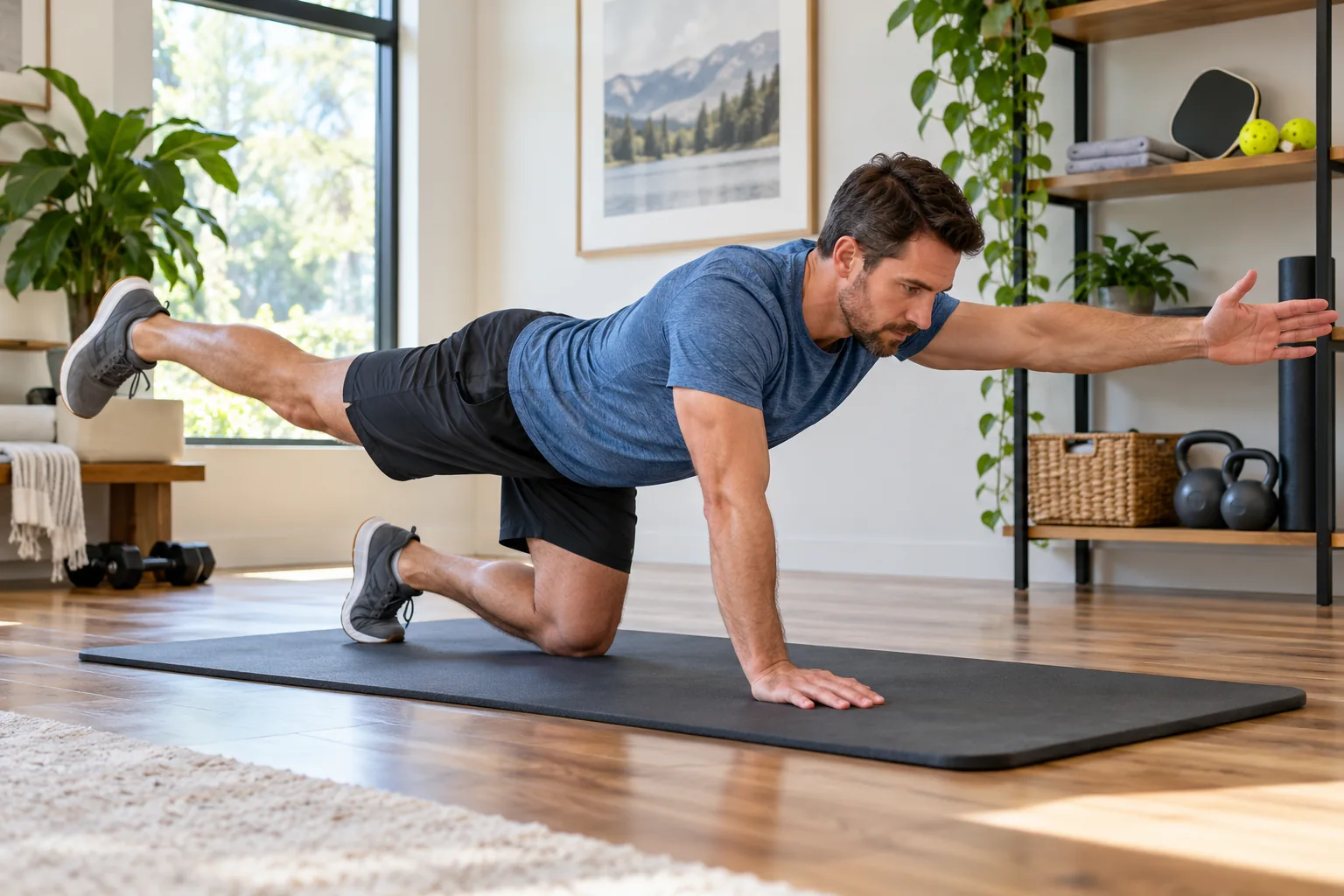
A short trunk exercise can finish either session. A modified bird dog, wall plank or dead-bug variation may fit, depending on floor access and comfort. Use an exercise mat (paid link) on a stable surface for kneeling or lying exercises, with enough cushioning for comfort but no unstable stacked pads. Move slowly, breathe and stop the set when you can no longer keep the chosen position. Long holds are optional and should not become a test of enduring discomfort.
Avoid adding heavy twisting simply because pickleball involves rotation. Shot mechanics depend on the feet, hips, trunk and arm coordinating, not the lower back being forced through the largest possible range. Learn comfortable control first, then ask a qualified coach or trainer about suitable progression. The pickleball core guide separates controlled trunk exercises from swing practice. Use the smallest range that achieves the exercise purpose and choose an alternative if a position causes radiating pain, tingling or persistent discomfort.
Rest long enough to keep the next set useful
Rest is part of the strength session rather than a failure to work hard. For a beginner, a minute or two may be a practical starting interval, but use longer when breathing, balance or focus has not returned. A interval timer (paid link) can remind you to check readiness without rushing to meet a rigid deadline. Do not treat shorter rest as automatic progression; it changes the demand and may reduce the quality of the next set.
Keep exercise order consistent while learning. If a lower-body movement requires your best concentration, do it before fatigue builds. Alternate upper- and lower-body patterns when that helps, but do not create a frantic circuit through unfamiliar equipment. You should be able to explain which exercise comes next and where you will safely place the previous weight. In a crowded gym, adapt the session to available space instead of carrying equipment across another person's workout area to preserve an exact order.
Fit two sessions around games and busy days
One possible week uses strength on Monday and Thursday, with pickleball on Tuesday and Saturday. That layout leaves a gap after the second strength session before the weekend game, but it is only an example. If Saturday is a tournament or unusually long event, Thursday may need to be lighter. If work makes Monday physically demanding, shift or reduce the session. A calendar should reflect real recovery rather than assume that all days outside the gym are restful.
Keep a training journal (paid link) with sets, repetitions, loads and a brief note about the next game. If your legs feel heavy on court, review the combined load instead of blaming one exercise automatically. Add one element at a time: perhaps two more repetitions, a modest load increase or another set. Keep other parts steady long enough to judge the change. Our recovery guide explains why missed workouts should not be piled into the day before a long playing session.
Check progress without turning the plan into a competition
Useful progress includes steadier repetitions, less assistance in a suitable variation or completing the same work with more comfortable control. A stronger squat does not guarantee improved court positioning, and a better game score cannot tell you how much strength changed. Keep fitness and skill measures separate. Repeat a load when technique is still developing; increasing it every session is not a requirement.
If soreness affects stairs, ordinary walking or your paddle grip, reduce the next session and examine the total week. Persistent joint pain, swelling or a change in movement needs assessment rather than an automatic deload-and-retry cycle. Stop immediately for concerning symptoms such as chest pain or faintness. A balanced program should support recreational play and daily function. The best next step is often a small adjustment you can repeat, rather than another exercise added because it looks impressive in a training video.
Practical Options at a Glance
| Situation | Practical option | What to consider |
|---|---|---|
| First strength sessions | Light familiar movement patterns | Leave room for technique and recovery. |
| Long weekend event | Reduce nearby optional demand | Do not crowd the hardest efforts together. |
| Progressing a load | Change one variable | Compare the same exercise setup. |
Frequently Asked Questions
Playing asks the body to perform repeated movement, but it does not automatically provide a balanced progressive resistance program. Suitable pushing, pulling, lower-body and trunk exercises may serve goals that games do not cover systematically. Keep strength practice appropriate to your experience and total workload. You do not need to add every gym exercise at once. Begin with a small controlled routine and consider professional instruction when technique is unfamiliar or health restrictions affect your options.
There is no universal order that suits every goal and schedule. During a learning phase, separate demanding strength work from important court sessions when possible. If both must occur together, keep the secondary activity modest and prioritize the task requiring your best concentration. Fatigue can affect lifting technique and court movement. Do not use an intense circuit as an automatic warm-up. Observe the response to your chosen arrangement and adjust it rather than copying a competitive athlete with different experience and recovery capacity.
No. Repeating a familiar load while movement becomes smoother can be useful progress. Increase only when you can keep the intended range and breathing, and when the wider week allows the extra demand. Change one variable rather than simultaneously increasing weight, sets and court time. A heavier load that shortens the movement or causes pain is not automatically better. Record the setup so comparisons are meaningful, and get guidance if you cannot judge a comfortable progression confidently.
Safety and Personal Needs
Stop activity and seek appropriate help for chest pain, faintness or severe unexpected breathlessness. Pain that changes movement, unexplained swelling, new weakness or recurrent instability needs assessment before progression. Follow individual guidance for health conditions, pregnancy, recent surgery or an injury. The routines are adjustable educational examples, not clinical rehabilitation plans or guarantees against injury.
This is general educational information. Individual needs vary with health, medications, fitness and training experience.