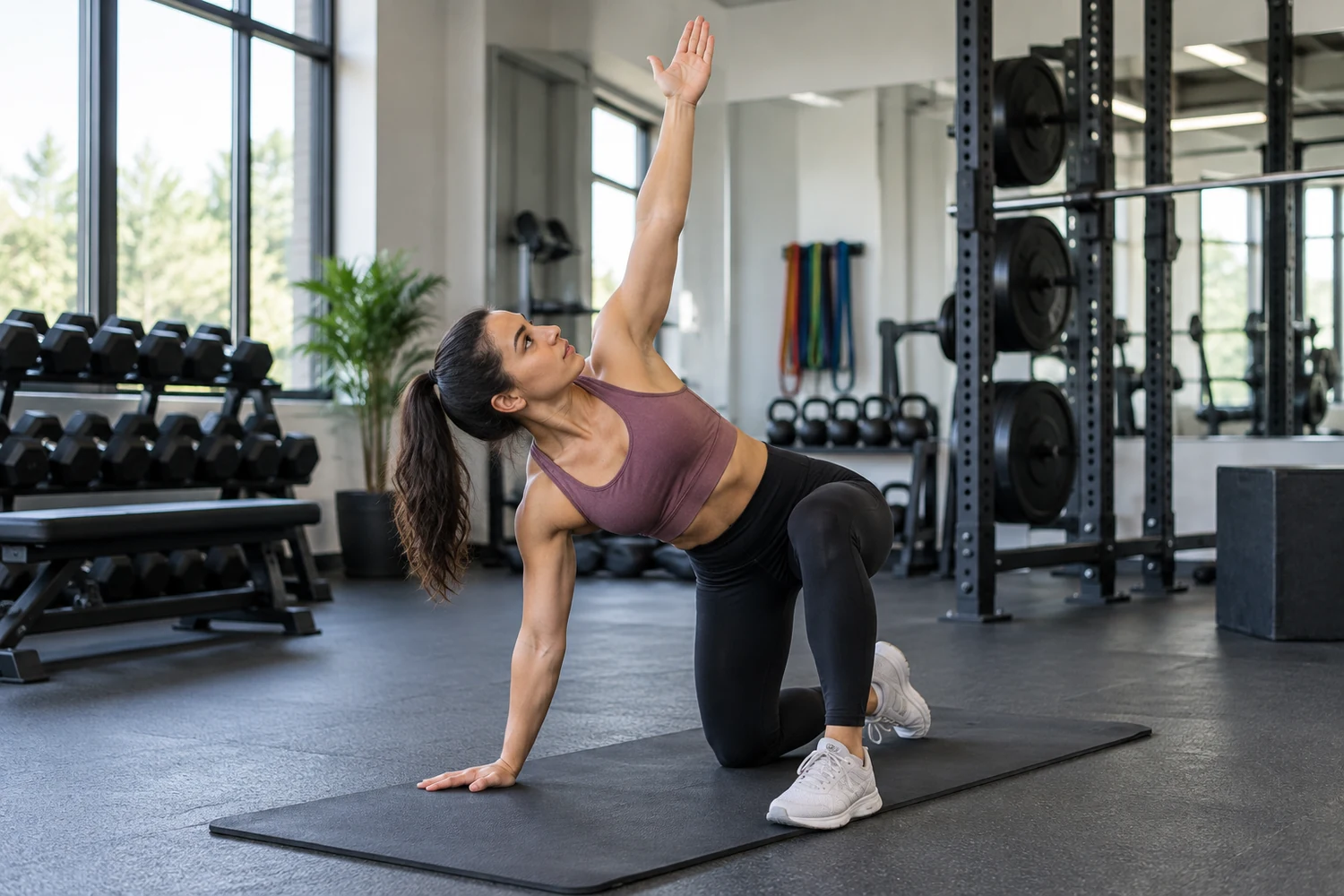

What Do Shoulder Mobility Exercises Improve?
Shoulder mobility is more than the ability to lift an arm overhead. Smooth reaching depends on the shoulder joint, shoulder blade, upper back and rib cage working together. When one part is stiff or poorly controlled, you may shrug, arch the lower back or rotate the torso just to get the arm into position.
The goal of shoulder mobility exercises is not to force maximum flexibility. It is to practice useful range with control. That is especially important for pressing, reaching into a cabinet, putting on a jacket, swimming and many daily tasks.
Upper-back movement often influences overhead position, so pair this work with thoracic mobility exercises when your chest feels tight or your ribs flare as the arms rise.
Benefits of Better Shoulder Mobility
Better coordination between the shoulder blade and arm can make reaching overhead feel smoother. Mobility drills prepare the shoulders for pressing, pulling and carrying without exhausting them. The larger goal is not a perfect-looking position; it is a movement option you can use comfortably in training and daily life. Consistency usually matters more than doing a long routine once in a while.
Wall slides and controlled reaches teach the shoulder blades to rotate and glide instead of staying pinned back. Useful mobility can reduce the tendency to overarch the lower back or crane the neck during overhead work. When mobility and strength improve together, the body has more choices for solving everyday movement tasks.
9 Shoulder Mobility Exercises
1. Wall slides
Stand with your back near a wall, ribs gently stacked over the pelvis. Place forearms against the wall and slide them upward only as high as you can without shrugging or arching. Think about allowing the shoulder blades to rotate upward. Perform eight to ten slow reps.
2. Scapular wall circles
Place one forearm or hand lightly on the wall. Move the shoulder blade through small controlled circles without twisting the whole torso. Keep the motion smooth and pain-free. Five circles each direction can improve awareness before larger movements.
3. Supine overhead reach
Lie on your back with knees bent. Hold a light dowel or towel between your hands and slowly reach the arms overhead while keeping the ribs from popping up. The floor gives clear feedback if you compensate through the spine. Do eight controlled repetitions.
4. Quadruped shoulder flexion rock-back
Start on hands and knees with hands on the floor or a bench. Keep the elbows straight while gently sitting the hips back, allowing the chest to lower between the arms. Stop before the shoulders pinch or the lower back arches. Repeat eight times.
5. Band pass-through
Hold a light resistance band or long towel with a wide grip. Keeping the elbows straight, raise it overhead and slightly behind you only within a comfortable range. Widen the grip if needed. Avoid forcing the hands behind the body.
6. Wall-supported external rotation
Stand beside a wall with the elbow bent to 90 degrees and tucked near your side. Rotate the forearm outward gently while keeping the shoulder relaxed. Use a towel between the elbow and ribs for feedback. Perform eight to twelve reps per side.
7. Serratus wall slide
Place forearms on the wall with a light resistance band around the wrists if desired. Gently press into the wall and slide upward while keeping tension outward. Feel the shoulder blades rotate around the rib cage rather than squeezing together.
8. Child’s-pose lat reach
From a kneeling position, place both hands on the floor or bench and sit the hips back. Walk the hands slightly to one side to emphasize the opposite lat and side body. Breathe for 20 to 30 seconds, then switch sides.
9. Controlled arm circles
Stand tall and make slow arm circles that gradually increase in size. Keep the ribs quiet and neck relaxed. This simple drill works best when you control every part of the circle instead of swinging quickly through the range.
A 7-Minute Shoulder Mobility Warm-Up
Perform wall slides for eight reps, serratus wall slides for eight reps, controlled arm circles for five each direction, and supine overhead reaches for eight reps. Finish with one or two gentle child’s-pose lat reaches. Before upper-body strength work, add light rows or carries to reinforce control. A farmer’s carry can be a useful next step because it trains the shoulders to stay organized under load.
Keep the first week intentionally easy. Write down the variation, repetitions and how the movement felt. If technique remains consistent and you recover well, add only a small amount the next week. This simple approach makes progress easier to judge and reduces the temptation to change several variables at once.
Common Mistakes to Avoid
Pulling the shoulders down during every overhead movement
The shoulder blades need to rotate upward as the arms rise. Forcing them down can limit useful motion.
Arching the lower back to fake range
Keep the ribs controlled. If you only reach overhead by leaning backward, reduce the range and work on thoracic mobility.
Stretching into a pinch
A sharp pinch in the front or top of the shoulder is not a productive mobility sensation. Back off and choose a different angle.
Using heavy resistance too soon
Mobility drills should usually feel controlled and repeatable. Heavy bands can turn them into strength exercises before you own the range.
Ignoring side-to-side differences
Small differences are common, but a large or painful asymmetry deserves a more individualized assessment.
Progressions and Practical Training Tips
First make the movement cleaner: less shrugging, less rib flare and smoother shoulder-blade motion. Then increase range gradually or add very light resistance. Once you can control overhead positions, integrate strength with carries, rows and presses. If the limitation seems to come from a rounded upper back, revisit thoracic mobility. If you are building a full-body routine, combine upper-body mobility with hip mobility work rather than doing every drill every day.
Use the exercise as part of a complete plan rather than an isolated challenge. A balanced week can include strength, aerobic activity, mobility and recovery. The best version is the one that fits your current ability and leaves you able to practice consistently.
How to Make Shoulder Mobility Carry Over to Strength
Progress is not always a larger angle. Better scapular control, less rib flare, smoother breathing and a more relaxed neck are meaningful improvements. If overhead range improves but strength feels unstable, pause the mobility progression and spend more time on controlled resistance work.
If you spend much of the day at a desk, consider short movement breaks instead of one very long stretching session. A few arm circles, wall slides and gentle thoracic rotations performed consistently can provide regular exposure without making the shoulders sore. Keep the effort low enough that the drills refresh the joint rather than fatigue it.
Mobility work has the most value when the new range is followed by light strength in that same range. For example, after wall slides you might do a light cable row, band pull-apart or controlled overhead press variation. This teaches the shoulder to use the position rather than treating mobility as a separate warm-up that disappears as soon as the workout starts.
Safety Tips
Stop if you feel sharp pain, instability, numbness, tingling or sudden loss of strength. Shoulder pain after trauma, a suspected dislocation, persistent night pain or symptoms that do not improve should be evaluated by a healthcare professional. People recovering from surgery should follow their surgeon or physical therapist’s specific range-of-motion limits rather than a general mobility routine.
If you are unsure whether a movement is appropriate after an injury or with a medical condition, a physical therapist or other qualified clinician can help tailor range, load and exercise selection. General fitness guidance cannot replace individual assessment.
Frequently Asked Questions
Most gentle drills can be practiced several times per week or daily if they remain comfortable and do not increase soreness.
Yes. Wall slides can train overhead range and shoulder-blade upward rotation while giving you feedback about rib flare and shrugging.
The limit may come from the shoulder joint, lats, chest, thoracic spine, shoulder-blade control or a combination of factors.
No. Mild stretching or muscular effort is fine, but sharp pain, pinching, tingling or instability are reasons to stop.
No. Mobility and strength work best together. Once you can access a useful range, strengthen it with appropriate pushing, pulling and carrying exercises.
Key Takeaways
- Shoulder mobility exercises work best when range and control progress together.
- Start with the easiest variation that lets you move without sharp pain or compensation.
- Progress one variable at a time—range, repetitions, time, support or resistance.
- Combine mobility with strength and balance so new range becomes useful in everyday movement.
- Stop and seek individualized guidance when symptoms include sharp pain, instability, numbness or persistent worsening.