Published by Best Fitness Routine. Editorial standards · Report a correction. Educational guidance; no individual clinical review is claimed unless a qualified reviewer is named.
Use the second trimester as a new starting point
Second trimester workouts often become easier to organize as early nausea settles, but that change is not guaranteed. Energy can improve while balance, body position, and exercise comfort continue to change. Start with your current experience rather than assuming the middle of pregnancy should be a period of uninterrupted progress. A useful routine leaves room for ordinary variations and for any restrictions your prenatal care team has given you.
This guide brings together walking and familiar strength movements without trying to prescribe the same session for everyone. Think about what you want the routine to support: comfortable daily activity, maintaining a training habit, or having a manageable break from a desk-based day. Those goals help you select an appropriate starting dose. They are more useful than choosing a workout because it promises the most dramatic result before your due date.
Review the movements that have changed
A growing abdomen can alter how much room you need between your feet, the path of an exercise, and the comfort of a floor position. Check each movement separately. A comfortable standing exercise does not establish that a lying exercise will also feel comfortable, and an easier walking pace does not mean every strength movement needs to disappear. Notice where the change occurs and ask for a modification that addresses that particular issue.
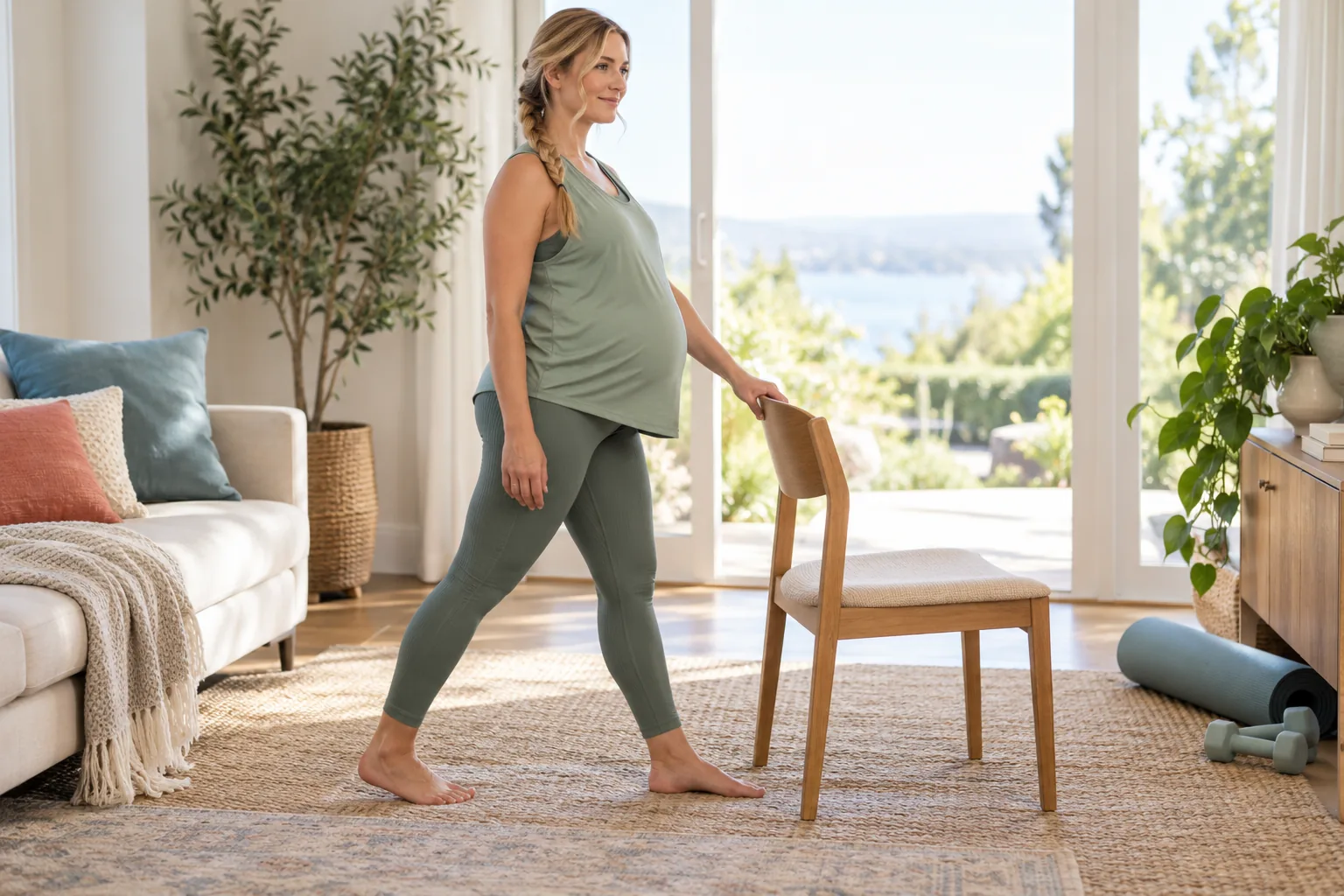
For a movement involving a chair, the seat height and available hand support may matter more than the number of repetitions. For a wall-supported movement, standing closer to the wall can change the demand. For an exercise using weights, a supported position may reduce the balance challenge. These are ways to organize a discussion with a pregnancy-informed instructor, rather than rules to use without considering your symptoms, exercise background, and individual pregnancy.
Keep walking easy to adjust
Choose a route with level footing and a convenient place to turn around. A loop near home can be easier to shorten than an out-and-back route where you discover halfway through that you feel tired. If you walk indoors, allow enough room to slow down safely and avoid abrupt turns around furniture. The best route is one you can change without making a short session into an obligation to finish a distance.
Begin at a comfortable pace and let your breathing guide the effort. Hills, heat, carrying a bag, and poor sleep can make the same route feel different on separate days. Slowing down is a normal adjustment. If walking creates pelvic pain, pressure, or symptoms that persist afterward, discuss the pattern with your care team. Do not assume that all low-impact activity is automatically comfortable or that discomfort must be accepted because walking seems simple.
Use familiar strength patterns with stable support
If strength training is appropriate for your pregnancy, familiar movements can help you keep the session straightforward. Examples to discuss include controlled chair rises, wall push-ups, and supported arm exercises. Start with a setup you can maintain without bracing hard or holding your breath. An instructor should be able to explain the exercise purpose and demonstrate a less demanding version if the original position is no longer comfortable.
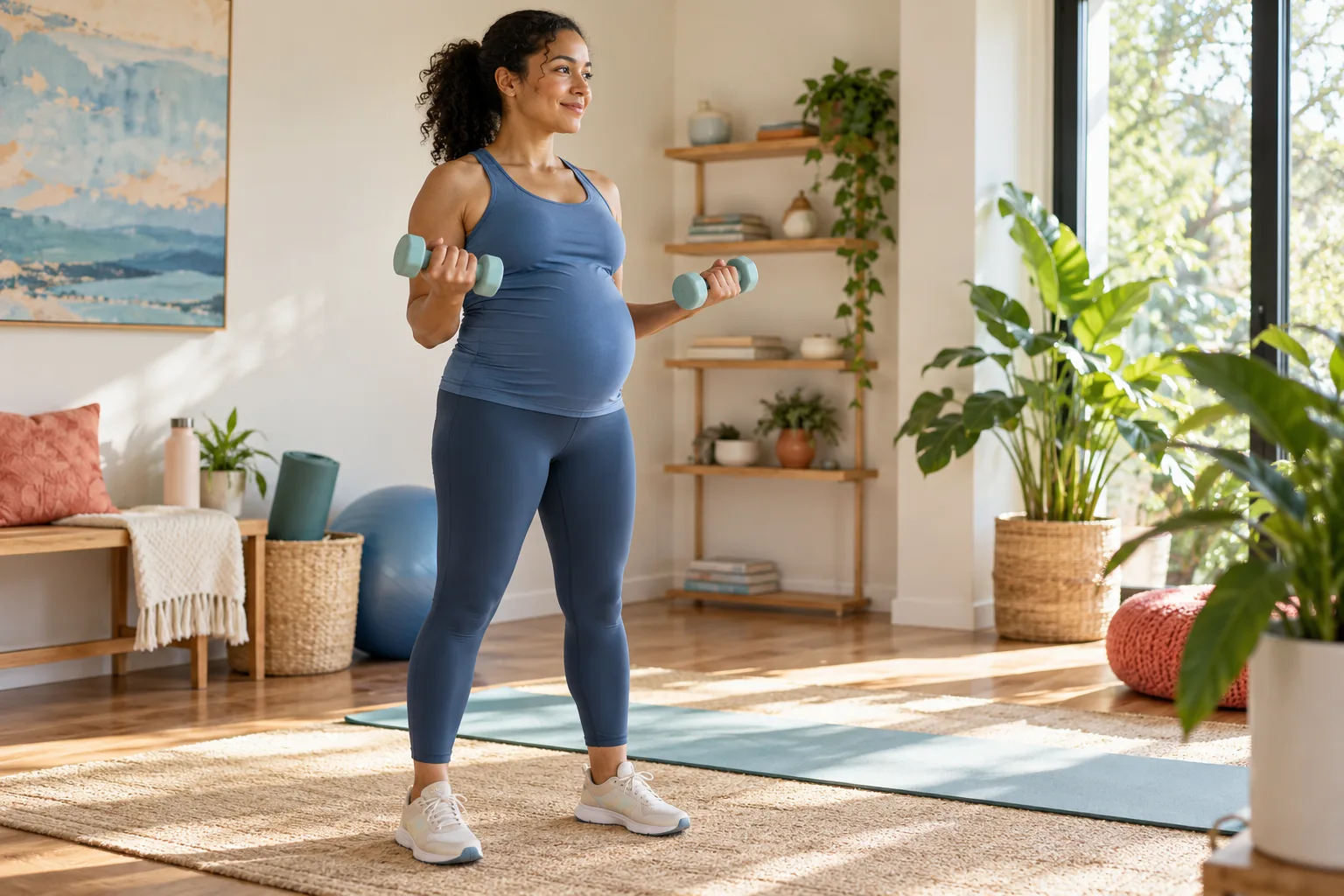
A pair of light dumbbells (paid link) can be useful for approved movements when the weight is comfortable and you have a clear place to put them down. Choose secure handles and a load you can manage through the entire movement, including picking up and storing the weights. The exercise is not finished until the equipment is safely out of the walking area. You can also practice an appropriate movement without added weight while you learn the position.
Make breathing part of technique
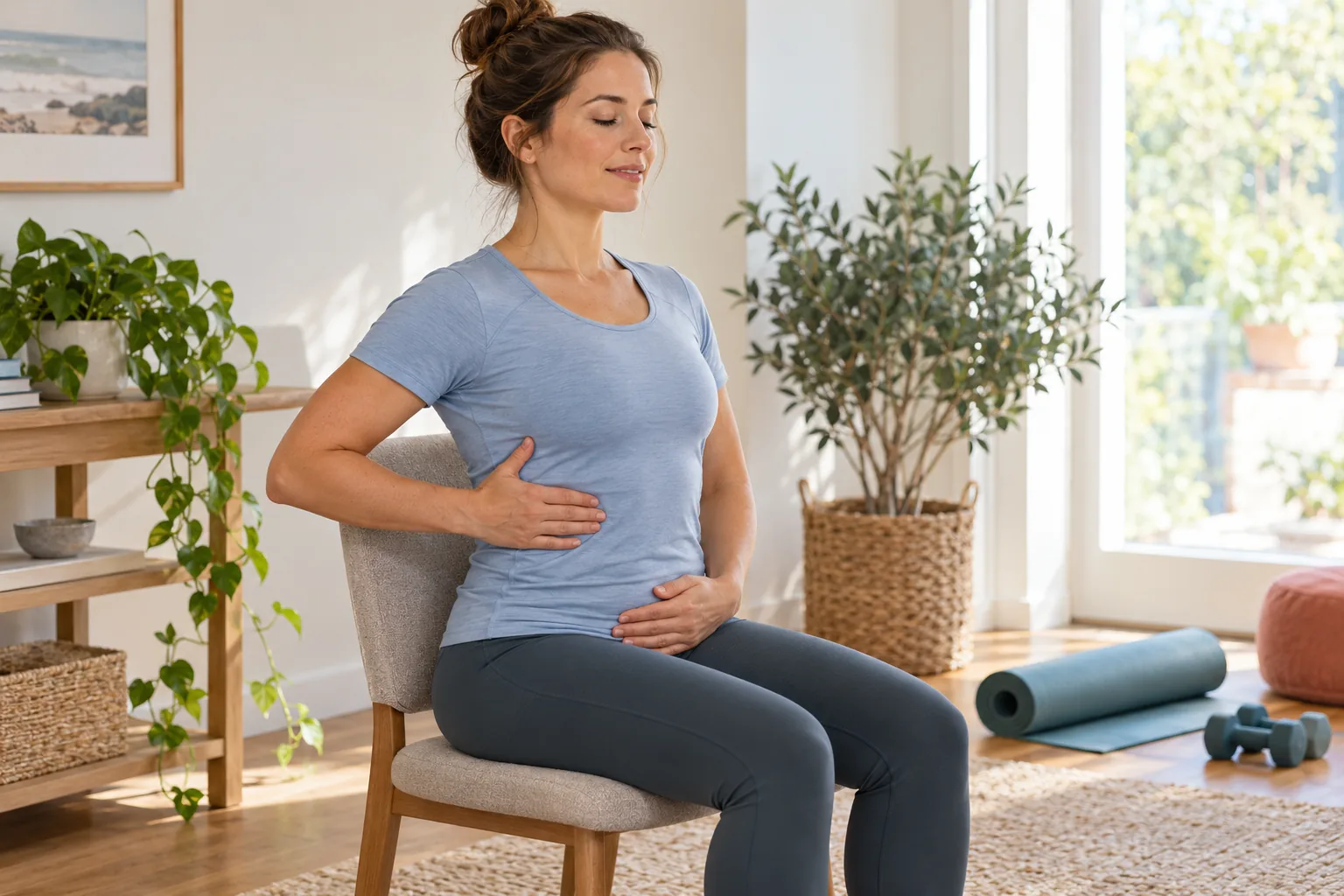
You should be able to breathe during each repetition rather than making every effort into a prolonged strain. Start slowly enough to notice whether you are holding your breath, clenching, or rushing to get the difficult part over with. If a load makes comfortable breathing difficult, reduce it or change the exercise. A technique cue should help you move more smoothly, not become a complicated checklist that makes you anxious during every repetition.
Do not use a fixed lifting number from another person's pregnancy as your target. Previous experience, the movement, the support available, and medical circumstances all affect the decision. If you are unsure how effort should feel, ask an instructor to observe a comfortable set and help you choose a starting point. Seek individualized advice for symptoms such as pain, pelvic heaviness, or leakage rather than trying to solve the problem by changing only your breathing pattern.
Adapt exercise positions as the abdomen grows
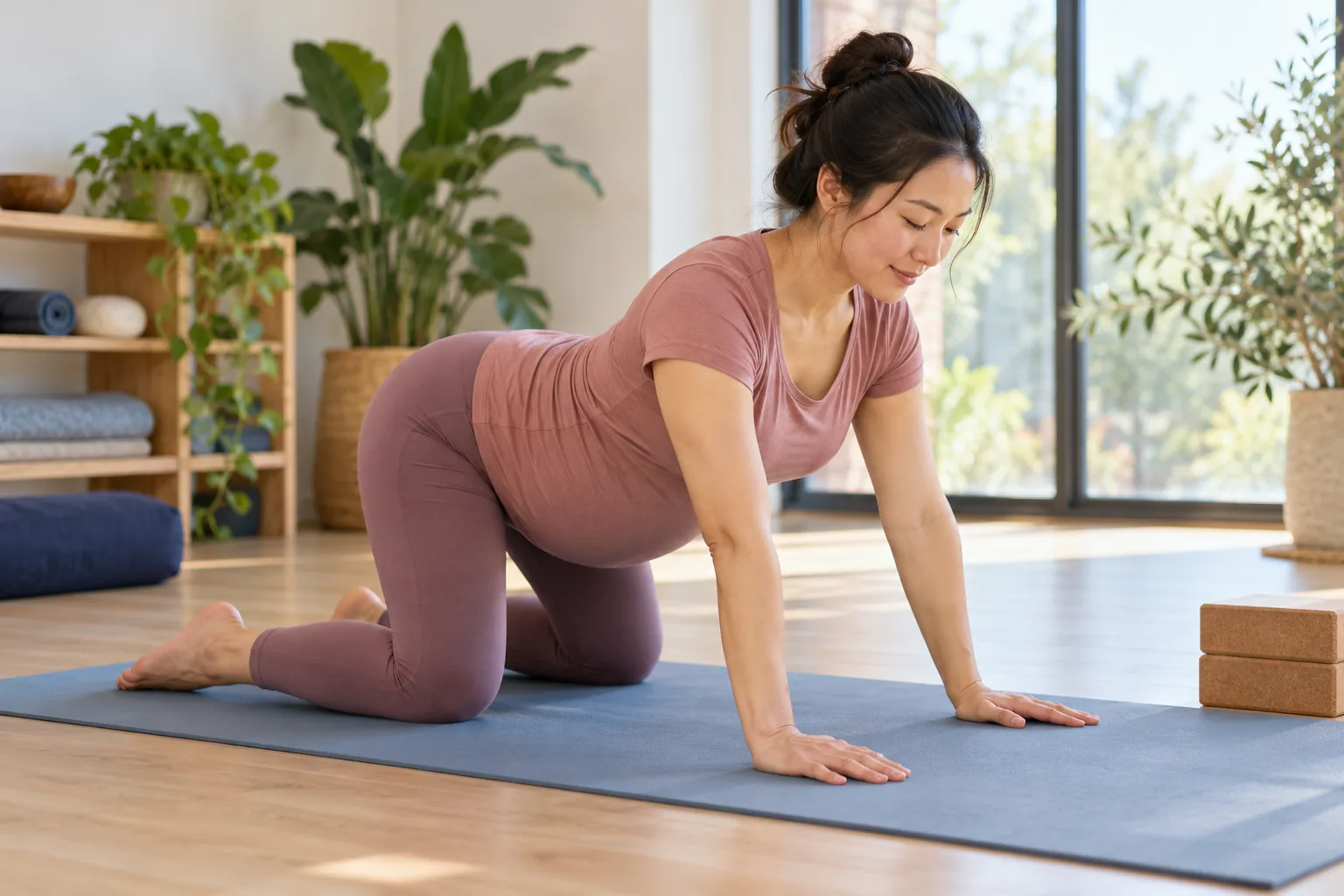
Leave room for your abdomen and choose positions that feel supported. A narrower stance or a familiar range may stop being comfortable even though the same exercise worked earlier. Avoid pressing into the abdomen or forcing a deep twist to imitate an instructor. If getting onto the floor is awkward, consider an upright alternative instead of assuming that a home routine requires you to perform every movement at mat level.
Prolonged flat-on-your-back exercise is generally avoided later in pregnancy. Speak with your care team about position changes and stop if a position makes you feel dizzy or unwell. A supported seated or side-lying option may be useful for an approved movement, but a change of position does not make every exercise suitable. Keep the purpose of the movement in mind and choose an alternative that matches your current comfort and guidance.
Plan rest, fluids, and a cooler setting
Rest is part of the session structure. Leave enough time between activities to settle your breathing, change position comfortably, and decide whether you want to continue. Do not use a crowded circuit to turn every pause into another task. If the room becomes warmer, reduce the work or move to a cooler setting. An indoor workout may need just as much attention to temperature as a walk on a sunny afternoon.
Bring a water bottle (paid link) that fits the location and is easy to reach without bending around equipment. Put it beside the place where you plan to rest rather than directly in your walking path. Take normal opportunities to drink and follow any individualized medical instructions. Water access supports the practical plan, but it does not replace choosing an appropriate effort, responding to symptoms, or avoiding an overheated room during pregnancy.
Combine activities without making every day demanding
An example week might alternate comfortable walks with short strength sessions, with easier days between activities that leave you tired. The exact arrangement depends on work, appointments, childcare, and how you recover. If walking is already part of your commute, count that when considering your total activity. Adding another session simply because a calendar has an empty space can make the plan more demanding than it first appears.
Keep an easier version ready. A day planned for strength work might become a short comfortable walk if the exercises feel unsuitable, or an outdoor walk might move indoors during poor weather. These changes are not failures to follow the routine. They are the reason to build a flexible plan in the first place. Avoid compensating for a missed session by doubling the following one when you have not established how the regular dose feels.
Review the routine before increasing it
In a training journal (paid link), note one or two observations that help you decide what to do next. You might record that a higher chair made transitions easier, a flatter route reduced discomfort, or extra rest improved the session. Include how you felt later, since a comfortable workout can still leave you more tired than expected. The notes should help you choose a practical adjustment rather than create pressure to increase the numbers every week.
Before progressing, ask whether the present version remains comfortable, whether medical advice has changed, and whether the increase fits your daily life. Sometimes maintaining the same dose is the right choice. Sometimes the next useful change is a simpler setup rather than more exercise. For a second-trimester routine, the aim is steady, adaptable participation. You can carry the useful habits forward while revising individual movements as pregnancy advances and your needs change.
Practical Options at a Glance
| Situation | Practical option | What to consider |
|---|---|---|
| More energy | Repeat a comfortable starting routine | Change one variable before adding another. |
| Changed balance | Choose stable support and level surfaces | Avoid movements that require rushing transitions. |
| Floor position uncomfortable | Ask for a seated or standing alternative | Pregnancy advice takes priority over a class sequence. |
Frequently Asked Questions
Improved energy can make a routine easier to follow, but it is not automatic clearance to make every exercise harder. Change one part at a time and keep your pregnancy advice in view. Notice comfortable breathing, balance and recovery before deciding whether more time or resistance would actually be useful.
No. Walking and appropriate seated or standing exercises can offer useful alternatives. Choose positions that feel comfortable and that your clinician or qualified prenatal instructor recommends. Think about getting into and out of an exercise as well as the movement itself, especially when balance or abdominal space has changed.
No. The same weight can represent very different effort for two people with different experience, health and exercises. Use your own manageable level and individual guidance. A number printed on a dumbbell cannot tell you whether your breathing, technique or pregnancy circumstances make that exercise suitable today.
Safety and Personal Needs
Discuss exercise with your prenatal care team and follow any individual restrictions. Stop activity and get medical help for concerning pregnancy symptoms. Chest pain, difficulty breathing, fainting, severe headache, vaginal bleeding or fluid leakage need urgent assessment; this is not an exhaustive list. Do not use an exercise modification to delay care.
This is general educational information. Pregnancy and postpartum recovery vary with health, delivery, healing and symptoms. This guide does not replace individualized maternity or physical therapy care.
Sources and Further Reading
- ACOG: Exercise During Pregnancy
- CDC: Physical Activity for Healthy Pregnant or Postpartum Women
- NHS: Exercise in Pregnancy
- CDC: Urgent Maternal Warning Signs