Published by Best Fitness Routine. Editorial standards · Report a correction. Educational guidance; no individual clinical review is claimed unless a qualified reviewer is named.
Rebuild control before chasing an abdominal workout
Postpartum core exercises should begin with your recovery and the movements you want to make easier. The core participates in breathing, changing position, and supporting ordinary tasks; it is not only the muscles you can see at the front of the abdomen. Start by asking what is currently difficult, such as getting out of a chair or managing a comfortable exercise position. That goal gives the practice a purpose beyond completing an abdominal circuit.
Delivery, surgical healing, pain, and pelvic symptoms affect which exercises fit. Follow your care team's instructions and seek assessment when you are unsure, particularly after complications or a C-section. This guide describes ways to approach early control and progression. It does not diagnose abdominal separation, promise a flatter stomach, or set a date when every person should begin demanding core work. The right starting level may be much simpler than the routine you performed before pregnancy.
Start in a position you can maintain comfortably
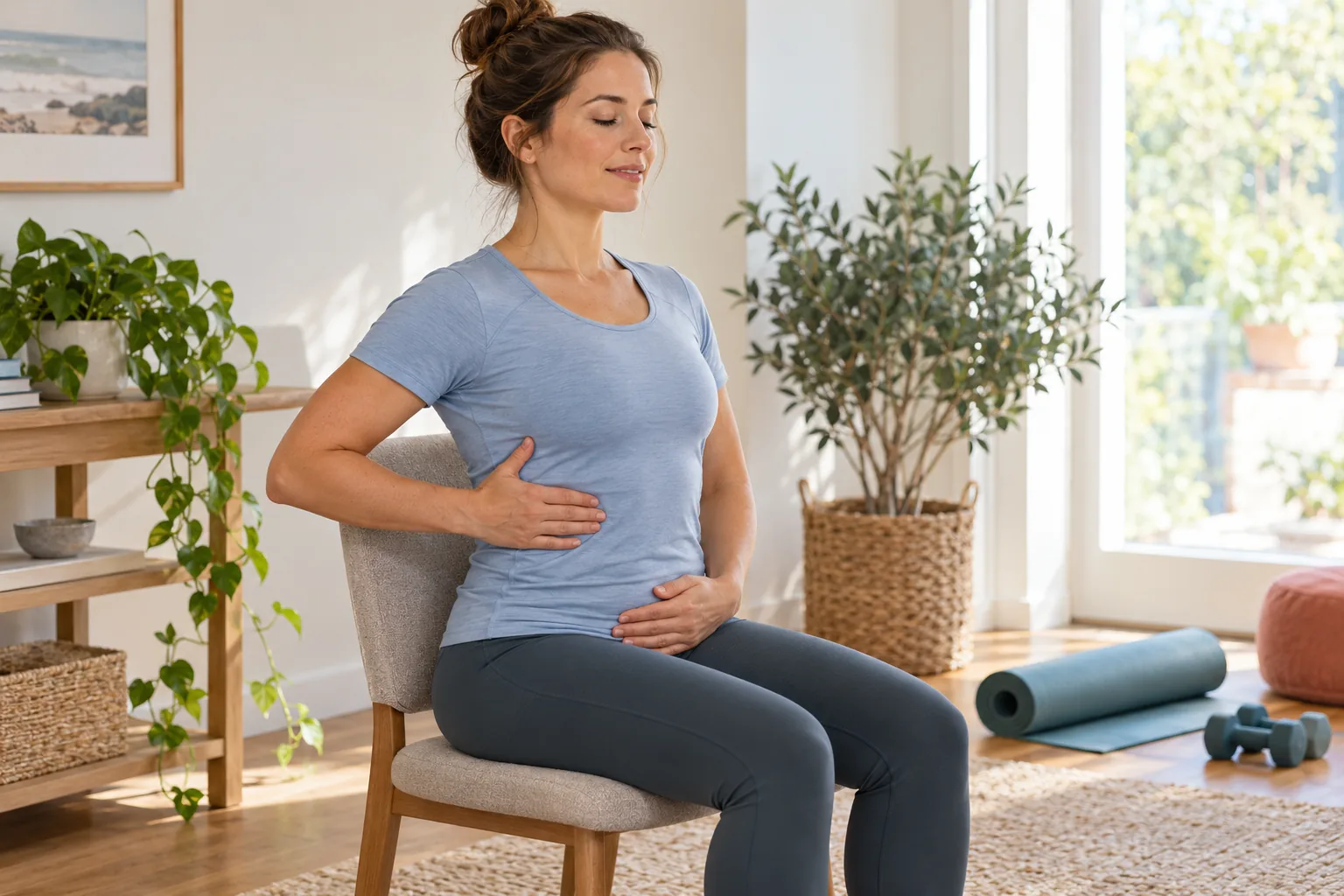
Choose a supported seat or another position your clinician or physical therapist has approved. In a chair, let your feet rest securely and choose a height that does not require you to strain to stay upright. Avoid turning the setup into a posture test. You should be able to breathe and leave the position easily. If you need to tense strongly to stay comfortable, simplify the setup before adding an exercise.
A support pillow (paid link) can provide comfortable support behind the back or in a suitable side-lying position. Use it to solve a specific comfort issue, not to force your body into a particular shape. If support does not make the position comfortable, try another approved option. Floor work is not compulsory at the beginning. Consider how you will get down and back up, because an exercise can look gentle while the transition places a much larger demand on recovery.
Practice relaxed breathing without constant bracing
In a comfortable seat, notice a few ordinary breaths before adding instructions. You may rest a hand at the side ribs if that helps you feel the movement. Let the breath remain easy rather than trying to make the abdomen perfectly still. An introductory breathing practice is an opportunity to notice tension and coordination; it should not create dizziness, pain, or a feeling that you need to control every breath throughout the day.
If a pelvic health professional has taught you a gentle activation cue, practice it with the breathing pattern they recommend and allow release between efforts. Ask them to clarify any cue that makes you clench or hold your breath. Keeping the abdomen tightened continuously is not the goal. The ability to relax and respond to different tasks matters as well. A written guide can explain the questions to ask but cannot confirm that your technique matches your individual needs.
Coordinate with pelvic floor guidance
The pelvic floor and abdominal wall are part of a wider movement system, and symptoms can require more than one adjustment. Leakage, heaviness, pain, or a dragging sensation are reasons to obtain appropriate advice rather than simply adding more core repetitions. Tell the clinician which task brings on the symptom and whether it appears during or after the activity. A clear description can help distinguish the need for technique coaching from the need for further assessment.
If pelvic floor muscle training is appropriate for you, learn both the intended contraction and the release. Do not repeatedly practice stopping urine flow as your everyday exercise. Avoid assuming that all discomfort means weakness or that stronger squeezing is always the solution. Follow the amount and technique taught for your situation. Core practice should work with that guidance rather than becoming a separate program that ignores pelvic symptoms or encourages constant bracing during daily tasks.
Add a small movement only when the base position fits
Once an approved starting position feels comfortable, a physical therapist may introduce a small arm or leg movement while you maintain easy breathing and control. The point is to learn how the task changes the demand. Begin with a version you understand and can stop without difficulty. If the movement causes pain, pressure, breath holding, or a loss of control, return to the simpler version and ask how to adjust it.
A exercise mat (paid link) can improve the surface for an approved floor exercise, but choose a position that fits your recovery rather than selecting exercises just because you own a mat. A side-lying or supported seated practice may be easier to organize than repeatedly lying down and rising. Keep enough room around you, and keep the area separate from infant care. The mat provides a surface; it does not determine readiness for a harder exercise or make an uncomfortable transition appropriate.
Understand what abdominal doming can tell you
You may notice the abdomen change shape during a movement. A visible ridge or doming can be a reason to review the task, position, and level of effort, especially if it accompanies symptoms or difficulty controlling the exercise. It is not a complete diagnosis by itself. Avoid interpreting every visual change as proof of damage or using a mirror to judge recovery without considering comfort, function, and a professional assessment when needed.
If you are concerned about diastasis recti, arrange an appropriate evaluation and read the separate guide on abdominal separation. A finger-width estimate or photograph cannot replace assessment of the broader picture. For this core-control practice, focus on an exercise you can manage while breathing comfortably and on the effect it has on daily function. Do not increase the difficulty just to test whether you can make the abdomen look different during the movement.
Apply the skill to an ordinary task
Choose one task that has become awkward, such as standing from a chair or changing position in bed. Discuss an appropriate strategy with your care team or therapist, then practice the sequence slowly. Arrange the environment so you are not reaching around obstacles or trying to complete the task while carrying several objects. A simpler setup can reduce the demand and give you a clearer opportunity to use the technique you have been taught.
For a chair rise, the practical issue might be seat height or the availability of hand support rather than the need for more abdominal exercise. For a bed transition, the issue may be choosing a comfortable sequence that fits incision or pelvic recovery. Avoid assuming that every difficult daily task reflects a weak core. Fatigue, pain, surroundings, and healing can also matter. Improving the task is a useful goal even when the exercise itself remains very gentle.
Progress one demand and watch the response
When the current practice fits, progression might mean a slightly larger movement, less support, or another brief opportunity during the week. Change one factor so you can understand its effect. More repetitions are not automatically better if the final efforts become tense or uncomfortable. Finish before the exercise turns into a struggle, and allow time to observe how you feel afterward. The next session should reflect that response rather than follow a required increase.
Demanding planks, repeated crunches, or heavy resistance are not necessary starting tests. They may belong in a later individualized progression, but an online checklist cannot determine that stage for you. If your goal is to return to lifting or sport, ask what abilities the next step requires and how to build them. A clear progression connects the current practice with the future task without using the hardest exercise as proof that recovery is complete.
Keep the practice small enough to use
Use a training journal (paid link) to note the position, movement, and one useful observation about comfort or control. You might record that a supported seat helped breathing feel easier or that a particular transition needs more guidance. The record should be brief enough to fit a busy postpartum day. Avoid turning it into an obligation to perform the exercise at every spare moment or to monitor the abdomen continuously.
Bring specific questions to your next appointment: which starting position fits, what symptom should change the practice, and how you will know when to progress. If an exercise does not make sense, ask for a demonstration or an alternative. The useful outcome is a skill you can apply comfortably and revise as recovery changes. Core work can be part of postpartum fitness without becoming a race to recover a previous appearance or a replacement for care when symptoms persist.
Practical Options at a Glance
| Situation | Practical option | What to consider |
|---|---|---|
| Uncomfortable floor transition | Try a supported approved seat | Getting down and up may be harder than the exercise. |
| Learning breathing control | Begin with ordinary comfortable breaths | Do not turn practice into all-day strong bracing. |
| Pelvic symptoms | Pause progression and request assessment | An individualized plan is more useful than more repetitions. |
Frequently Asked Questions
No. Breathing, trunk movement and pelvic floor coordination also matter when you change position or manage everyday tasks. Begin with a practical goal and suitable guidance. An exercise that helps you move comfortably can be useful even when it looks less demanding than a traditional abdominal workout or produces no visible change.
Constantly holding a strong brace is not the goal of this guide. Practice ordinary breathing and learn the effort needed for an appropriate movement, with relaxation between efforts. If you cannot find a comfortable pattern or have pelvic symptoms, a pelvic health physical therapist can assess the issue and provide individual instruction.
Notice discomfort, breath holding, pelvic pressure or difficulty controlling the chosen movement. Make it easier and seek professional advice for persistent symptoms. A video or mirror cannot determine the cause on its own. Useful adjustments depend on recovery and the task, rather than a rule that one particular exercise is always required.
Safety and Personal Needs
Follow the recovery advice from your maternity care team. Seek immediate care for urgent symptoms such as chest pain, difficulty breathing, heavy bleeding, fainting or severe headache. Persistent pelvic pressure, leakage or pain needs assessment before exercise progression. Wound concerns after surgery also require prompt advice; this is not an exhaustive symptom list.
This is general educational information. Pregnancy and postpartum recovery vary with health, delivery, healing and symptoms. This guide does not replace individualized maternity or physical therapy care.
Sources and Further Reading
- ACOG: Exercise After Pregnancy
- ChoosePT: Physical Therapy Guide to Diastasis Rectus Abdominis
- CDC: Urgent Maternal Warning Signs