Published by Best Fitness Routine. Editorial standards · Report a correction. Educational guidance; no individual clinical review is claimed unless a qualified reviewer is named.
A Practical Starting Point
As an Amazon Associate I earn from qualifying purchases. This guide includes paid Amazon links.
An elliptical can give a runner another way to do aerobic activity indoors. Its guided foot platforms feel different from running, however, and the display cannot convert the session into equivalent road miles. Begin by deciding whether the workout replaces a run or adds to the week.
This guide is for runners exploring general cross-training. It is not clearance to exercise through an injury. A runner with pain needs advice appropriate to the problem, even if the elliptical movement initially feels easier than running.
Give the session one job
Write down the reason for using the elliptical before choosing a workout. You might want indoor variety, a manageable aerobic session while travelling or a replacement for an easy run when your schedule changes. Each is more useful than treating any extra gym time as automatically beneficial.
If you are already running and lifting regularly, a replacement is often the clearer experiment: the session occupies an existing slot rather than silently increasing the week. Keep track of the changed activity and your response. A hard elliptical session can still create substantial fatigue even though your feet remain on the platforms.
If useful, a training diary (paid link) can show which run the session replaced; an existing notebook works.
Learn the machine before borrowing running intensity
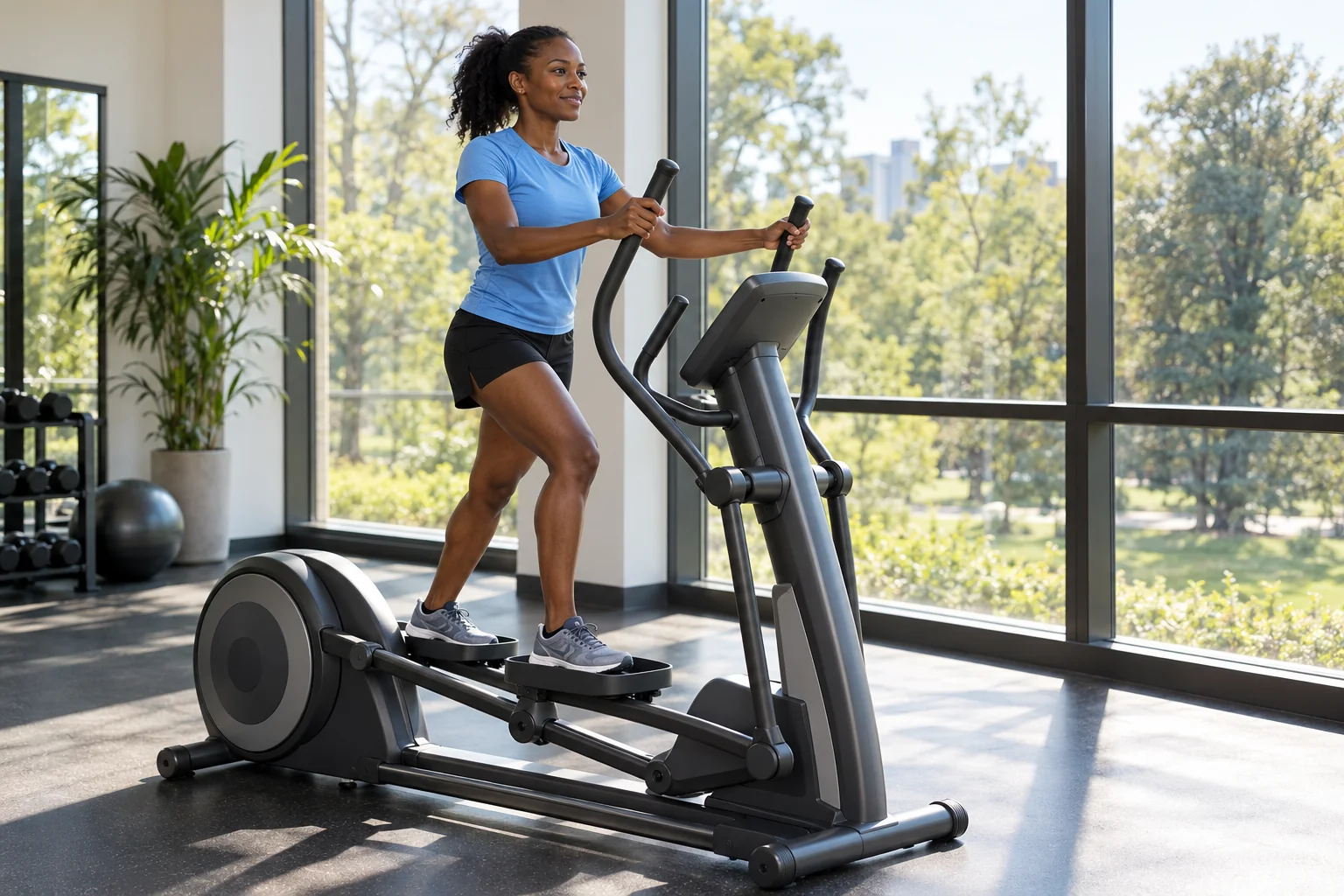
Running experience does not teach the controls or guarantee that a particular stride path fits you. Ask for an orientation, including how to mount, change effort and stop. Begin at an easy controllable effort with the supports the manufacturer provides. Avoid trying to imitate a running cadence number.
Check the elliptical setup guide before concentrating on training. If the pedal path makes you reach or rock, resolve fit first. You should not need to force your running posture onto a guided machine movement. A comfortable trial on one model also does not guarantee identical settings will work on another.
Try a short, easy replacement session
One adjustable example is five easy minutes, ten comfortable minutes and five easy minutes to finish: twenty minutes in total. This is a familiarisation framework, not a running-distance conversion or a requirement to complete the full time. Shorten the middle or end early if technique, comfort or control deteriorates.
Use breathing and speech alongside how the movement feels. The CDC intensity guide describes moderate effort through the talk test, but the aim here is a manageable session, not proving that you can reach a high intensity. Use our resistance guide to understand why level numbers alone are not a prescription.
An optional simple workout timer (paid link) can mark the three parts, although the machine clock usually makes an extra purchase unnecessary.
Protect the rest of the training week
Review what comes before and after the session. An easy cross-training day between demanding runs has a different role from extra work after a heavy leg session. If the next planned run feels unusually difficult, examine total activity, sleep and recovery before adding more elliptical minutes.
Record time and perceived effort separately from running kilometres or miles. Keeping separate columns avoids inflating a running-volume record with a console estimate. Strength work still needs its own place. Our guide to exercise order discusses same-visit planning, while the easy session after leg day covers a different recovery decision.
Keep transfer claims in perspective
A small study by Joubert and colleagues examined a short period of elliptical training in runners after an initial running phase. It did not show a significant change in predicted aerobic fitness between the small groups. The published study is useful background, but its short duration and small sample cannot establish that elliptical work replaces all the demands of running.
Road pacing, terrain, impact tolerance and race preparation involve tasks the machine does not reproduce. Use cross-training as part of a routine with a clear purpose. Do not take a study protocol or a console heart-rate recommendation as an individual training prescription.
Review the replacement before extending it
After several manageable sessions, ask whether you achieved the original purpose. Did the indoor option fit the schedule? Could you use the machine comfortably? Did it leave room for the running and strength sessions that matter to you? Those observations are more informative than an isolated high calorie number.
Keep the same simple session while learning, or change just one feature when it feels appropriate. You may decide that a bike, walk or rest day fits better. Cross-training is a choice, not a requirement to fill every free day. New pain, worsening symptoms or unusual breathlessness calls for stopping and reassessing rather than treating another machine as automatic rehabilitation.
Practice and Setup Checklist
- Decide whether this replaces a run or adds activity.
- Learn the actual model at an easy effort.
- If suitable, try 5 easy + 10 comfortable + 5 easy minutes, shortening freely.
- Log elliptical minutes separately from running distance.
- Review the next run and overall recovery before extending the session.
Practical Options at a Glance
| Part of the example | Time | Purpose |
|---|---|---|
| Easy start | 5 minutes | Learn the movement and check control |
| Comfortable middle | Up to 10 minutes | Repeat a manageable aerobic effort |
| Easy finish | Up to 5 minutes | Reduce effort gradually before stopping |
| Whole session | Up to 20 minutes | Optional replacement example; not equivalent road miles |
Common Mistakes and Useful Adjustments
Choose a role and count the session in total activity.
Track time and effort in a separate cross-training record.
Get advice for the actual injury; change of machine is not a diagnosis.
Frequently Asked Questions
It can provide another aerobic activity, but it does not reproduce all running demands. Decide what the replacement is meant to achieve and monitor the overall week.
No universal cadence conversion is established here. Learn the machine and choose a controlled effort appropriate to you.
An article cannot clear that decision. Seek individual advice and stop activity that causes or worsens symptoms.
No. The example is adjustable. A shorter easy trial may be more useful when the equipment is new.
Safety and Personal Needs
This is general fitness education, not a personalized exercise or rehabilitation plan. Learn the actual model’s entry, controls, supports and stopping procedure with gym staff or the manufacturer’s instructions. Stop for pain, dizziness, instability or unusual breathlessness. Chest pain, fainting or severe unexpected breathlessness needs urgent appropriate help. Follow individual guidance for a medical condition, pregnancy, recent surgery or injury. A written guide and illustrative image cannot assess your movement or establish whether a machine suits you.
Sources and Further Reading
- CDC: measuring intensity
- Joubert, Oden and Estes: short elliptical cross-training study
- NIDDK: starting manageable activity
Prepared by the Best Fitness Routine Editorial Team. The example sessions are educational frameworks; they have not been individually tested for every reader. Images are AI-generated illustrations.