Published by Best Fitness Routine. Editorial standards · Report a correction. Educational guidance; no individual clinical review is claimed unless a qualified reviewer is named.
Understand the workout before counting muscles
The question of rowing machine muscles worked usually begins with a practical decision: can one machine cover both cardio and strength? Indoor rowing involves several major muscle groups in a repeated coordinated movement. That makes it different from an isolated arm exercise, but using many muscles does not automatically make a session equivalent to a complete resistance-training program. The effect depends on the movement, resistance, duration and how the workout challenges you. A muscle can participate without receiving the same stimulus it would during a loaded lift.
Think of the rower as a tool for rhythmic whole-body work, with particular demands from pressing through the legs, moving through the hips and controlling the handle. It can fit an aerobic routine and build familiarity with repeated effort. It cannot promise equal development of every muscle or replace every exercise you might need. This guide explains the main contributions in plain language, then helps you decide what to keep alongside rowing when planning a balanced week.
The leg drive supplies more than a seat movement
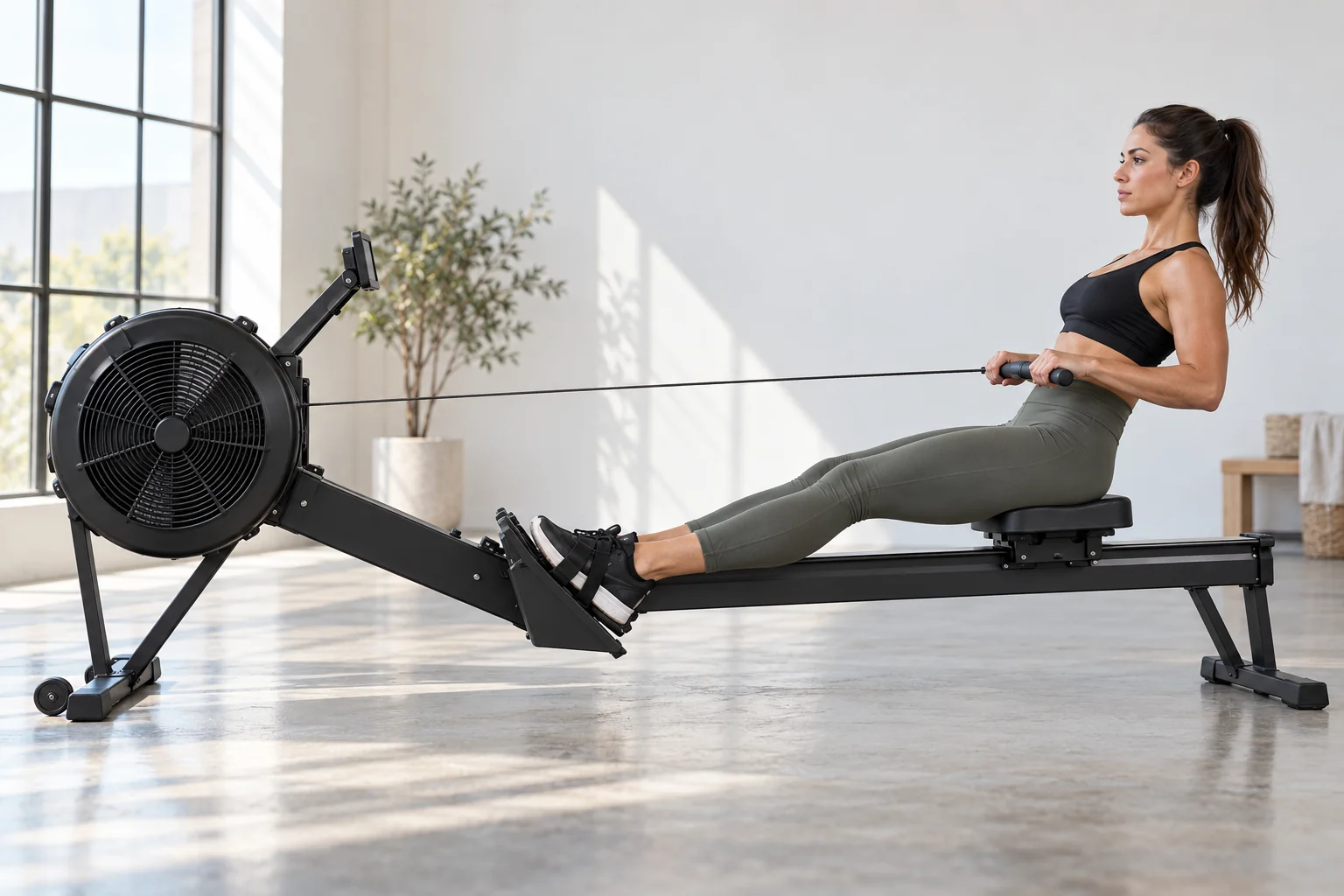
At the front of a conventional rower, your knees and hips are bent within a comfortable range. Pressing against the footplates begins the drive. The muscles around the thighs and hips contribute to extending those joints and moving your body backward along the rail. This is why a leg press coordinated with the handle matters. If you mainly bend the elbows while the seat barely moves, the stroke becomes an arm-dominated pull and misses much of the intended movement.
Leg effort on a rowing machine (paid link) differs from moving a barbell or carrying a heavy load. Repeated strokes typically ask the legs to contribute many times over a cardio session, while strength exercises may use fewer repetitions with a different loading pattern. Neither format makes the other pointless. If your goal includes stronger legs for stairs, lifting or sport, retain suitable resistance exercises. Judge your program by what you want to improve rather than by whether your thighs feel tired after rowing.
The hips and back help connect the drive
After the leg press begins, a controlled opening of the torso helps continue the stroke. The hips and the muscles supporting the trunk contribute to this connection. Avoid interpreting that contribution as a reason to swing backward dramatically. A large lean can increase the movement you must control without adding a useful training benefit. The aim is a coordinated hinge and stable handle path, with a range you can manage comfortably throughout the session.
Back fatigue is not proof that you have discovered the perfect back workout. It can also reflect overreaching, poor timing, an unfamiliar volume or a setting that feels too heavy for your current control. Reduce the demand and review your stroke if the lower back becomes disproportionately tired. Persistent or sharp symptoms need assessment rather than more repetitions. Compare your experience with technique feedback from a qualified instructor; muscle participation and the cause of pain are different questions.
The arms complete a stroke they do not start alone
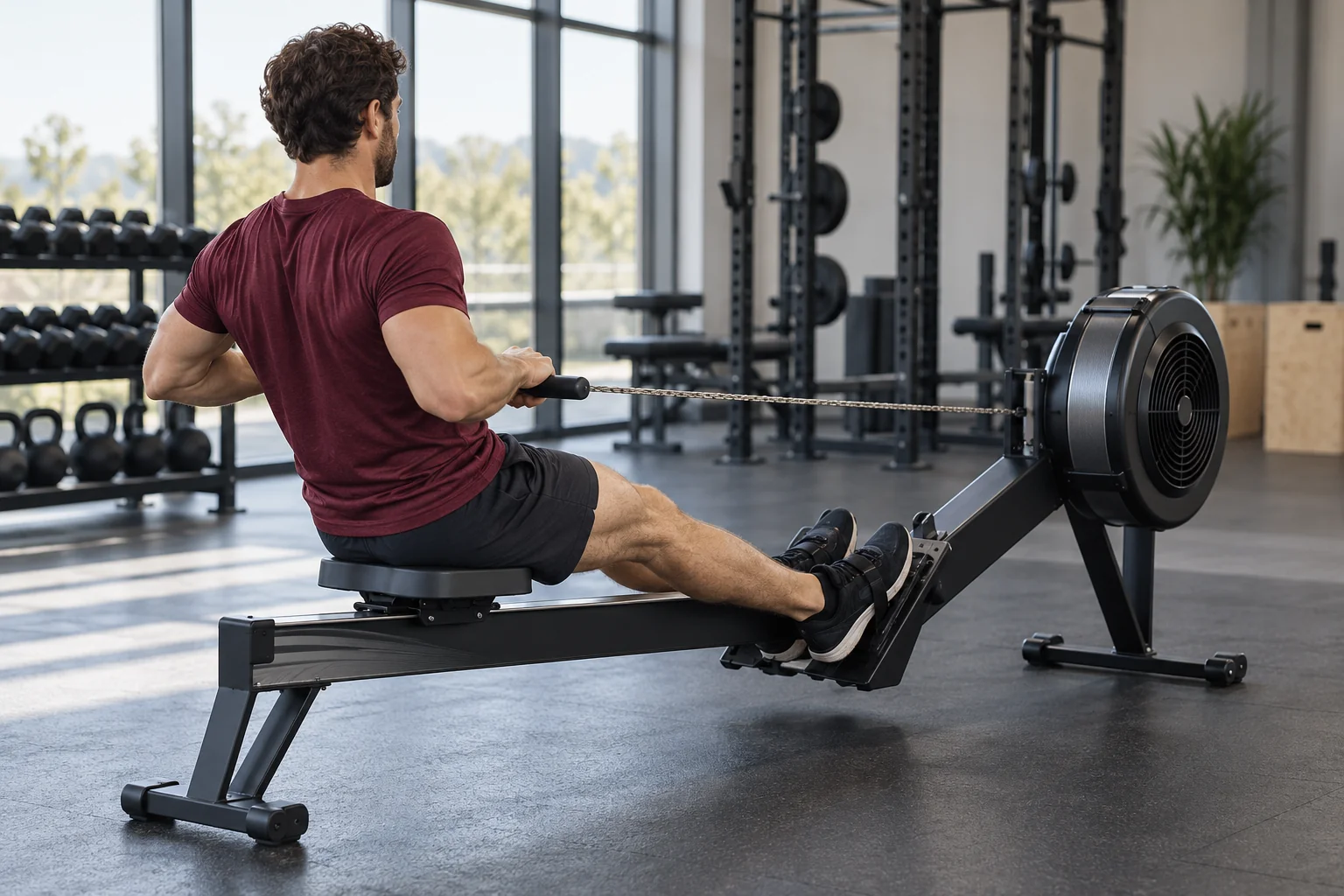
The elbow bend near the end of the drive brings the handle toward the body. Muscles around the upper back, shoulders and arms help control this pull and its return. The arms matter, but they should not have to perform the whole stroke independently. Keep the shoulders relaxed and avoid curling the handle upward. If the forearms burn immediately, check whether you are squeezing excessively or pulling with bent arms before the legs have had a chance to contribute.
For separate upper-body strength work, a pair of adjustable dumbbells (paid link) can support appropriately chosen exercises such as controlled presses and rows. Pick loads and movements that fit your ability, and use instruction when learning them. The point is to add a different training demand, not to copy the rowing action with weights. You may already have suitable gym equipment and need no purchase. Include pushing movements as well as pulling, because the rower's repeated handle pull does not represent a balanced upper-body routine by itself. Use our stroke technique guide when reviewing how the legs and handle connect.
The trunk supports movement without becoming an ab shortcut
Your trunk helps transfer and control force between the legs and the handle. That role requires coordination as the torso changes angle. It does not mean every rowing session is a complete abdominal workout, and it does not make extra backward leaning a sensible way to train the abs harder. Maintain comfortable breathing and a controlled range. Constantly bracing as hard as possible can make the stroke unnecessarily tense and distract from the timing that actually needs practice.
If trunk strength or control is a separate goal, choose appropriate exercises outside the rowing session with an instructor's guidance. A stable exercise mat (paid link) can make suitable floor movements more comfortable, but it does not determine which exercise you should do. Planks, carries and other options involve different positions and demands; none is mandatory for every rower. Select a small number that address your needs and can be performed well. Keep extra work manageable enough that fatigue does not undermine the next rowing session.
The return still requires coordination
During the recovery, the hands move away, the torso hinges forward and the knees bend to bring the seat toward the front. This is the return portion of a continuous cycle, not a moment when all muscular control disappears. You still manage the handle, posture and moving seat. Rushing forward can turn a calm reset into an unstable approach to the catch. Give yourself enough time to arrive comfortably before beginning the next drive.
Because the recovery is part of the stroke, your technique deserves attention on both halves of the cycle. A hard pull followed by a careless return is not better training than a balanced rhythm. If your arms and legs feel out of sync, slow down and practice a few easy strokes. Resist trying to solve the problem by increasing resistance. More force can hide the coordination issue briefly while making the whole session harder to manage.
Separate muscle involvement from muscle growth
Muscle growth depends on an adequate training stimulus over time, recovery and nutrition, among other individual factors. A rowing session may challenge a beginner's muscles in an unfamiliar way, but it should not be advertised as a guaranteed replacement for progressive strength training. Increasing the damper to its maximum does not turn a rower into a full-body weight machine. It changes the feel on some models and may make technique harder to sustain before it creates the intended cardio benefit.
Similarly, soreness cannot tell you which muscles received the best long-term stimulus. You may feel sore after trying a new movement even when the session was modest, or feel little soreness after a productive familiar workout. Record a practical goal in your training journal (paid link), such as maintaining a smooth fifteen-minute easy row or completing a controlled strength session. Observable performance and consistent practice are more informative than seeking soreness as evidence that every part of the body has been trained equally.
Build a week that covers the missing demands
For general health, U.S. activity guidance combines aerobic activity with muscle-strengthening work. Rowing can contribute to the aerobic side at an appropriate effort. Keep suitable strengthening exercises for the major muscle groups, rather than assuming repeated strokes automatically fulfill that separate part of the guidance. Walking, other comfortable movement and balance practice can also remain useful. Variety need not mean a complicated schedule; a few repeatable activities can address different needs without filling every day with formal training.
An example is two manageable rowing sessions and two strength sessions, with walking or ordinary activity around them. This is a scheduling illustration, not a universal prescription or a complete aerobic-minute target. If both activities heavily fatigue your legs or back, reduce one session or separate them. A short easy row can serve a different role from a demanding interval session. Name the purpose before adding it to the week so that every row does not become another hidden hard workout. Our combined rowing and strength schedule explores practical ways to keep both activities.
Check whether rowing suits your actual goal
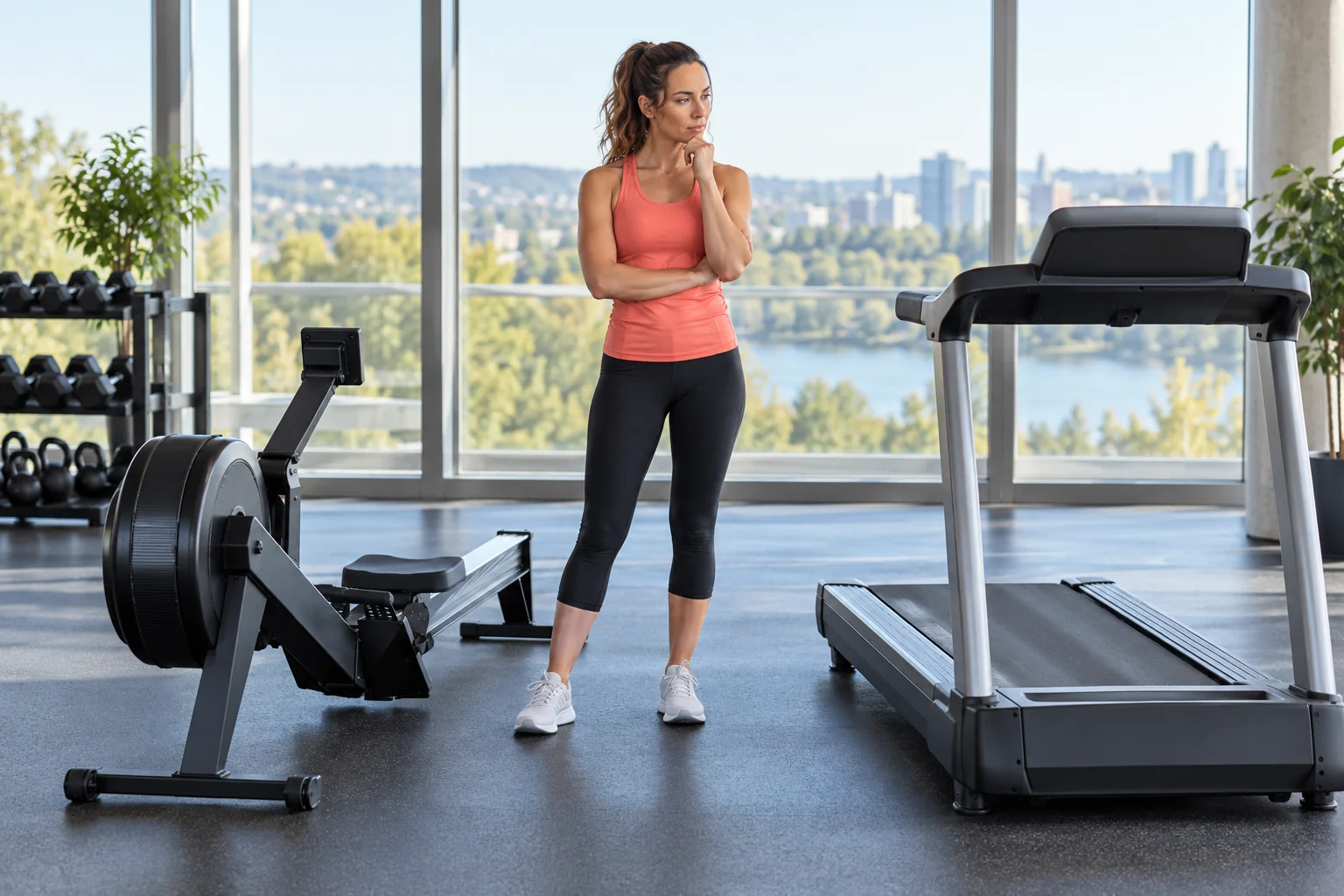
If you want enjoyable indoor cardio, the broad muscle involvement may help make rowing appealing. If you want maximum lifting strength, a rowing-only plan leaves important training gaps. If you are returning after injury, the fact that rowing is seated and usually described as low impact does not establish that it suits your condition. Ask about the repeated joint positions and movement demands involved. A useful decision connects the machine's characteristics to your personal goal and circumstances.
Try several comfortable sessions before judging the activity by a single muscle sensation. Notice whether the stroke becomes smoother, whether you recover adequately and whether the routine fits your week. Keep changes small enough to understand their effect. An exercise can be valuable without covering everything. Treat indoor rowing as one capable part of a wider fitness routine, then choose the additional strength and movement work that makes the whole program more complete.
Practical Options at a Glance
| Situation | Practical option | What to consider |
|---|---|---|
| Leg contribution | Practice a coordinated drive | Repeated effort is different from a strength program. |
| Back discomfort | Reduce demand and seek advice | Pain is not proof of productive muscle work. |
| Balanced training | Keep suitable pushing and other strength work | The rower does not cover every movement. |
Frequently Asked Questions
Rowing asks the legs to contribute repeatedly, but that is not the same as a complete progressive strength program. Keep suitable resistance exercises when leg strength is part of your goal. The useful combination depends on experience and recovery. Tired thighs after rowing do not prove that every strength need has been met.
The trunk contributes to controlling the stroke, but participation does not make rowing a complete abdominal routine. Extra backward leaning is not a shortcut to a better core workout. Choose suitable separate exercises when needed, and keep the rowing movement comfortable rather than exaggerating it to chase a muscle sensation.
The arms finish a stroke that also involves the legs and torso. Immediate arm or grip fatigue can be a reason to review timing and tension at easier effort. Do not simply pull harder. A qualified instructor can help identify whether early arm pulling, excessive gripping or another setup issue is involved.
Safety and Personal Needs
Stop rowing and seek appropriate care for chest pain, faintness or unusual shortness of breath. Persistent or worsening joint or back pain needs assessment before progression. Follow individual advice for health conditions, recent surgery or exercise restrictions. Lower impact does not establish that rowing is suitable for every condition.
This is general educational information. Individual needs vary with health, fitness, mobility and training experience.