Gym Workout Plan for Women Over 40: An 8-Week Strength, Cardio, and Mobility Routine is a practical program for women who want to become stronger without turning every gym visit into an exhausting test. The plan uses repeatable exercises, moderate weekly volume, planned progression, and enough recovery to fit around work, family, sleep, and normal life.
The primary keyword is gym workout plan for women. This guide also supports readers comparing workout plans for women, workout programs for women, a workout routine to build muscle, and a balanced weight loss exercise plan. The goal is not to promise a specific body shape or rapid result. It is to provide a clear structure that can be adjusted for experience, equipment, joint comfort, and qualified medical guidance.
Why Strength Training Becomes More Valuable After 40
Many women reach their forties with years of inconsistent exercise, long periods of sitting, demanding schedules, or routines built almost entirely around cardio. None of that means it is too late to improve. Resistance training can be started or restarted at many ages, and progress still comes from the same fundamentals: appropriate loading, consistent practice, sufficient protein and total nutrition, and recovery between sessions. For a useful comparison, see our Workout Plans for Women Over 50.
Strength work supports the muscles used for carrying groceries, climbing stairs, getting up from the floor, maintaining posture, and performing recreational activities. A program that trains squatting, hinging, pushing, pulling, carrying, and trunk stability creates broader capability than a routine based only on small isolation exercises.
Training after 40 does not require fragile or overly cautious workouts. It does require intelligent dose selection. A useful session should feel challenging enough to stimulate adaptation while leaving the trainee able to recover and repeat the plan. Persistent joint pain, declining performance, poor sleep, and constant soreness are not signs of superior effort; they usually indicate that exercise selection, volume, load, or recovery needs adjustment.
This plan therefore combines three primary strength sessions with one optional cardio-and-mobility day. Women with limited time can complete the three strength days only. Women recovering well can add the fourth day or use it as an easier activity session.
Complete a Readiness Check Before Week One
Before beginning, review current activity, recent injuries, medications, cardiovascular symptoms, balance concerns, and any clinician-imposed restrictions. People with chest discomfort, unexplained shortness of breath, fainting, rapidly worsening pain, recent surgery, or an unstable health condition should obtain appropriate professional advice before starting a new program.
Use the first gym visit to learn equipment settings and establish comfortable ranges. Test a leg press or goblet squat, a hip hinge, a chest press, a row, and a supported core exercise. Choose weights that allow eight controlled repetitions while leaving roughly three good repetitions available. This is deliberately conservative: the first goal is to learn the movements and return for the next session.
Record the exercise, weight, repetitions, machine settings, and one technique cue. A simple notebook or phone note is enough. Objective records prevent accidental jumps in load and make small improvements visible, which is especially useful when progress is occurring gradually.
Program Structure: Four Training Roles, Not Four Maximal Days
Day One emphasizes lower-body strength, horizontal pushing, and upper-back work. Day Two focuses on the hips, vertical pulling, shoulders, and trunk control. Day Three repeats the major patterns with different variations and slightly higher repetitions. The optional fourth day uses moderate cardio, mobility, and light accessory work.
Each strength session begins with a brief warm-up, then places the most technically demanding movement first. Compound exercises are followed by stable machine or dumbbell work, then core training and an optional short conditioning finish. This order protects technique and keeps the session useful even when time is limited.
The plan is written for a typical commercial gym, but most movements have alternatives. A leg press can replace a squat; a machine chest press can replace dumbbells; a cable row can replace a supported dumbbell row. The replacement should train the same movement pattern and feel stable enough to progress.
Weekly Schedule and Recovery Pattern
Place at least one easier day between demanding strength sessions when possible. Monday, Wednesday, and Friday works well, with Saturday used for the optional session. A Tuesday, Thursday, and Sunday arrangement is equally acceptable. The calendar matters less than consistent recovery.
Easy walking can be performed on most days if it does not worsen pain or fatigue. Moderate cardio should feel controlled enough to speak in short sentences. Hard intervals are optional and should not be added simply because a workout feels incomplete without exhaustion.
Sample Weekly Plan
| Day | Main Session | Purpose |
|---|---|---|
| Monday | Workout A: squat pattern, chest press, row, split stance, carry | Whole-body strength foundation |
| Tuesday | Easy walk or rest | Recovery and daily movement |
| Wednesday | Workout B: hinge, pulldown, shoulder press, hip thrust, core | Posterior chain and upper-body strength |
| Thursday | Mobility or complete rest | Joint comfort and recovery |
| Friday | Workout C: full-body variations and controlled conditioning | Practice, muscle endurance, and progression |
| Saturday | Optional Day D: cardio, mobility, and light accessories | Aerobic fitness without excessive fatigue |
| Sunday | Rest and prepare | Sleep, meals, and schedule planning |
Workout A: Lower Body, Chest, and Upper Back
Begin with five to eight minutes of treadmill walking or cycling. Perform eight bodyweight box squats, eight hip hinges, eight wall or bench push-ups, and ten light cable rows. The warm-up should increase temperature and rehearse the session without becoming a workout itself. For the gym workout plan for women over 40, if you want another way to structure the same goal, compare this approach with our Workout Programs for Women.
Use a leg press, goblet squat to a box, or supported squat for three sets of six to ten repetitions. Follow with a machine or dumbbell chest press for three sets of eight to twelve and a seated cable row for three sets of eight to twelve. Rest approximately ninety seconds after compound sets and longer when breathing or technique has not recovered.
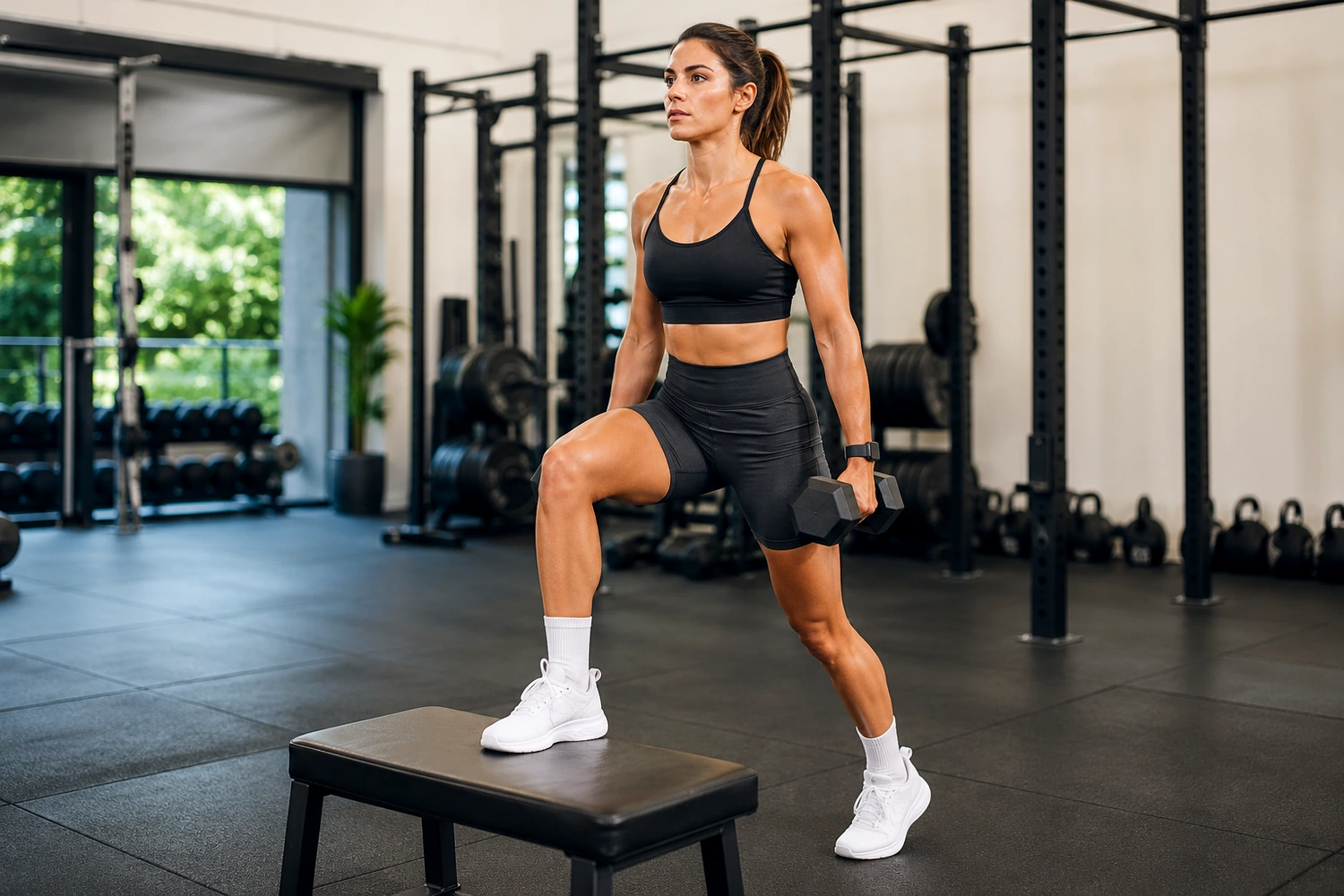
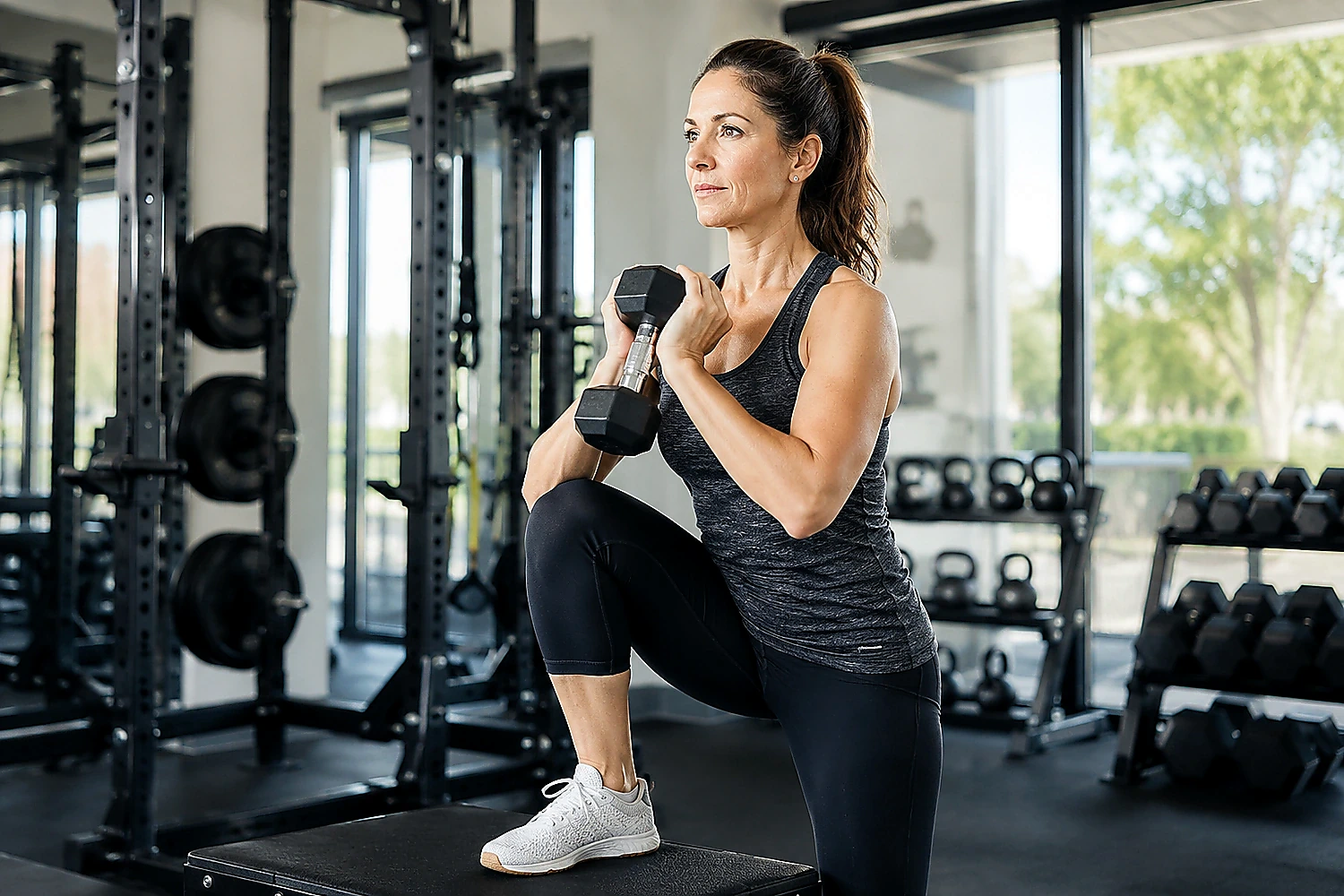
Finish with supported reverse lunges or low step-ups for two sets per side, then a suitcase carry or farmer carry for three short trips. Women with knee discomfort can reduce depth, use a more vertical shin position, select the leg press, or replace lunges with a stable hamstring curl.
Exercise Guide
| Movement Role | Primary Choice | Comfortable Alternative | Key Cue |
|---|---|---|---|
| Squat | Goblet squat to box | Leg press | Use a controlled depth and keep the whole foot supported |
| Hinge | Dumbbell Romanian deadlift | Cable pull-through | Move the hips back while keeping the weights close |
| Horizontal push | Dumbbell bench press | Machine chest press | Keep shoulders supported and wrists stacked |
| Horizontal pull | Seated cable row | Chest-supported dumbbell row | Pull elbows toward the ribs without shrugging |
| Vertical pull | Neutral-grip pulldown | Assisted pull-up | Lead with the elbows and avoid leaning far back |
| Single-leg | Supported reverse lunge | Low step-up | Use support so balance does not limit leg training |
| Core | Pallof press | Dead bug | Exhale and resist unwanted trunk movement |
Workout B: Hips, Pulling Strength, and Shoulder Control
Start with a dumbbell Romanian deadlift or cable pull-through for three sets of eight to ten. Use a range that allows the hips to move back without rounding the lower back. The exercise should create tension through the hamstrings and glutes rather than a sharp sensation in the spine.
Perform a neutral-grip lat pulldown for three sets of eight to twelve, followed by a seated machine shoulder press for two or three sets of eight to twelve. A landmine press is a useful alternative when pressing directly overhead is uncomfortable. Keep the rib cage controlled and avoid turning the last repetitions into a large backbend.
Add a hip thrust or glute bridge for three sets of ten to fifteen, then perform a Pallof press or dead bug. Finish with five to ten minutes of easy incline walking if energy remains. The optional cardio should not reduce the quality of the strength work.
Workout C: Full-Body Strength and Controlled Conditioning
Workout C repeats familiar patterns with moderate repetitions. Use a leg press or split squat, an incline dumbbell press, a chest-supported row, a hamstring curl, and a cable or machine glute exercise. Two or three sets of ten to fifteen repetitions work well for most exercises.
Because the repetitions are higher, begin with slightly lighter weights than on Days A and B. Stop the set when technique changes noticeably or when only one or two clean repetitions remain. The purpose is productive volume, not reaching failure on every exercise.
Finish with six rounds of one minute at a purposeful pace and one minute easy on a bike, elliptical, or treadmill. Beginners can use four rounds. Women who prefer steady cardio can walk for twelve to twenty minutes instead. Both approaches can improve fitness when progressed gradually.
Optional Day D: Cardio, Mobility, and Weak-Point Training
The optional day begins with twenty to thirty minutes of moderate cardio. Choose a mode that feels comfortable and can be repeated: brisk walking, cycling, rowing, elliptical work, or swimming. Keep the intensity below an all-out effort so recovery for the next strength session remains intact.
Follow with ankle mobility, gentle hip flexor stretching, thoracic rotation, and shoulder range work. Add one or two light accessory exercises such as calf raises, lateral raises, cable triceps work, or biceps curls. This is not a hidden fourth maximal workout; it is a flexible session that supports consistency and enjoyment.
How to Progress Across Eight Weeks
Weeks 1 and 2: learn equipment, establish ranges, and use two sets for accessory exercises. Keep approximately three repetitions in reserve. A session that feels slightly easy is acceptable while technique is developing.
Weeks 3 and 4: use three sets on the primary movements and add repetitions within the listed range. When all sets reach the top of the range with stable technique, increase the smallest available weight at the next session.
Weeks 5 and 6: continue small load increases and add the optional cardio day when recovery is good. Avoid increasing sets, weight, cardio duration, and daily steps simultaneously. One meaningful change at a time is easier to evaluate.
Weeks 7 and 8: aim for the strongest clean performance of the cycle, then reduce volume during the final few sessions if fatigue has accumulated. After week eight, repeat the structure with slightly heavier starting loads or change only a few exercises while preserving the movement patterns. For the gym workout plan for women over 40, when adjusting your weekly plan, you can also use the How to Stay Consistent With Workouts as a practical reference.
Cardio, Walking, and Daily Movement
Current public-health guidance recommends that adults work toward a combination of aerobic activity and muscle-strengthening activity. The complete weekly target does not need to be reached immediately. Someone starting from a low activity level can begin with ten-minute walks and build gradually.
For this program, one or two dedicated cardio sessions plus regular walking is enough to start. Use the talk test: moderate effort allows conversation in short sentences, while vigorous effort makes speaking difficult. Most optional cardio in the first month should remain moderate.
Daily movement also matters. Short walks after meals, taking stairs when practical, and standing periodically during desk work can increase activity without creating another formal workout. These habits support a broader fitness routine but should not be treated as punishment for eating.
Nutrition, Protein, Sleep, and Recovery
A gym workout plan for women works best when meals provide adequate energy, protein, produce, carbohydrates, and fluids. Protein supports repair, but more is not automatically better. Distribute protein-containing foods across meals and choose portions that fit overall needs, preferences, and any clinical advice.
Carbohydrates can support training quality, especially around demanding sessions. Whole grains, potatoes, beans, lentils, fruit, and other minimally processed sources can be adjusted according to appetite and activity. Dietary fat also has a role; the practical objective is a balanced pattern rather than eliminating a macronutrient group.
Sleep and stress influence recovery, motivation, and perceived effort. A difficult week may call for lighter loads, fewer sets, or walking instead of intervals. Flexible adjustment protects the long-term routine better than forcing the written plan regardless of circumstances.
Joint-Friendly Modifications and Exercise Substitutions
Knee discomfort does not automatically require avoiding all leg training. Reduce depth, use a supported squat, choose the leg press, adjust foot position, or perform an isometric wall sit if tolerated. The best variation is one that can be performed without worsening symptoms during or after the session.
For shoulder discomfort, use neutral grips, machine presses, landmine presses, and rows with chest support. Avoid forcing range simply to match another person. For lower-back sensitivity, begin with cable pull-throughs, hip thrusts, and supported rows before progressing to unsupported hinging.
Pain that is sharp, worsening, associated with swelling or weakness, or persistent despite modification deserves qualified assessment. Exercise substitutions are useful, but they are not a diagnosis or treatment plan.
Common Mistakes That Slow Progress
- Changing the program every week: frequent novelty makes progress difficult to measure.
- Training every set to failure: constant maximal effort can increase fatigue without improving consistency.
- Adding cardio too quickly: sudden increases can compete with recovery from strength sessions.
- Ignoring technique records: machine settings and useful cues should be written down.
- Using soreness as the score: adaptation can occur without severe next-day discomfort.
- Comparing loads with other people: equipment, limb lengths, experience, and exercise technique differ.
The most effective workout programs for women are usually the ones that make progression visible and attendance realistic. A moderate plan completed for eight weeks will generally provide more useful information than an aggressive plan abandoned after ten days.
Eight-Week Implementation Roadmap
Week 1: complete two or three sessions and learn setup. Week 2: repeat the same exercises and improve control. Week 3: add repetitions before adding weight. Week 4: review soreness, sleep, and schedule adherence.
Week 5: make the smallest sensible load increases. Week 6: add the optional cardio day if recovery is stable. Week 7: aim for strong, technically consistent sets. Week 8: finish the cycle, review the training log, and choose the next progression rather than starting over randomly.
At the end of the cycle, measure success using more than body weight. Useful signs include improved exercise loads, more repetitions, steadier balance, better walking pace, lower perceived effort, more consistent attendance, and increased confidence using gym equipment. For the gym workout plan for women over 40, for more closely related training ideas, browse our workout guides for women.
Frequently Asked Questions
Yes. Begin with two sets, stable machine variations, conservative weights, and three strength days. Add the optional day only when recovery is good.
It can support a broader weight-management approach when paired with an appropriate eating pattern, daily activity, sleep, and consistent habits. No exercise plan guarantees a specific amount of weight loss.
Most strength sessions take about forty-five to sixty-five minutes. Use fewer accessory exercises when time is limited rather than rushing the main movements.
The weight needs to be challenging relative to your current ability, not impressive to someone else. Controlled sets that approach fatigue can be effective across a range of loads.
Yes. The three strength sessions form the core program. Day D is optional and can be replaced with walking or rest.
Adjust the dose. Reduce sets or weight, choose stable exercises, and use easy walking instead of hard conditioning. Seek individualized clinical advice for significant or persistent symptoms.
You can repeat it with slightly heavier starting loads or replace a small number of exercises. Keeping the main movement patterns allows progress to continue.
Safety and Scope
This page provides general educational fitness information. It does not diagnose a condition, prescribe treatment, or replace advice from a physician, physical therapist, registered dietitian, or qualified exercise professional. Stop exercising and seek appropriate care for chest pain, fainting, severe shortness of breath, sudden weakness, or persistent and worsening pain.