Published by Best Fitness Routine. Editorial standards · Report a correction. Educational guidance; no individual clinical review is claimed unless a qualified reviewer is named.
About This Healthy Recipe
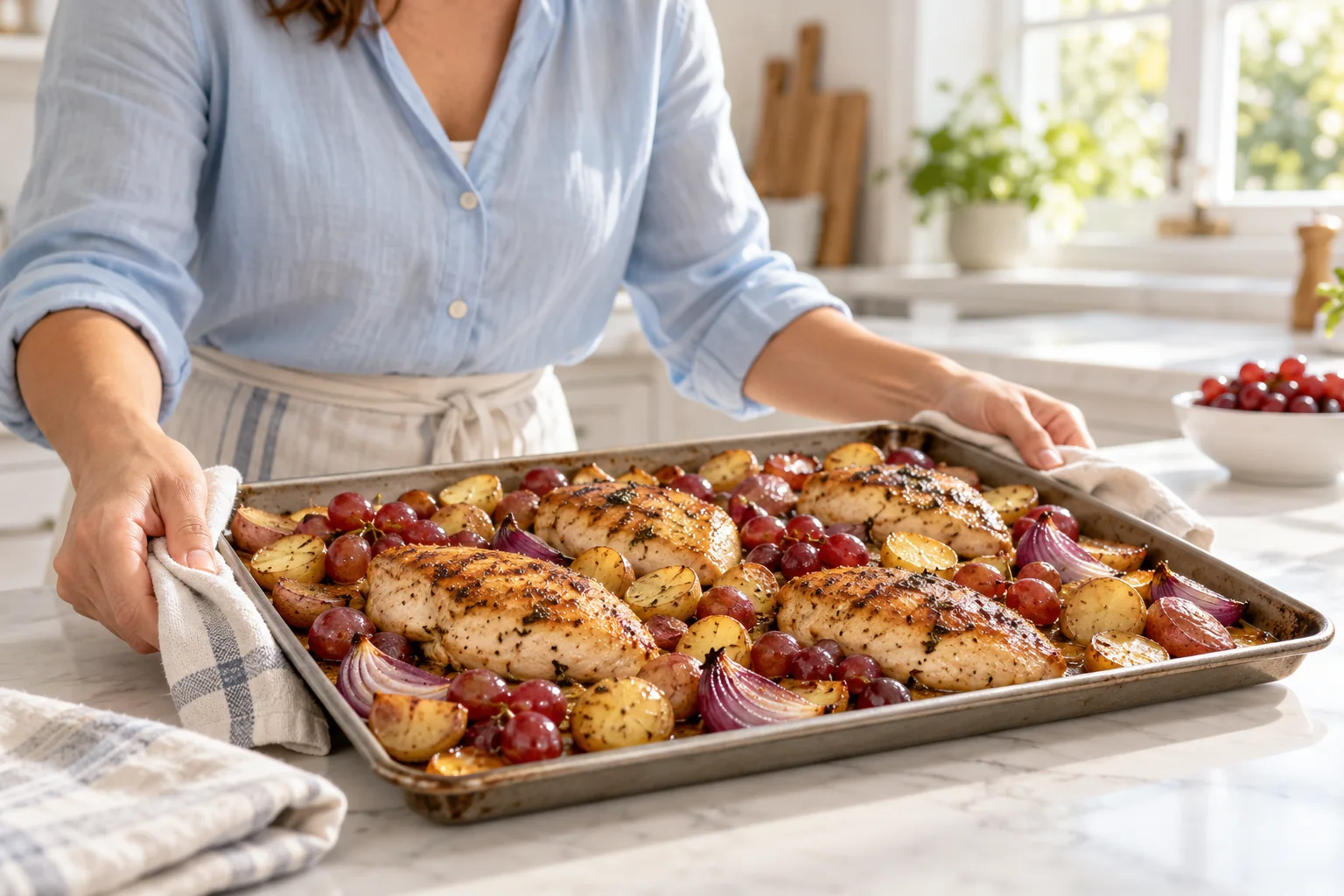
This sheet-pan balsamic chicken dinner combines lean chicken breast with roasted grapes, red onion and baby potatoes. The grapes provide a naturally sweet contrast to the measured vinegar coating, while the potatoes make the four-serving meal more substantial.
Use two roomy trays rather than piling the batch onto one small sheet. The potatoes begin first because they need longer than the chicken. Reserve clean coating for the fruit and vegetables before adding raw poultry to the remainder.
Similar chicken thickness helps the pieces finish together. The grape skins may split as they roast, releasing juices into the coating; that is expected. Keep the final plate balanced by dividing every component, not just the chicken, into four portions.
Why Readers May Like It
- 1Measured portions and clear staged oven cooking.
- 2Clear dry, cooked and drained ingredient weights.
- 3A complete four-serving meal with practical cooking cues.
Recipe Summary and Estimated Nutrition
Nutrition is estimated from the listed ingredient weights and the specific USDA records or manufacturer references linked below. Weights labeled dry, cooked or drained must be matched to that state.
4 servings
One serving is one quarter of the base batch. Values are estimates rather than laboratory analysis.
Per one quarter of the base recipe
Per one quarter of the base recipe
Per one quarter of the base recipe
Per one quarter of the base recipe
Brands, drained weights, substitutions and final serving sizes can change these values.
Ingredient-by-Ingredient Nutrition Breakdown
Gram weights are the calculation basis; household measures are approximate. Cooking water is listed for preparation, and drained water is not included.
| Ingredient | Amount used | Weight | Calories | Protein | Carbs | Fat |
|---|---|---|---|---|---|---|
| Raw boneless skinless chicken breast | 4 pieces, about 5 oz each | 600 g | 720 kcal | 135 g | 0 g | 15.7 g |
| Baby potatoes, raw, halved or quartered | about 1 lb 5 oz | 600 g | 462 kcal | 12.3 g | 104.9 g | 0.5 g |
| Red seedless grapes | about 1 1/2 cups | 240 g | 166 kcal | 1.7 g | 43.4 g | 0.4 g |
| Red onion, thick wedges | 1 large | 200 g | 80 kcal | 2.2 g | 18.7 g | 0.2 g |
| Olive oil | 2 tablespoons | 28 g | 248 kcal | 0 g | 0 g | 28 g |
| Balsamic vinegar | about 3 tablespoons | 50 g | 44 kcal | 0.2 g | 8.5 g | 0 g |
| Garlic, minced | 2 cloves | 8 g | 12 kcal | 0.5 g | 2.6 g | 0 g |
| Dried thyme | about 1 teaspoon | 1 g | 3 kcal | 0.1 g | 0.6 g | 0.1 g |
| Table salt | about 1/3 teaspoon | 2 g | 0 kcal | 0 g | 0 g | 0 g |
| Black pepper | about 1/2 teaspoon | 1 g | 3 kcal | 0.1 g | 0.6 g | 0 g |
| Full recipe estimate | 4 servings | — | 1738 kcal | 152.1 g | 179.3 g | 44.9 g |
How This Nutrition Estimate Was Prepared
- Match each listed ingredient to its linked food record or stated label reference.
- Multiply the per-100-g values by the listed gram weight and add the unrounded ingredient values.
- Divide the full calculation by four servings, then round for the cards.
- Recalculate if you change the ingredient brand, amount or serving yield.
Ingredient cells are rounded independently. The footer sums displayed cells; per-serving cards use the unrounded calculation, so small rounding differences are expected. Cooking-water losses affect finished weight, not the fixed four-serving calculation.
Ingredients
Measured ingredients
Step-by-Step Preparation
As an Amazon Associate I earn from qualifying purchases. Equipment links are paid affiliate links; use suitable tools you already own.
Equipment
- Digital kitchen scale (paid link)
- Chef’s knife (paid link)
- Cutting board (paid link)
- Mixing bowls (paid link)
- Rimmed baking sheet set (paid link)
- Oven gloves (paid link)
- Instant-read food thermometer (paid link)
- Kitchen tongs (paid link)
Before You Start
Use two roomy trays rather than piling the batch onto one small sheet. The potatoes begin first because they need longer than the chicken. Reserve clean coating for the fruit and vegetables before adding raw poultry to the remainder.
Allow about 60 minutes. Components can overlap; use the doneness cues rather than the clock alone. Keep surfaces and utensils clean. The tray size, ingredient state and doneness cues matter more than an exact timer.
Heat the oven and measure the ingredients
10 minutesHeat a conventional oven to 425°F / 220°C, or 400°F / 200°C fan. Use a digital kitchen scale (paid link) for the base gram quantities. Wash grapes and potatoes, cut the potatoes and onion, then prepare chicken on a separate clean surface.
Give potatoes a head start
20 minutesToss potatoes with 14 g oil and half the salt and pepper. Spread across two trays from a rimmed baking sheet set (paid link), allowing space between pieces. Roast for 20 minutes, turning once if the undersides color quickly.
Mix the balsamic coating
3 minutesCombine vinegar, garlic, thyme, remaining 14 g oil and remaining salt and pepper. Reserve one third in a clean small bowl for the grapes and onion before any coating touches raw poultry. Coat the chicken with the other portion.
Arrange poultry and fruit
3 minutesAdd grapes and onion with their reserved coating to the potatoes. Make space for the chicken so pieces lie flat without overlapping. Keep enough open space for steam to escape, dividing evenly between trays.
Roast until cooked through
18–25 minutesRoast until the chicken is cooked and the potatoes are tender, rotating tray positions midway if your oven browns unevenly. If the fruit colors too quickly, cover that area loosely with foil while finishing the chicken.
Check several pieces
2 minutesUse an instant-read food thermometer (paid link) in the thickest part of each chicken piece, away from the pan. Poultry must reach 165°F / 74°C. Test a potato with a fork; it should have no hard center. Continue cooking anything not ready.
Rest and collect the juices
3 minutesLet the cooked chicken rest briefly on a clean serving area. Keep the cooked grapes, onion and potatoes together with the fully heated tray juices. Do not reuse the raw preparation board for slicing.
Portion the complete tray meal
2 minutesUse clean kitchen tongs (paid link) to divide chicken equally among four plates, then share all potatoes, grapes, onion and cooked juices equally. Slice chicken if helpful for even portions.
How to Know It Is Ready
Every chicken piece reaches 165°F / 74°C; potatoes are tender.
Juicy chicken, softened grapes, browned potato edges.
One quarter of all chicken, potatoes, fruit, onion and cooked juices.
What This Meal Provides and What to Consider
Meal Balance
- The measured batch supplies about 38 g protein per serving.
- Vegetables and the listed grain or legume portions make this a full meal, rather than a protein-only snack.
Things to Consider
- Contains no deliberately added wheat or dairy, but check vinegar and packaged ingredient labels for your needs.
- Vinegar and grape sweetness vary. This recipe uses measured amounts and does not claim a low-sugar or weight-loss outcome.
Who May Enjoy This Recipe?
Sheet-pan meal planning
People looking for a practical meal with a measured grain, protein or legume component.
Home cooking
Similar chicken thickness helps the pieces finish together. The grape skins may split as they roast, releasing juices into the coating; that is expected. Keep the final plate balanced by dividing every component, not just the chicken, into four portions.
Measured portions
People who want to understand how ingredient weights relate to a four-serving batch.
How to Adjust the Meal
Smaller appetite
Serve a smaller portion and save the rest. Recalculate nutrition for the portion you actually eat rather than labeling an unchanged serving low-calorie.
Larger appetite
Add vegetables or another suitable accompaniment, and include those ingredients in the meal calculation.
Protein adjustments
If changing raw boneless skinless chicken breast, check its product label and recalculate. A larger amount may also change texture and cooking requirements.
Substitutions, Dietary Notes, and Allergens
Practical Substitutions
- Use green seedless grapes at the same weight; the color and sweetness change.
- Use yellow onion at the same weight while retaining the wedge size and cooking checks.
Allergen Information
Contains no deliberately added wheat or dairy, but check vinegar and packaged ingredient labels for your needs.
Check packaged ingredient labels for the allergens relevant to you. A substitution changes both the recipe and the calculation.
Storage and Meal Preparation
Refrigerate perishable food within 2 hours, or within 1 hour when the surroundings exceed 90°F (32°C). Use shallow containers and a refrigerator at 40°F (4°C) or colder. Use cooked leftovers within 3–4 days; reheat hot leftovers to 165°F (74°C). Keep clean ready-to-eat sauces separate when that helps preserve texture.
Frequently Asked Questions
Boneless thighs need their own timing and nutrition calculation. Keep the safe poultry temperature of 165°F / 74°C, but do not assume the breast estimate or listed cooking interval remains accurate.
Crowding or very wet vegetables can trap moisture. Dry the washed ingredients, use the two specified roomy trays and leave gaps rather than making a deep layer.
The listed ingredients provide an estimated 38 g protein per one quarter of the batch. Brands and portions can change this value.
Use the 2× or 3× control for gram quantities and serving count. Keep the per-serving estimate as a base guide; use larger cookware or batches and check doneness rather than multiplying the cooking time.
Nutrition Sources and Recipe Notes
These values are planning estimates, not individualized nutrition advice. Use the labels for your exact products when precision is important. The recipe has not been kitchen-tested and the image is a generated illustration of the intended dish.
Nutrition Data Sources
See our Nutrition Calculation Methodology for weights, rounding and substitutions.
Food Safety Reference
Recipe development note: this page does not claim independent kitchen testing. The image is illustrative and does not document a tested result. Ingredient-based nutrition estimates can change with brands, weighing state, preparation and serving size; use exact labels when precision matters.
Useful Tools for This Recipe
As an Amazon Associate I earn from qualifying purchases. The links below are paid affiliate links.
These are the tools used in the preparation above. Use suitable equipment you already own, or compare options if you need an item.
Digital kitchen scale
Weigh the gram quantities used in the ingredient calculation.
Compare on Amazon →Paid link · opens in a new tabChef’s knife
Cut the recipe ingredients into the specified sizes.
Compare on Amazon →Paid link · opens in a new tabCutting board
Use a clean preparation surface and separate raw meat from ready-to-eat food.
Compare on Amazon →Paid link · opens in a new tabMixing bowls
Keep wet mixtures, coatings or fillings organized during preparation.
Compare on Amazon →Paid link · opens in a new tabRimmed baking sheet set
Use two roomy half-sheet pans, about 18 × 13 inches / 46 × 33 cm each, or more trays when needed; avoid deep crowded layers.
Compare on Amazon →Paid link · opens in a new tabOven gloves
Protect your hands when moving the hot tray or oven-safe pan.
Compare on Amazon →Paid link · opens in a new tabInstant-read food thermometer
Check the stated safe center temperature rather than relying on surface color alone.
Compare on Amazon →Paid link · opens in a new tabKitchen tongs
Handle the ingredient described in the method; clean after contact with raw food.
Compare on Amazon →Paid link · opens in a new tab