Published by Best Fitness Routine. Editorial standards · Report a correction. Educational guidance; no individual clinical review is claimed unless a qualified reviewer is named.
About This Healthy Recipe
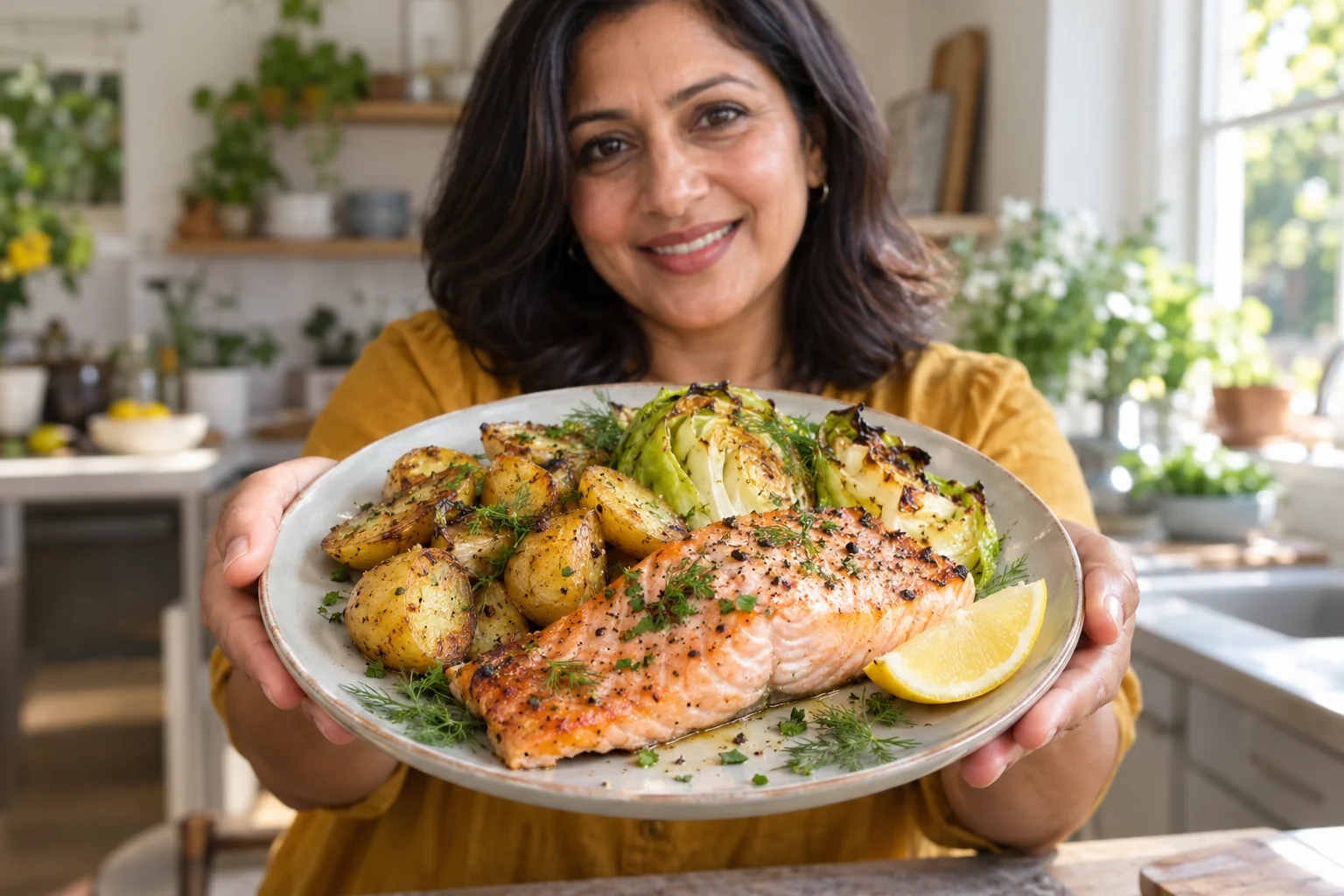
This salmon cabbage tray bake gives the vegetables a head start before fish enters the oven. Thin cabbage wedges and halved baby potatoes roast on one tray while the salmon waits refrigerated. Lemon and dill are added as a clean finishing dressing, not reused raw-fish marinade.
Salmon is weighed raw without skin and pin bones; potatoes and cabbage are raw edible weights. Wild and farmed salmon references differ in fat and energy.
All 28 g oil is counted, including clean finishing dressing. Do not reuse a raw-fish bowl as a sauce bowl. For another preparation, see Sheet-Pan Maple-Dijon Salmon with Sweet Potatoes and Broccolini.
Why Readers May Like It
- 1Measured portions, clear cooking guidance and practical doneness checks.
- 2Clear dry, cooked and drained ingredient weights.
- 3Four measured portions with cabbage, sauces and all listed sides included.
Recipe Summary and Estimated Nutrition
Nutrition is estimated from the listed ingredient weights and the specific USDA records or manufacturer references linked below. Weights labeled dry, raw, cooked or drained must be matched to that state.
4 servings
One serving is one quarter of the base batch. Values are estimates rather than laboratory analysis.
Per one quarter of the base recipe
Per one quarter of the base recipe
Per one quarter of the base recipe
Per one quarter of the base recipe
Brands, drained weights, substitutions and final serving sizes can change these values.
Ingredient-by-Ingredient Nutrition Breakdown
Gram weights are the calculation basis; household measures are approximate. The table includes all listed oil, sauce and toppings. All measured oil, sauces and sides are included. Discarded soaking, pressing or cooking water is not counted as consumed food.
| Ingredient | Amount used | Weight | Calories | Protein | Carbs | Fat |
|---|---|---|---|---|---|---|
| Atlantic farmed salmon, raw, skin and pin bones removed, four 150 g fillets | about 1 lb 5 oz edible raw fish | 600 g | 1248 kcal | 122.5 g | 0 g | 80.5 g |
| Green cabbage, raw, trimmed into 8 thin wedges | about 8 wedges of 100 g | 800 g | 200 kcal | 10.2 g | 46.4 g | 0.8 g |
| Baby potatoes with skin, raw, washed and halved | about 1 lb 12 oz | 800 g | 616 kcal | 16.4 g | 139.9 g | 0.7 g |
| Olive oil: 16 g vegetables, 8 g fish, 4 g dressing | about 2 tablespoons total | 28 g | 248 kcal | 0 g | 0 g | 28 g |
| Fresh lemon juice for finishing dressing | about 2 tablespoons plus 2 teaspoons | 40 g | 9 kcal | 0.1 g | 2.8 g | 0.1 g |
| Fresh dill, washed and chopped | about 1/3 cup loose | 16 g | 7 kcal | 0.6 g | 1.1 g | 0.2 g |
| Garlic, raw, peeled and minced | about 2 cloves | 8 g | 12 kcal | 0.5 g | 2.6 g | 0 g |
| Ground black pepper | about 1/2 teaspoon | 1 g | 3 kcal | 0.1 g | 0.6 g | 0 g |
| Table salt: 2 g vegetables, 1 g fish | about 1/2 teaspoon total | 3 g | 0 kcal | 0 g | 0 g | 0 g |
| Full recipe estimate | 4 servings | — | 2343 kcal | 150.4 g | 193.4 g | 110.3 g |
How This Nutrition Estimate Was Prepared
- Match each listed ingredient to its linked food record or stated label reference.
- Multiply the per-100-g values by the listed gram weight and add the unrounded ingredient values.
- Divide the full calculation by four servings, then round for the cards.
- Recalculate if you change the ingredient brand, amount or serving yield.
Ingredient cells are rounded independently. The footer sums displayed cells; per-serving cards use the unrounded calculation, so small rounding differences are expected. Final cooking yield and brands can change the estimate.
Ingredients
Measured ingredients
Step-by-Step Preparation
As an Amazon Associate we earn from qualifying purchases. Equipment links are paid affiliate links; use suitable tools you already own.
Equipment
- Two rimmed metal trays (paid link)
- Thin-probe food thermometer (paid link)
- Wide fish spatula (paid link)
- Digital kitchen scale (paid link)
- Chef knife and cutting board (paid link)
- Mixing bowls (paid link)
- Measuring spoons (paid link)
Before You Start
Salmon is weighed raw without skin and pin bones; potatoes and cabbage are raw edible weights. Wild and farmed salmon references differ in fat and energy.
Allow about 65 minutes for preparation, cooking all batches and any stated resting. Some tasks overlap; doneness checks take priority over the clock. Measure the listed oil before cooking and keep the sides within the stated four portions. Use the raw, dry, cooked or drained state specified for each ingredient.
Preheat and prepare vegetables
10 minutes plus oven heatingHeat oven to 425°F / 220°C conventional or 390°F / 200°C fan with upper- and lower-middle racks. Wash potatoes and halve them to pieces no thicker than about 2.5 cm. Cut cabbage into eight thin wedges, keeping a narrow core strip attached. Weigh the trimmed edible vegetables. A digital kitchen scale (paid link) helps keep the measured quantities consistent.
Start the vegetable tray
5 minutesToss potatoes and cabbage with 16 g oil, 2 g salt, garlic and half the pepper on a large rimmed metal tray. Spread potatoes cut-side down and wedges on their cut faces without stacking. If the tray is crowded, use a second vegetable tray and allow more oven space rather than pile food.
Roast and turn vegetables
20–25 minutesRoast vegetables on the lower-middle rack for 20–25 minutes, turning wedges and potatoes after about 15 minutes. Potatoes should be partly tender before the salmon enters. Thick potato pieces need a longer head start; do not shorten their cooking to match the fish.
Make a clean finishing dressing
2 minutes overlapping vegetablesBefore handling raw fish, mix all lemon juice, chopped dill and 4 g oil in a clean bowl (paid link). Set aside with a clean spoon, away from the fish board. This dressing is not brushed onto raw salmon or put back in contact with raw utensils.
Prepare the salmon tray
5 minutesKeep fish chilled until needed. Check the four 150 g raw fillets for pin bones on a separate board. Coat with the remaining 8 g oil, 1 g salt and remaining pepper. Put them on a separate rimmed metal tray, leaving gaps. Wash hands and clean raw-fish equipment.
Roast fish while vegetables finish
12–16 minutes, longer if neededPut salmon on the upper-middle rack and continue roasting for about 12–16 minutes. Rotate trays if browning unevenly. If vegetables finish sooner, remove and hold hot; if fish finishes sooner, remove it to a clean plate while potatoes continue. Do not force both components to finish at the same minute.
Check fish and potato centers
2 minutes within final cookingCheck thickest fish centers with a thin-probe thermometer for 145°F / 63°C. Continue cooking and recheck any underdone fillet. A knife should enter potato and cabbage cores easily without raw firmness. Check several pieces, especially at the center of a crowded tray.
Finish four plates
2 minutesGive each plate one fully cooked salmon fillet, two cabbage wedges and a quarter of all potatoes. Spoon one quarter of the clean lemon-dill dressing over each, including loose cabbage leaves and measured oil-containing tray juices. Serve promptly.
How to Know It Is Ready
Salmon thick centers reach 145°F / 63°C; potatoes and cabbage cores are knife-tender.
Moist cooked salmon, tender potatoes with browned cut faces and soft cabbage cores with crisp edges.
One quarter of the complete recipe, including all listed sides, oil, dressing and sauce.
What This Meal Provides and What to Consider
Meal Balance
- The measured batch supplies about 37.6 g protein per serving.
- Cabbage, the listed protein or legumes, accompaniments and measured cooking oil are included in the portion.
Things to Consider
- Contains fish. Check any packaged salmon or seasonings for additional allergens and handling requirements.
- Energy, sodium and saturated fat still depend on ingredients and portion size. This meal does not guarantee a particular fitness or health result.
Who May Enjoy This Recipe?
Cabbage meal planning
Home cooks looking for a measured seafood lunch or dinner.
Home cooking
All 28 g oil is counted, including clean finishing dressing. Do not reuse a raw-fish bowl as a sauce bowl.
Measured portions
People who want to understand how ingredient weights relate to a four-serving batch.
How to Adjust the Meal
Smaller appetite
Serve a smaller portion and save the rest safely. Recalculate nutrition for the portion you actually eat.
Larger appetite
Choose an appropriate larger portion or accompaniment and include those ingredients in the meal calculation.
Protein adjustments
If changing the main ingredients or listed sides, use its product label and recalculate. The amount can also change texture and cooking requirements.
Substitutions, Dietary Notes, and Allergens
Practical Substitutions
- Another fish needs its own raw reference and appropriate cooking method; thickness affects time. Parsley can replace dill by weight with an updated estimate.
- Changing the protein, cabbage cut or accompaniment changes cooking time, texture and nutrition. Follow safe handling and doneness guidance for the replacement and recalculate the estimate.
Allergen Information
Contains fish. Check any packaged salmon or seasonings for additional allergens and handling requirements.
Check packaged ingredient labels for the allergens relevant to you. A substitution changes both the recipe and the calculation.
Storage and Meal Preparation
Refrigerate perishable food within 2 hours, or within 1 hour when surroundings exceed 90°F / 32°C. Use shallow containers and a refrigerator at 40°F / 4°C or colder. Follow the component-specific storage limits below; rice has a shorter storage window where specified. Reheat hot leftovers to 165°F / 74°C.
Keeping This Cabbage Meal
Refrigerate cooked fish and vegetables in shallow containers within 2 hours, or within 1 hour above 90°F / 32°C. Keep at 40°F / 4°C or below and use within 2 days, following an earlier ingredient use-by date. Store leftover clean dressing separately. For best texture, freeze cooled fish and vegetables separately for up to 1 month; cabbage softens after thawing.
Reheating the Meal
Thaw frozen portions in the refrigerator. Reheat only the portion needed, covered loosely in a moderate oven or suitable microwave dish, until fish and vegetables reach 165°F / 74°C throughout. Check several places and turn or rearrange as needed. Salmon becomes firmer during reheating; do not reduce the temperature target to retain its original softness.
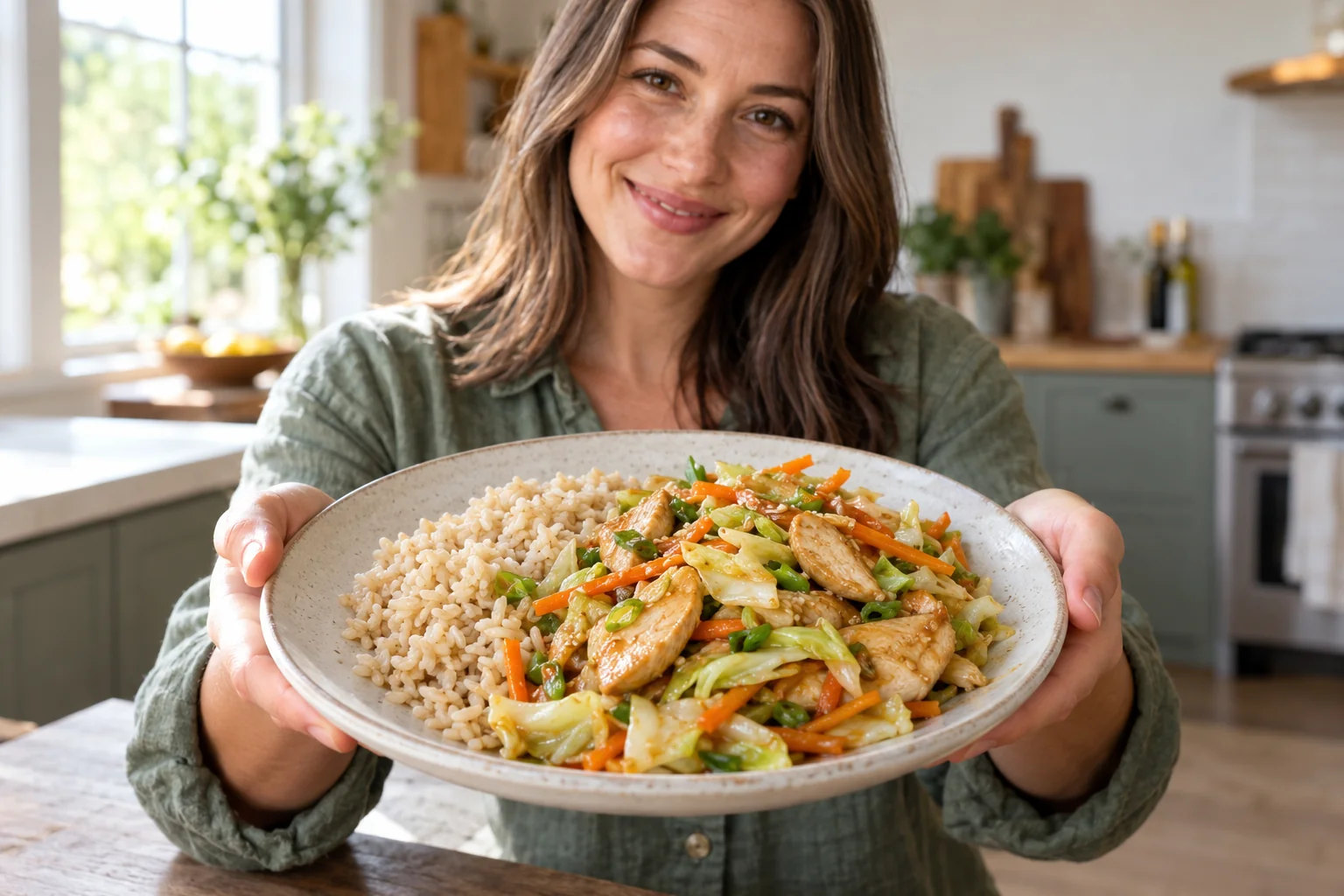
Follow USDA leftovers guidance. For another meal idea, browse Ginger Chicken and Cabbage Stir-Fry with Brown Rice.
Frequently Asked Questions
Only if it fits in one uncrowded layer after the vegetable head start. A crowded tray slows cooking; the two-tray method here is more manageable for the listed amounts.
Potatoes need a head start and even small pieces. Remove cooked fish safely and continue vegetables rather than overcook the salmon to wait for hard potatoes.
Thaw safely in the refrigerator and follow package instructions. Drain, pat dry and weigh edible raw fillets; do not assume the listed time applies to a frozen center.
Use the serving controls to scale gram quantities and serving count. Use additional trays or cook more batches; cooking time does not simply double. Household notes describe the base four-serving recipe.
Nutrition Sources and Recipe Notes
These values are planning estimates, not individualized nutrition advice. Use labels for your exact products when precision is important. The recipe has not been kitchen-tested and the image is a generated illustration of the intended dish.
Nutrition Data Sources
See our Nutrition Calculation Methodology for weights, rounding and substitutions.
Food Safety Reference
Useful Tools for This Recipe
As an Amazon Associate we earn from qualifying purchases. Equipment links are paid affiliate links; use suitable tools you already own.
These tools fit the preparation above. Use suitable equipment you already own, or compare options if you need an item.
Two rimmed metal trays
Separates vegetables and fish for staggered cooking.
Compare on Amazon → (paid link)Paid link · opens in a new tabThin-probe food thermometer
Checks salmon centers and reheated leftovers.
Compare on Amazon → (paid link)Paid link · opens in a new tabWide fish spatula
Lifts cooked fillets without breaking them.
Compare on Amazon → (paid link)Paid link · opens in a new tab