Published by Best Fitness Routine. Editorial standards · Report a correction. Educational guidance; no individual clinical review is claimed unless a qualified reviewer is named.
What this calculator estimates
The calculator estimates exercise fluid loss from the change in body mass, adjusted for fluid consumed and urine passed during the same session. It treats one kilogram of mass change as approximately one liter of water. This is a field estimate, not a laboratory measurement of sweating or a medical diagnosis.
Sweat rate changes with weather, intensity, clothing and acclimatization. Measure more than one representative session before using the result in a discussion about hydration. The output does not measure sodium loss and does not tell you to drink exactly that volume each hour.
Calculate Your Sweat Rate
Use kilograms, litres and minutes. Measure under similar conditions with dry clothing. This estimate is not a prescribed drinking target.
Estimated sweat loss = pre-exercise mass − post-exercise mass + fluid consumed − urine produced. Approximately 1 kg of mass change is treated as 1 litre of fluid.
How to collect usable measurements
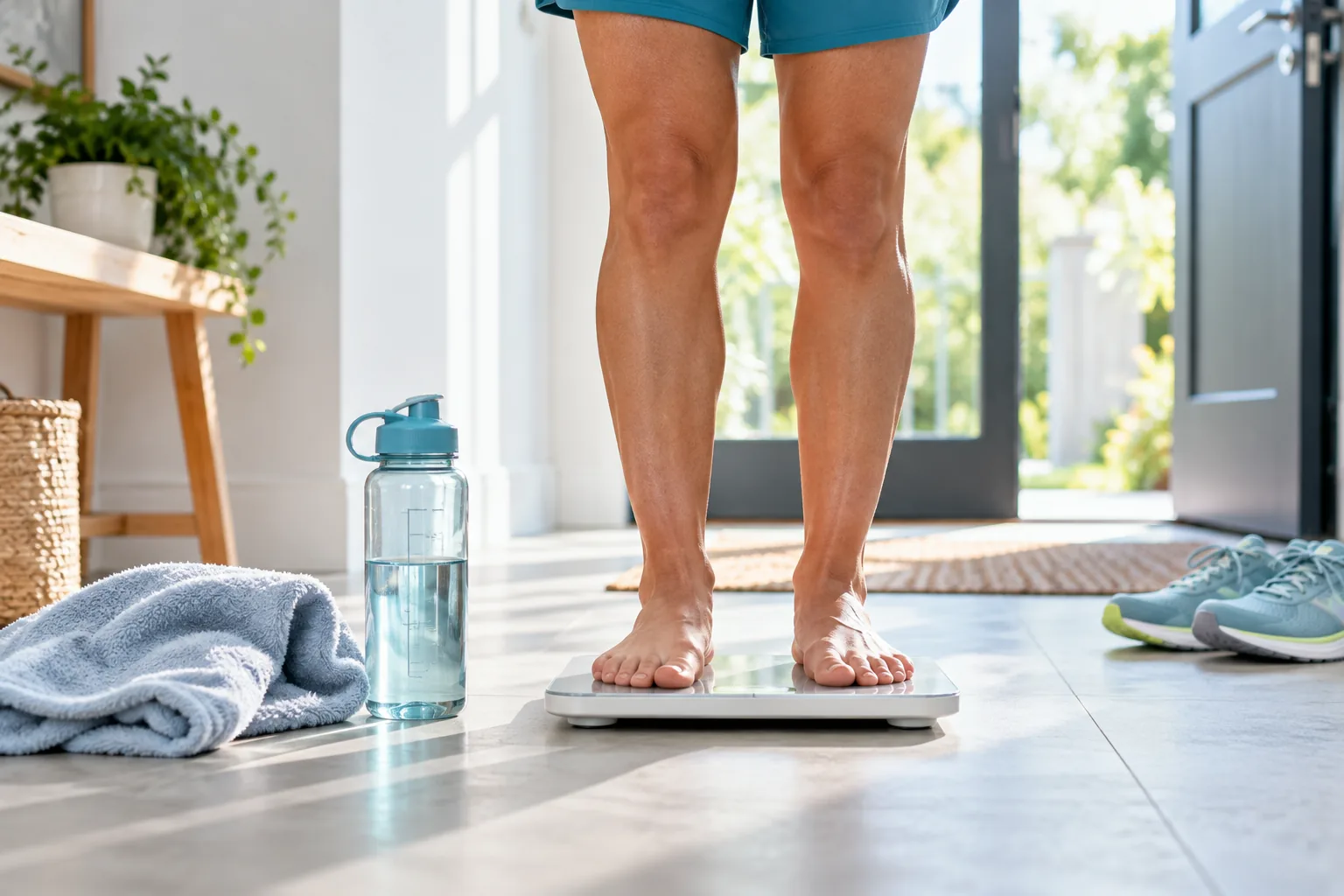
Weigh yourself before and after exercise using the same digital bathroom scale, on a firm level surface, with comparable minimal dry clothing. After the session, dry off first. Wet clothing adds mass and can hide some fluid loss. Do not undress where privacy or safety is compromised.
Track fluid consumed with a water bottle whose usable volume is known; estimate what remains rather than counting a bottle you did not finish. Record urine passed during the measurement period if applicable. A training journal helps keep body mass, duration and conditions together instead of reconstructing them later.
Formula and worked example
Estimated loss in liters = pre-exercise kilograms − post-exercise kilograms + liters drunk − liters of urine. Divide that loss by session hours. Urine is subtracted because it contributes to weight change without being sweat. Consistent units are essential.
Example: 70.0 kg before, 69.4 kg after, 0.5 L consumed, no urine and 60 minutes gives 1.1 L estimated loss and 1.1 L/hour. Drinking 0.5 L did not erase that fluid turnover; it is included in the adjustment. This example demonstrates arithmetic, not a replacement recommendation.
Understand errors before changing your drinking
Scale precision, food consumed, wet kit and unrecorded toilet stops can affect the estimate. Longer sessions also introduce non-sweat mass changes that this simple model does not fully represent. If the calculated loss is negative, check your entries rather than interpreting it as “negative sweating.”
Use the result alongside thirst, conditions and professional guidance when needed. Do not intentionally overdrink to match or exceed the number. Body-mass gain across exercise can signal that fluid intake exceeded losses, but the calculator cannot diagnose a fluid or electrolyte disorder.
Prepare a consistent measurement session
Choose an ordinary training session and describe the conditions: temperature, whether you were indoors, approximate effort and clothing. Keep the measurement process manageable so you can repeat it later. Use the same reliable scale before and after, placed on a firm, level surface according to its instructions. Weigh under comparable conditions and avoid introducing a large clothing difference between measurements. Wet clothing can complicate the interpretation of a post-exercise weight. A consistent digital bathroom scale (paid link) is an optional tool for this measurement method; follow its setup instructions.
Before starting, decide how you will measure drinks and any urine produced during the session. A bottle with volume markings or a measured amount prepared in advance can help. Record only what you actually consume, not the amount originally packed. If you refill the bottle, include the refill and subtract what remains. The calculator cannot identify these details afterward. Careful input is more useful than displaying several decimal places from measurements that were mostly guessed.
Convert pounds and fluid ounces before entering values
The calculator uses kilograms and litres. If your scale shows pounds, convert the number before entering it: one pound is approximately 0.454 kilograms. For example, a difference of about 2.2 pounds is approximately one kilogram. Use the same conversion for both body-mass readings and keep enough precision to describe the change sensibly. Do not enter a pounds reading into a kilograms field, because the resulting estimate would describe the wrong units.
For drinks, one thousand millilitres equals one litre. A five-hundred-millilitre bottle is therefore half a litre. Fluid ounces require care because US and UK imperial fluid ounces differ: a US fluid ounce is approximately 29.6 millilitres, while a UK imperial fluid ounce is approximately 28.4 millilitres. Check which measure your container uses. Bottles sold in Canada, Australia, New Zealand and much of Europe commonly show metric volumes, which can make entry simpler. Use actual volume rather than assuming every cup has the same capacity.
Walk through an example step by step
Suppose the pre-exercise reading is seventy kilograms and the post-exercise reading is sixty-nine point four kilograms. The measured decrease is six-tenths of a kilogram. If you consumed half a litre and produced no urine during the measured period, the formula adds that drink volume to the mass decrease. The estimated sweat loss is therefore one point one litres. Over sixty minutes, that corresponds to an estimated sweat rate of one point one litres per hour.
Now suppose the same session included two-tenths of a litre of urine. Subtract that amount, because it is a different fluid loss accounted for by the formula. The estimate becomes nine-tenths of a litre over the hour. If duration changes, the hourly rate changes even when total estimated loss stays the same. These are arithmetic examples to explain the calculator, not recommended drinking amounts. Your input and the measurement limitations determine how useful the result is. A water bottle (paid link) with clear volume markings can simplify recording the drink actually consumed.
Troubleshoot unusual or negative results
A negative sweat-loss estimate means the entered values do not support a usable estimate with this formula. Recheck the before and after readings, unit conversions, actual drinking volume and urine entry. Consider whether you ate, changed clothes or used a different scale between measurements. Do not reverse values simply to produce a positive number. An implausible result is a reason to examine the process rather than to treat the calculator output as an accurate description of your body.
Very small measured changes can also be difficult to interpret when scale precision is limited. If the scale only reports broad increments, rounding can have a noticeable effect on a short session. Similarly, an estimated drink volume can overwhelm a small body-mass change. Try improving measurement consistency on another appropriate day instead of assuming a highly precise rate from uncertain inputs. The calculator does not diagnose a medical problem or distinguish every possible contributor to body-mass change during exercise.
Repeat measurements under relevant conditions
A sweat-rate estimate belongs to the session in which it was measured. A cool indoor workout and a warm outdoor run may produce different observations. You do not need to collect numbers for every day, but a few carefully measured, comparable sessions can show whether the estimate is reasonably consistent. Record conditions alongside the result. Without that context, a saved number may later be applied to a workout that has very different demands. A training journal (paid link) can store the conditions alongside the estimate so you do not lose that context.
Avoid turning repeated testing into pressure to manipulate body mass. The purpose is to understand a practical exercise measurement, not to chase the lowest post-workout weight. Do not deliberately avoid fluids, wear extra layers or extend exercise to create a more dramatic result. If weighing causes distress or you have a history of disordered eating, choose a different approach with professional support. An optional calculator should make planning clearer rather than create an unhealthy monitoring ritual.
Use the estimate as information rather than a prescription
The result can help you discuss fluid access and session planning, but it does not automatically specify what you must drink each hour. Your circumstances, thirst, intake tolerance and medical needs matter. It also does not measure sodium concentration or establish an electrolyte requirement. Keep the question modest: what does this approximate measurement suggest about this session, and what other information is needed before changing the plan? A single output should not override symptoms or professional advice.
For an event with demanding conditions, take your observations to a qualified sports professional who can consider the wider picture. Describe the method, route, weather, drinks and any symptoms rather than supplying only the final number. Avoid copying someone else's rate because you share a body size or run the same distance. Individual variation and different conditions can make that misleading. The calculator is most useful when measurements are consistent, limitations are understood and the result supports a sensible discussion about exercise hydration.
Keep a measurement note that another person can understand
Write the inputs beside the result rather than saving only the final hourly rate. Include pre-exercise mass, post-exercise mass, fluid consumed, urine produced where measured and session duration. State the units for every number. Add a short description of conditions and any detail that may have reduced accuracy, such as wet clothing or estimated bottle refills. This makes the record useful later and allows a sports professional to see how the estimate was produced. A number without its method can look more certain than it deserves.
When comparing sessions, check that the measurement approach stayed similar. If one session used dry clothing and another used a soaked shirt, the difference in results may partly reflect the method. If one drink amount was carefully measured and another was guessed, do not treat both estimates as equally reliable. You can improve the next measurement without trying to correct old inputs after the fact. Record uncertainty honestly. A less precise estimate with clear limitations is more useful than a highly specific figure created by assuming every unknown amount was exact.
Use the record to discuss practical needs such as reliable access to drinks on a particular route. Avoid converting it directly into a rule to replace every calculated litre immediately, and never use it to justify drinking through severe discomfort or concerning symptoms. Repeat measurements only when they help answer a sensible question about your training conditions. You do not need to monitor every workout indefinitely. The calculator's value comes from a careful, limited estimate that supports better planning; it does not replace personal health advice or provide a complete description of exercise hydration.
Practical Options at a Glance
| Situation | Practical option | What to consider |
|---|---|---|
| Pre/post body mass | Kilograms on the same scale | Use comparable dry clothing |
| Drink/urine volumes | Liters during the session | Count only the measurement period |
| Time | Minutes of exercise | Rate is loss divided by hours |
Frequently Asked Questions
Urine contributes to body-mass loss but is not sweat. Subtracting it helps separate the estimated losses.
No. It is an estimate to inform planning, not an automatic drinking prescription. Consider conditions, thirst and qualified advice.
No. It estimates fluid loss only; sweat sodium concentration is not measured.
Safety and Personal Needs
Do not use this tool to diagnose dehydration, heat illness or low blood sodium. Confusion, collapse, severe headache or repeated vomiting during exercise needs urgent care. Follow clinical fluid limits if prescribed.
This is general educational information. Individual needs vary with health, medications, training and food tolerance.