Published by Best Fitness Routine. Editorial standards · Report a correction. Educational guidance; no individual clinical review is claimed unless a qualified reviewer is named.
About This Healthy Recipe
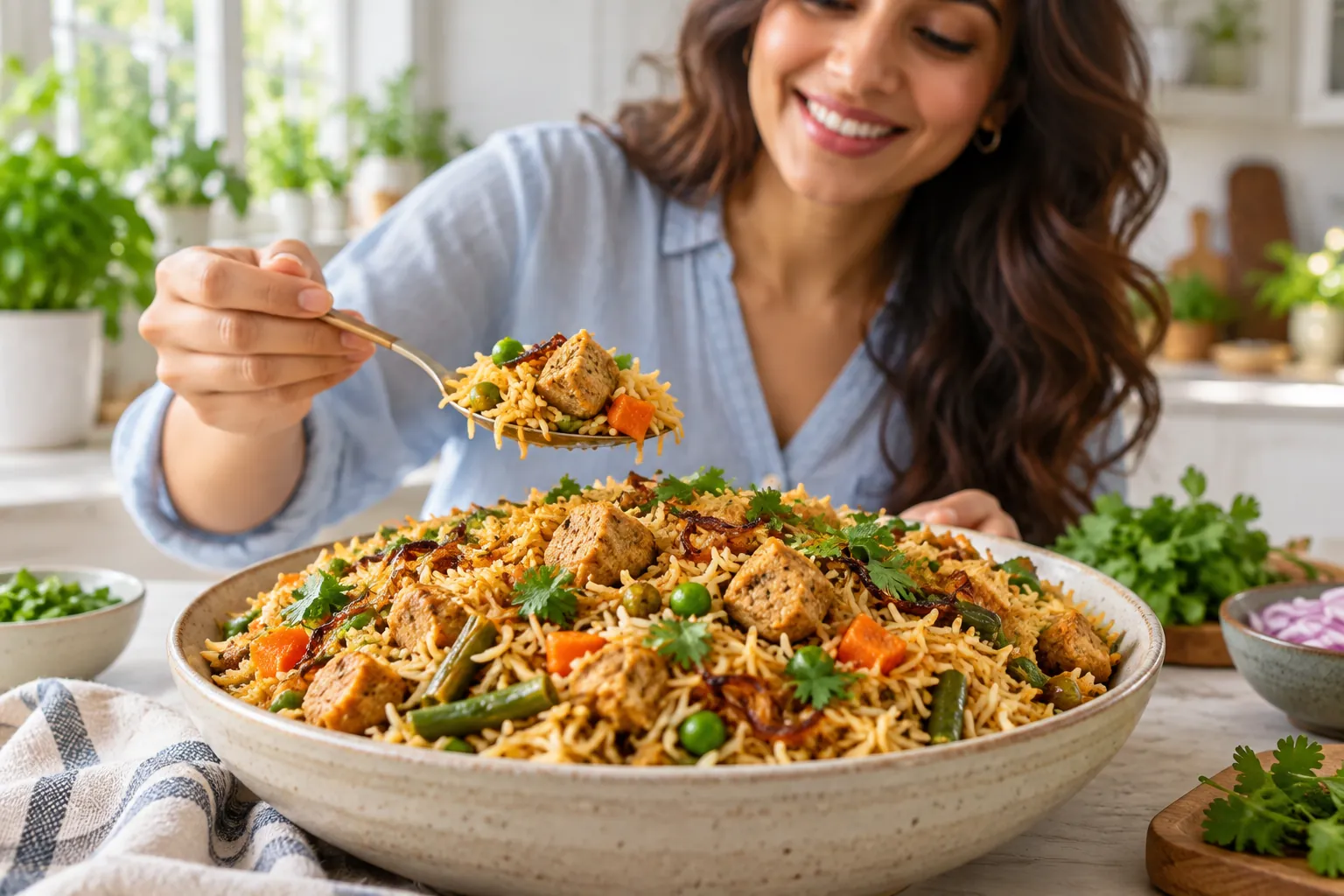
Soy chunk biryani uses textured soy as its main protein and brown basmati rice as the grain. Carrots, beans and peas make the pot a complete vegetarian meal. This is a practical home-cooking adaptation with measured oil, not a restaurant-style oil-heavy biryani.
Rice and soy chunks are measured dry. The soy is hydrated and squeezed before it enters the pot. Nutrition for soy chunks uses a dry textured-soy label as a stated proxy; chunk products can differ, so the label on your pack is the better source.
Brown basmati brands require different liquid ratios and cooking times. Check the package and use the tenderness cue rather than stopping when a timer rings. The rice should separate when fluffed, with no hard center.
Why Readers May Like It
- 1A measured vegetarian protein source.
- 2Clear dry, cooked and drained ingredient weights.
- 3A complete four-serving meal with practical cooking cues.
Recipe Summary and Estimated Nutrition
Nutrition is estimated from the listed ingredient weights and the specific USDA records or manufacturer references linked below. Weights labeled dry, cooked or drained must be matched to that state.
4 servings
One serving is one quarter of the base batch. Values are estimates rather than laboratory analysis.
Per one quarter of the base recipe
Per one quarter of the base recipe
Per one quarter of the base recipe
Per one quarter of the base recipe
Brands, drained weights, substitutions and final serving sizes can change these values.
Ingredient-by-Ingredient Nutrition Breakdown
Gram weights are the calculation basis; household measures are approximate. Cooking water is listed for preparation, and drained water is not included.
| Ingredient | Amount used | Weight | Calories | Protein | Carbs | Fat |
|---|---|---|---|---|---|---|
| Dry soy chunks | about 6 1/3 oz | 180 g | 626 kcal | 93.9 g | 70.4 g | 0 g |
| Dry brown basmati rice | about 1 1/2 cups | 280 g | 1028 kcal | 21.1 g | 213.5 g | 9 g |
| Carrots, diced | about 1 1/2 cups | 200 g | 82 kcal | 1.9 g | 19.2 g | 0.5 g |
| Green beans, trimmed and chopped | about 2 cups | 200 g | 62 kcal | 3.7 g | 13.9 g | 0.4 g |
| Green peas | about 1 cup | 150 g | 122 kcal | 8.1 g | 21.7 g | 0.6 g |
| Onion, sliced | 1 large | 180 g | 72 kcal | 2 g | 16.8 g | 0.2 g |
| Tomatoes, diced | about 1 1/2 cups | 250 g | 45 kcal | 2.2 g | 9.7 g | 0.5 g |
| Olive oil | 1 tablespoon | 14 g | 124 kcal | 0 g | 0 g | 14 g |
| Garlic | 4 cloves | 12 g | 18 kcal | 0.8 g | 4 g | 0.1 g |
| Ginger | about 1 1/2 tablespoons grated | 20 g | 16 kcal | 0.4 g | 3.6 g | 0.1 g |
| Curry powder | about 1 tablespoon | 8 g | 26 kcal | 1.1 g | 4.5 g | 1.1 g |
| Ground cumin | about 1 1/2 teaspoons | 3 g | 11 kcal | 0.5 g | 1.3 g | 0.7 g |
| Table salt | about 1/3 teaspoon | 2 g | 0 kcal | 0 g | 0 g | 0 g |
| Cilantro | small handful | 10 g | 2 kcal | 0.2 g | 0.4 g | 0.1 g |
| Water for the rice | 750 ml | 750 g | 0 kcal | 0 g | 0 g | 0 g |
| Full recipe estimate | 4 servings | — | 2234 kcal | 135.9 g | 379 g | 27.3 g |
How This Nutrition Estimate Was Prepared
- Match each listed ingredient to its linked food record or stated label reference.
- Multiply the per-100-g values by the listed gram weight and add the unrounded ingredient values.
- Divide the full calculation by four servings, then round for the cards.
- Recalculate if you change the ingredient brand, amount or serving yield.
Ingredient cells are rounded independently. The footer sums displayed cells; per-serving cards use the unrounded calculation, so small rounding differences are expected. Cooking-water losses affect finished weight, not the fixed four-serving calculation.
Dry soy-chunk nutrition uses a dry textured-soy protein label as a proxy. Use the label for your actual chunks when precision matters.
Ingredients
Measured ingredients
Step-by-Step Preparation
As an Amazon Associate I earn from qualifying purchases. Tool links below are paid links.
Equipment
- Heavy lidded pot (paid link)
- Fine sieve
- Knife, board and scale
Before You Start
Rice and soy chunks are measured dry. The soy is hydrated and squeezed before it enters the pot. Nutrition for soy chunks uses a dry textured-soy label as a stated proxy; chunk products can differ, so the label on your pack is the better source.
Allow 75 minutes overall. Component steps can overlap; check doneness and package directions rather than relying only on time.
Hydrate soy and rinse rice
10 minutesRehydrate soy chunks in hot water following the package directions. Drain, cool enough to handle and squeeze gently. Rinse brown rice separately. Weigh the listed ingredient quantities with a digital kitchen scale (paid link) before starting this step.
Soften the onion
7 minutesHeat oil in a heavy lidded pot (paid link) and cook sliced onion until soft and lightly golden. Stir in garlic, ginger, cumin and curry powder for 30 seconds.
Add vegetables and rice
3 minutesAdd tomatoes, carrots, green beans and drained soy. Stir in rinsed rice and measured salt until coated with the aromatic mixture.
Simmer covered
40–45 minutesAdd the measured rice water and bring to a boil. Cover, turn to low and cook until the rice is tender. Add peas for the last 8 minutes. Check the rice package for a different liquid ratio.
Rest and fluff
5 minutesTake the pot off the heat and rest covered for 5 minutes. Fluff carefully with a fork and fold in cilantro.
Divide into portions
2 minutesDistribute rice, soy chunks and vegetables evenly into four bowls. Cool meal-prep portions promptly in shallow containers.
How to Know It Is Ready
Rice is tender with no hard center.
Soy chunks are hydrated and vegetables are tender.
Each portion contains an even share of soy and rice.
What This Meal Provides and What to Consider
Meal Balance
- The measured batch supplies about 34 g protein per serving.
- Vegetables and the listed grain or legume portions make this a full meal, rather than a protein-only snack.
Things to Consider
- Contains soy. Dry soy chunks are not interchangeable gram-for-gram with hydrated chunks.
- This is not a low-carbohydrate dish; rice is a deliberate part of the meal.
Who May Enjoy This Recipe?
Vegetarian meal planning
People looking for a meat-free meal with a clearly defined protein source.
Home cooking
Brown basmati brands require different liquid ratios and cooking times. Check the package and use the tenderness cue rather than stopping when a timer rings. The rice should separate when fluffed, with no hard center.
Measured portions
People who want to understand how ingredient weights relate to a four-serving batch.
How to Adjust the Meal
Smaller appetite
Serve a smaller portion and save the rest. Recalculate nutrition for the portion you actually eat rather than labeling an unchanged serving low-calorie.
Larger appetite
Add vegetables or another suitable accompaniment, and include those ingredients in the meal calculation.
Protein adjustments
If changing dry soy chunks, check its product label and recalculate. A larger amount may also change texture and cooking requirements.
Substitutions, Dietary Notes, and Allergens
Practical Substitutions
- Use a different mix of carrots, green beans and peas by equal total weight.
- Use white basmati only with its shorter cooking time and new nutrition calculation.
Allergen Information
Contains soy. Dry soy chunks are not interchangeable gram-for-gram with hydrated chunks.
Check packaged ingredient labels for the allergens relevant to you. A substitution changes both the recipe and the calculation.
Storage and Meal Preparation
Refrigerate perishable food within 2 hours, or within 1 hour when the surroundings exceed 90°F (32°C). Use shallow containers and a refrigerator at 40°F (4°C) or colder. Use cooked leftovers within 3–4 days; reheat hot leftovers to 165°F (74°C). Keep raw salad components and dressings separate when that improves texture.
Frequently Asked Questions
Brown basmati needs enough liquid and a gentle covered simmer. Add a little hot water and continue cooking until tender, following the package guidance.
They may not have hydrated fully. Follow the packet instructions, then squeeze them gently before simmering them in the rice mixture.
The listed ingredients provide an estimated 34 g protein per one quarter of the batch. Brands and portions can change this value.
Use the 2× or 3× control for gram quantities and serving count. Keep the per-serving estimate as a base guide; use larger cookware or batches and check doneness rather than multiplying the cooking time.
Nutrition Sources and Recipe Notes
These values are planning estimates, not individualized nutrition advice. Use the labels for your exact products when precision is important. The recipe has not been kitchen-tested and the image is a generated illustration of the intended dish.
Nutrition Data Sources
See our Nutrition Calculation Methodology for weights, rounding and substitutions.
Food Safety Reference
Recipe development note: this page does not claim independent kitchen testing. The image is illustrative and does not document a tested result. Ingredient-based nutrition estimates can change with brands, weighing state, preparation and serving size; use exact labels when precision matters.