Published by Best Fitness Routine. Editorial standards · Report a correction. Educational guidance; no individual clinical review is claimed unless a qualified reviewer is named.
About This Healthy Recipe
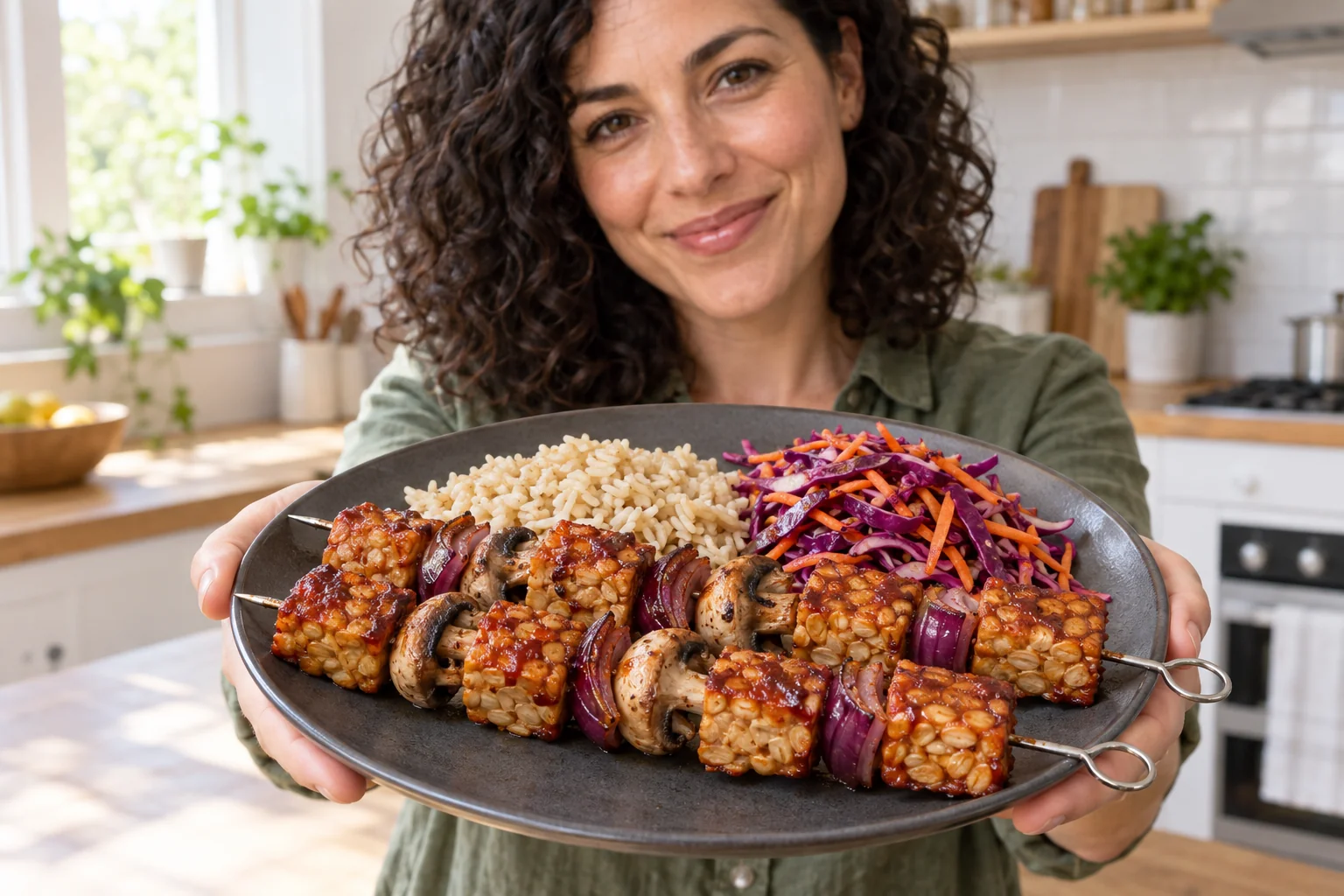
BBQ tempeh and mushroom skewers pair nutty soy tempeh with tender button mushrooms and red onion. A measured tomato-vinegar glaze gives the skewers their sweet-tart barbecue flavor. Brown rice and a crisp red-cabbage and carrot slaw complete the plate, with all oil and glaze measured for four servings.
The tempeh amount is the as-sold plain product before heating. The explicit label basis supplies all seven displayed nutrients; a different brand, flavored product or cooked weight needs recalculation.
All homemade sauce ingredients and both halves of the sauce are counted, including coating that may remain on a utensil. The serving half stays separate from the skewer bowl from the start. For another preparation, see Sheet-Pan Peanut Tempeh with Broccoli and Sweet Potatoes.
Why Readers May Like It
- 1Measured portions, clear cooking guidance and practical doneness checks.
- 2Clear dry, cooked and drained ingredient weights.
- 3Four measured meal portions with skewers, sauces and listed sides included.
Recipe Summary and Estimated Nutrition
Nutrition is estimated from the listed ingredient weights and the specific USDA records or manufacturer references linked below. Weights labeled dry, raw, cooked or drained must be matched to that state.
4 servings
One serving is one quarter of the base batch. Values are estimates rather than laboratory analysis.
Per one quarter of the base recipe
Per one quarter of the base recipe
Per one quarter of the base recipe
Per one quarter of the base recipe
Brands, drained weights, substitutions and final serving sizes can change these values.
Ingredient-by-Ingredient Nutrition Breakdown
Gram weights are the calculation basis; household measures are approximate. The table includes all listed oil, sauce and toppings. All listed marinades, oil, sauces and sides are included. The estimate counts the full measured amounts, even if some remain on cooking equipment. Discarded plain cooking water is not counted as food.
| Ingredient | Amount used | Weight | Calories | Protein | Carbs | Fat |
|---|---|---|---|---|---|---|
| Plain soy tempeh, as sold before heating; Tofurky Treehouse label reference | about 1 lb 5 oz; use your package label for a revised estimate | 600 g | 1200 kcal | 105.9 g | 91.8 g | 42.4 g |
| Small white button mushrooms, raw, cleaned, stems trimmed | about 16–24 small mushrooms | 400 g | 88 kcal | 12.4 g | 13 g | 1.4 g |
| Red onion, raw, peeled and separated into short two-layer petals | about 1 medium-large | 160 g | 64 kcal | 1.8 g | 14.9 g | 0.2 g |
| Long-grain brown rice, dry | about 7/8 cup dry | 180 g | 661 kcal | 13.6 g | 137.2 g | 5.8 g |
| Water: 450 g rice and 80 g barbecue sauce | about 2 1/4 cups total | 530 g | 0 kcal | 0 g | 0 g | 0 g |
| Crushed canned tomatoes, including their liquid | about 1 cup; regular-sodium reference | 240 g | 77 kcal | 3.9 g | 17.5 g | 0.7 g |
| Apple cider vinegar for the sauce | 2 tablespoons plus 2 teaspoons | 40 g | 8 kcal | 0 g | 0.4 g | 0 g |
| Pure maple syrup for the sauce | about 1 tablespoon plus 2 teaspoons | 32 g | 83 kcal | 0 g | 21.5 g | 0 g |
| Reduced-sodium soy sauce made from soy and wheat | about 1 1/2 tablespoons | 24 g | 14 kcal | 2.2 g | 1.3 g | 0.1 g |
| Ground paprika for the sauce | about 1 tablespoon | 6 g | 17 kcal | 0.8 g | 3.2 g | 0.8 g |
| Garlic, raw, peeled and finely grated | about 3 cloves | 12 g | 18 kcal | 0.8 g | 4 g | 0.1 g |
| Red cabbage, raw, core removed and finely shredded | about 4 1/2 cups shredded | 400 g | 124 kcal | 5.7 g | 29.5 g | 0.6 g |
| Carrot, raw, trimmed and finely shredded | about 2 medium-large | 200 g | 82 kcal | 1.9 g | 19.2 g | 0.5 g |
| Fresh lime juice for the slaw | 2 tablespoons plus 2 teaspoons | 40 g | 10 kcal | 0.2 g | 3.4 g | 0 g |
| Olive oil: 6 g trays, 14 g skewers, 4 g slaw | about 1 tablespoon plus 2 teaspoons total | 24 g | 212 kcal | 0 g | 0 g | 24 g |
| Table salt: 1 g rice and 1 g slaw | about 1/3 teaspoon total | 2 g | 0 kcal | 0 g | 0 g | 0 g |
| Full recipe estimate | 4 servings | — | 2658 kcal | 149.2 g | 356.9 g | 76.6 g |
How This Nutrition Estimate Was Prepared
- Match each listed ingredient to its linked food record or stated label reference.
- Multiply the per-100-g values by the listed gram weight and add the unrounded ingredient values.
- Divide the full calculation by four servings, then round for the cards.
- Recalculate if you change the ingredient brand, amount or serving yield.
Ingredient cells are rounded independently. The footer sums displayed cells; per-serving cards use the unrounded calculation, so small rounding differences are expected. Final cooking yield and brands can change the estimate.
Ingredients
Measured ingredients
Step-by-Step Preparation
As an Amazon Associate we earn from qualifying purchases. Equipment links are paid affiliate links; use suitable tools you already own.
Equipment
- Instant-read food thermometer (paid link)
- Eight all-metal oven-safe skewers (paid link)
- Two rimmed metal baking sheets (paid link)
- Digital kitchen scale (paid link)
- Lidded saucepan (paid link)
- Small saucepan (paid link)
- Chef knife and cutting board (paid link)
- Mixing bowls (paid link)
- Kitchen tongs (paid link)
- Oven mitts (paid link)
Before You Start
The tempeh amount is the as-sold plain product before heating. The explicit label basis supplies all seven displayed nutrients; a different brand, flavored product or cooked weight needs recalculation.
Allow about 95 minutes for preparation, cooking all batches and any stated resting. Some tasks overlap; doneness checks take priority over the clock. Measure the listed oil before cooking and keep the sides within the stated four portions. Use the raw, dry, cooked or drained state specified for each ingredient.
Start the rice and tomato glaze
About 55–60 minutes rice including boil-up, simmer and 10-minute rest; sauce simmers 8–10 minutes concurrentlyRinse 180 g dry brown rice and combine in a lidded saucepan with 450 g water and 1 g salt. Bring to a boil, cover and simmer for 35–45 minutes or as its packet directs, then rest covered off the heat for 10 minutes. In a separate small saucepan mix crushed tomatoes, all 80 g sauce water, vinegar, maple syrup, soy sauce, paprika and garlic. Simmer for 8–10 minutes, stirring, until lightly thickened. A digital kitchen scale (paid link) helps keep the measured quantities consistent.
Divide the clean sauce and prepare tempeh
6 minutesBefore the sauce touches any skewer ingredients, divide it into two equal shares in clean bowls. Cover one half for serving. Cut 600 g plain soy tempeh, weighed as sold before heating, into pieces about 2 cm thick that will hold on the skewers. This recipe uses the named plain-soy label reference rather than a cooked weight or flavored bacon-style product.
Coat and briefly rest the skewer ingredients
4 minutes coating plus 15 minutes refrigerated rest; oven preheats concurrentlyCombine the tempeh, cleaned small mushrooms and two-layer onion petals with 14 g oil and the designated coating half of the sauce. Fold gently and refrigerate for 15 minutes. During this period preheat the oven to 425°F / 220°C conventional, or 390°F / 200°C fan, with racks in the upper and lower middle; allow about 15 minutes for heating.
Make the cabbage-carrot slaw
6 minutes during the refrigerated restToss the measured shredded red cabbage and carrot with the lime juice, remaining 4 g oil and 1 g salt in a clean mixing bowl (paid link). Refrigerate until plating. Keep the slaw separate from the skewer coating so it remains crisp and has its own measured dressing rather than absorbing an uncounted extra barbecue sauce.
Thread eight skewers across two trays
10 minutesBrush two rimmed metal baking sheets with 3 g oil each. Divide the tempeh, mushrooms and onion among eight all-metal oven-safe skewers, leaving small gaps. Spread the coating left in its bowl over these skewers before baking. Arrange four per tray in a single layer; cook any small pieces that do not fit beside their assigned skewer rather than crowding the metal shafts.
Roast and rotate for even heating
25–30 minutes total, turning halfwayRoast for about 25–30 minutes total, turning carefully at 12–15 minutes and swapping trays between rack positions and front to back. Use oven mitts and tongs. Mushrooms should soften and release much of their moisture, and the tempeh should be hot through. Check the thickest tempeh centers for 165°F / 74°C, following any stricter package instruction; dark glaze alone does not establish center temperature.
Heat the reserved sauce and finish rice
3–5 minutes near the end of roastingWarm the untouched serving half of the sauce in its clean saucepan until steaming, keeping it separate from coating utensils. Fluff the rice once tender and keep covered and hot at 140°F / 60°C or above if waiting briefly. Transfer the finished skewers using clean tongs to clean serving plates, remembering that their metal handles remain hot.
Divide the complete meal and serve
3 minutesGive each plate two skewers, one quarter of the rice and one quarter of the slaw with its dressing. Divide all reserved clean sauce across the four portions, serving it beside the skewers or over them at the table. Slide food off the skewers before eating if preferred. The planning allowance includes preheating, a 15-minute refrigerated coating and 5-minute rice rest; longer packet cooking requirements take priority.
How to Know It Is Ready
Tempeh centers reach 165°F / 74°C or a stricter package requirement, mushrooms and onion are softened, rice is tender and the reserved clean sauce is heated separately.
Hot firm tempeh with softened mushrooms and onion, a lightly glossy tomato glaze, brown rice and crisp red-cabbage carrot slaw.
One quarter of the skewers, listed sides, sauce and measured oil.
What This Meal Provides and What to Consider
Meal Balance
- The measured batch supplies about 37.3 g protein per serving.
- Skewers, listed accompaniments and measured cooking oil are included in the complete portion.
Things to Consider
- Contains soy in tempeh and soy sauce, and wheat in the specified soy sauce. Some tempeh products include other grains or allergens; check the actual package and cross-contact information.
- Energy, sodium and saturated fat still depend on ingredients and portion size. This meal does not guarantee a particular fitness or health result.
Who May Enjoy This Recipe?
Skewer meal planning
Home cooks looking for a measured vegan lunch or dinner.
Home cooking
All homemade sauce ingredients and both halves of the sauce are counted, including coating that may remain on a utensil. The serving half stays separate from the skewer bowl from the start.
Measured portions
People who want to understand how ingredient weights relate to a four-serving batch.
How to Adjust the Meal
Smaller appetite
Serve a smaller portion and save the rest safely. Recalculate nutrition for the portion you actually eat.
Larger appetite
Choose an appropriate larger portion or accompaniment and include those ingredients in the meal calculation.
Protein adjustments
If changing the main protein, marinade or side, use its product label and recalculate. The amount can also change texture and cooking requirements.
Substitutions, Dietary Notes, and Allergens
Practical Substitutions
- Use a different plain soy tempeh only with its own label-based calculation and cooking instructions. A suitable certified gluten-free sauce may change sodium and other nutrients; it does not remove soy from the tempeh.
- Changing the protein, piece size or marinade changes cooking time and nutrition. Follow the safe doneness guidance for the replacement and recalculate the estimate.
Allergen Information
Contains soy in tempeh and soy sauce, and wheat in the specified soy sauce. Some tempeh products include other grains or allergens; check the actual package and cross-contact information.
Check packaged ingredient labels for the allergens relevant to you. A substitution changes both the recipe and the calculation.
Storage and Meal Preparation
Refrigerate perishable food within 2 hours, or within 1 hour when surroundings exceed 90°F / 32°C. Use shallow containers and a refrigerator at 40°F / 4°C or colder. Follow the component-specific storage limits below; rice has a shorter storage window where specified. Reheat hot leftovers to 165°F / 74°C.
Keeping This Skewer Meal
Slide cooked food off the metal skewers into shallow containers so it cools promptly. Refrigerate cooked components and perishable sauces separately within 2 hours, or within 1 hour above 90°F / 32°C. Keep at 40°F / 4°C or below and use within 2 days, following an earlier ingredient use-by date and counting from the earliest cooked component. Do not leave a deep warm pan on the counter until it is completely cold. For the rice, divide into shallow portions and cool quickly, ideally within 1 hour; refrigerate and use within 24 hours. Do not leave it in the warm cooking pan to cool. This shorter rice limit applies to any portion stored already mixed with rice. Store the slaw separately from rice, tempeh and sauce.
Reheating the Meal
Remove metal skewers before using a microwave. Reheat only the portion needed in a covered oven-safe or vented microwave-safe dish until 165°F / 74°C throughout, checking several places and turning or stirring where possible. Reheat only once and serve immediately; keep cold salad and yogurt sauce chilled and add after heating. Reheat rice once only until steaming hot throughout and 165°F / 74°C, with no cold spots. Poor storage cannot be corrected by reheating.
Follow USDA leftovers guidance. For another skewer and accompaniment combination, browse Greek Yogurt Chicken Skewers in the Oven with Bulgur.
Frequently Asked Questions
Follow the specific package. The manufacturer reference used here says the product is not fully cooked and must reach 165°F / 74°C, which is the endpoint used in this oven method. Fermentation alone does not mean every packaged tempeh is ready to eat.
It has its own sugar, sodium, allergens and serving amount. Measure it, check the label and calculate a revised recipe rather than adding it on top of the complete homemade sauce.
Small or thin pieces can split under pressure. Cut substantial pieces about 2 cm thick, thread gently and leave a little space. Cook any broken pieces beside their portion on the tray rather than discarding part of the measured meal.
Use the serving controls to scale gram quantities and serving count. Use additional trays or cook more batches; cooking time does not simply double. Household notes describe the base four-serving recipe.
Nutrition Sources and Recipe Notes
These values are planning estimates, not individualized nutrition advice. Use labels for your exact products when precision is important. The recipe has not been kitchen-tested and the image is a generated illustration of the intended dish.
Nutrition Data Sources
See our Nutrition Calculation Methodology for weights, rounding and substitutions.
Food Safety Reference
Useful Tools for This Recipe
As an Amazon Associate we earn from qualifying purchases. Equipment links are paid affiliate links; use suitable tools you already own.
These tools fit the preparation above. Use suitable equipment you already own, or compare options if you need an item.
Instant-read food thermometer
Checks the thickest protein pieces and reheated leftovers without relying on browning.
Compare on Amazon → (paid link)Paid link · opens in a new tabEight all-metal oven-safe skewers
Holds uniform pieces in eight portions without wooden handles or direct-flame exposure.
Compare on Amazon → (paid link)Paid link · opens in a new tabTwo rimmed metal baking sheets
Holds four spaced skewers on each tray in a single layer.
Compare on Amazon → (paid link)Paid link · opens in a new tab