Published by Best Fitness Routine. Editorial standards · Report a correction. Educational guidance; no individual clinical review is claimed unless a qualified reviewer is named.
Make walking a routine you can change
Walking during pregnancy can fit into ordinary days without a gym membership or a complicated exercise sequence. It also gives you several ways to adjust the activity: route, pace, duration, time of day, and the amount of support available. Begin with the walking you already do and how it currently feels. A new plan should account for commuting, work, and household movement rather than automatically adding another walk to a demanding day.
Discuss activity with your prenatal care team and follow any restrictions or individualized advice. Walking is commonly included among pregnancy exercise options, but low impact does not mean that every route or dose is appropriate for every person. Pain, pelvic pressure, balance concerns, or unusual breathlessness can change the decision. This guide helps you organize a comfortable routine and useful questions; it cannot determine why a symptom is happening or provide personal medical clearance.
Choose a route with an easy exit
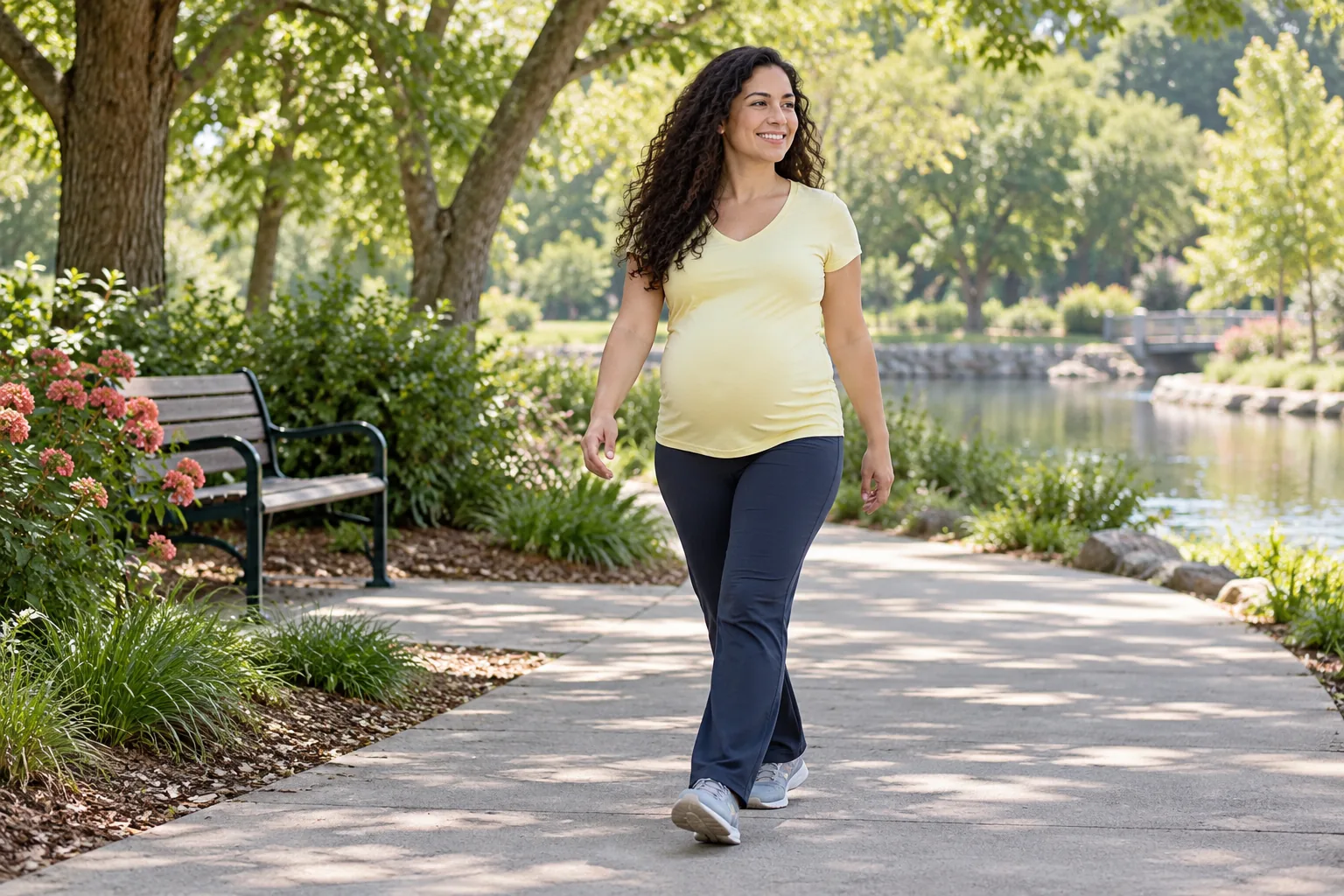
A short level loop near home can be simpler to manage than a long route with no convenient place to stop. Check pavement condition, road crossings, hills, shade, and whether you can sit if needed. If you use a park, think about how far the walking area is from the parking lot or transit stop. That approach distance is part of the outing, even if it is not included in the route you planned.
Restroom access may also affect the choice as pregnancy progresses. A route that looks attractive on a map can become inconvenient when you need a break. Choose an arrangement that allows you to shorten the session without embarrassment or a difficult return journey. If you walk with someone, explain that the route may change. A companion who accepts an early turn-around is more useful than one who encourages you to finish the original distance regardless of comfort.
Use effort instead of a required pace
Start comfortably and let your breathing help you judge the effort. You should be able to talk during moderate walking rather than needing to shorten every sentence. A familiar speed can feel different on a hill, in warm weather, after poor sleep, or later in pregnancy. Slow down when the conditions change. A pace recorded before pregnancy is not a compulsory benchmark for the current routine, and a slower walk can still be a worthwhile activity.
Avoid making every outing a test of how many steps you can accumulate. A step count does not describe footing, heat, symptoms, or recovery. It also includes movement outside the planned walk, which may already be substantial. If a watch encourages you to continue when you need to stop, hide the target or use a simpler record. The practical goal is a manageable routine that supports movement, not a number that overrides how the outing is going.
Begin with the duration that feels repeatable
If you are beginning or restarting, choose an amount you can complete comfortably and recover from without disrupting the rest of the day. A brief walk can be a starting point, and you do not need to add time at every opportunity. Repeat an appropriate dose before deciding whether a change fits. This lets you notice how the route and timing affect the experience instead of making each outing a different challenge.
You can divide movement across the day when that arrangement is more practical. A short walk before work and another comfortable opportunity later may fit better than one longer session, although the right amount still depends on your situation. Avoid using shorter bouts as a reason to exceed your current capacity by accumulating them without considering fatigue. Look at the combined day, including necessary errands and occupational activity, when reviewing the plan.
Prepare for weather and temperature
Check the forecast and choose a cooler part of the day when warm conditions make walking uncomfortable. Shade, humidity, direct sun, and the distance from a resting place all matter. During unusually hot weather, an indoor option or a rest day can be the more useful decision. You do not need to preserve the outdoor route at all costs. Changing the setting is an ordinary part of a pregnancy walking plan, especially when weather shifts quickly.
A sun hat (paid link) can provide some shade during a suitable outdoor walk, but it does not make extreme heat safe. Choose a comfortable fit and enough visibility to see the path. In cold or wet conditions, think about slippery surfaces and whether footwear and clothing allow stable movement. If the route feels uncertain, use a clearer indoor setting or postpone the outing. Practical equipment supports an appropriate choice; it should not be used to justify unsuitable conditions.
Keep water access uncomplicated
Carry a water bottle (paid link) if there is no convenient drinking access or if the route makes carrying your own water useful. Check that the lid is secure and the bottle is comfortable to hold or store. A heavy bag can change the feel of the walk, so take only what you need and avoid loading one shoulder with unnecessary items. Arrange water before leaving rather than depending on a fountain that may be closed or too far from the route.
Use ordinary opportunities to drink and follow any individual advice from your care team. There is no universal bottle volume that determines whether the walk is safe. If you feel lightheaded or unwell, change the plan and obtain guidance when needed instead of assuming you only need to drink and continue. Persistent vomiting or difficulty keeping fluids down is a medical concern, not a problem that can be solved by changing your walking accessories.
Adjust stride and terrain when comfort changes
As pregnancy progresses, the comfortable stride and distance may change. Keep a relaxed pace and avoid deliberately lengthening the stride to maintain speed. Choose flatter ground if hills have become awkward or tiring. If you need support or have a balance concern, discuss options with your care team rather than improvising with an unstable object. The route should make it easy to focus on ordinary walking instead of requiring repeated obstacle negotiation.
If pain or pelvic symptoms occur, record where and when they appear and stop the activity that is provoking them. Shortening a walk can reduce its demand, but it does not identify the cause of pain. Recurrent discomfort deserves individualized advice. You may need a different activity or a more specific assessment. Avoid assuming that you should simply get used to the symptoms because other pregnant people describe walking long distances without difficulty.
Build the weekly arrangement around real commitments
Choose a few practical opportunities and attach them to routines you already understand. A walk before a desk-based shift, a short route during a lunch break, or a comfortable outing with a partner may be easier to remember than a separate daily workout appointment. Include a reduced option for days when time or energy changes. The reduced option might be a shorter route or a clearer indoor setting, not a faster pace to squeeze the same distance into less time.
Leave space for recovery and prenatal appointments. If a planned walk does not fit, resume the next appropriate opportunity rather than doubling the following outing. For someone with a physically demanding job, the most useful adjustment may be protecting rest rather than adding another session. Tell your clinician about the total activity you are doing, since a weekly exercise plan can look moderate while work and household demands make the overall day much harder.
Review the routine with a few useful notes
In a training journal (paid link), record the route, approximate duration, and a brief observation about comfort during and afterward. Note changes that may explain a difficult outing, such as a hill, warmer weather, a heavy bag, or poor sleep. These details help you compare similar walks. You do not need to record every step or convert the outing into a calorie calculation. Keep the record focused on the decisions you actually want it to support.
At your next prenatal visit, ask about persistent symptoms, position or balance concerns, and any changes to your activity advice. A clear example is useful: you may explain that a level loop feels comfortable but a hill produces pressure that lasts afterward. Continue revising the walking routine as pregnancy changes. The successful plan is not necessarily the longest route; it is the one you can organize, respond to, and adapt without ignoring the needs of the day.
Practical Options at a Glance
| Situation | Practical option | What to consider |
|---|---|---|
| Hot afternoon | Choose a cooler time or suitable indoor route | Keep access to water and an easy way to stop. |
| Busy workday | Consider a brief familiar loop | Include activity already completed during the day. |
| Walking with a friend | Agree on your pace and optional breaks | The companion should reduce pressure to keep up. |
Frequently Asked Questions
A fixed step target is not necessary for planning a useful walking routine. Start with a comfortable route and consider your prenatal advice, ordinary activity and recovery. Steps from work and errands also affect the day. A tracker can describe activity, but it should not decide whether you ignore discomfort.
Choose a cooler time, shade or a suitable indoor route, and keep access to water and a place to stop. Shorten or postpone the walk when conditions make it uncomfortable. Avoid treating a planned mileage as a requirement. Feeling overheated or unwell calls for stopping and seeking advice when necessary.
Yes, if the friend follows your pace and accepts breaks and route changes. Agree beforehand that either person can stop without explanation. A companion should make the walk more practical, such as helping with a familiar short loop, rather than turn conversation or distance into pressure to keep up.
Safety and Personal Needs
Discuss exercise with your prenatal care team and follow any individual restrictions. Stop activity and get medical help for concerning pregnancy symptoms. Chest pain, difficulty breathing, fainting, severe headache, vaginal bleeding or fluid leakage need urgent assessment; this is not an exhaustive list. Do not use an exercise modification to delay care.
This is general educational information. Pregnancy and postpartum recovery vary with health, delivery, healing and symptoms. This guide does not replace individualized maternity or physical therapy care.
Sources and Further Reading
- ACOG: Exercise During Pregnancy
- CDC: Physical Activity for Healthy Pregnant or Postpartum Women
- NHS: Exercise in Pregnancy
- CDC: Urgent Maternal Warning Signs