Gym Workout Plan for Beginners: A 6-Week Machine-and-Dumbbell Strength Guide provides a practical framework that can be adjusted to individual experience, schedule, equipment, and recovery. The plan emphasizes repeatable training rather than extreme sessions. It is educational information, not medical treatment, and people with health conditions, recent injuries, or unexplained symptoms should follow qualified professional guidance.
The primary search focus is gym workout plan for beginners, but the program also explains technique, progression, recovery, cardio, and realistic scheduling. Use the tables as starting points and adjust the exercises when comfort, equipment, or professional advice requires a different option.
Why a Beginner Gym Plan Should Feel Simple
A good gym workout plan for beginners removes unnecessary decisions. New members often walk into a large training space, see dozens of machines, and assume they need to learn everything at once. They do not. Early progress comes from repeating a small set of movements, learning how the equipment feels, and leaving each session with enough energy to return. The first six weeks should build familiarity rather than test toughness. For a useful comparison, see our Beginner Workout Plan.
This plan uses three full-body sessions because that frequency gives beginners repeated practice without demanding daily training. Each workout includes a lower-body movement, a push, a pull, a hip-dominant exercise, simple core work, and optional cardio. The exercises are common in commercial gyms, easy to adjust, and stable enough for someone still learning technique.
Use the first visit as an orientation rather than a performance test. Locate the changing area, water station, cardio equipment, machine section, dumbbells, cable station, and an open space for warm-ups. Ask a staff member to demonstrate unfamiliar adjustment levers and safety pins. Knowing where things are reduces anxiety and makes the next session more efficient.
Learn the Gym and Establish a Starting Baseline
Record a calm baseline for each exercise. Choose a light load, perform eight controlled repetitions, and notice whether you can keep the same posture from the first repetition to the last. The correct starting weight should feel purposeful but leave about three good repetitions available. Write down the machine setting, seat position, dumbbell weight, and any technique cue that helped.
The plan is organized around movement patterns rather than a long list of body parts. A squat or leg press trains the knees and hips together. A hinge, such as a dumbbell Romanian deadlift, teaches the hips to move backward while the torso stays controlled. A horizontal push and pull develop the chest, shoulders, upper back, and arms. A carry or anti-rotation exercise teaches the trunk to resist unwanted movement.
Thinking in patterns makes substitutions easier. When a machine is occupied, replace a chest press with an incline push-up, a seated row with a cable row, or a leg press with a supported goblet squat. The workout still makes sense because the movement role remains the same.
Movement Patterns and an Efficient Warm-Up
Begin with five minutes of comfortable walking, cycling, or elliptical work. The goal is to feel warmer and more alert, not tired. Follow that with one set each of bodyweight squats to a bench, wall push-ups, hip hinges, and light cable rows. Move slowly and use the warm-up to rehearse the positions required later in the workout.
Before the first heavy set of a major exercise, complete one or two lighter practice sets. For example, use an empty machine or very light dumbbells for eight repetitions, then use roughly two-thirds of the planned working weight for five repetitions. Warm-up sets should improve coordination without adding meaningful fatigue.
Train on three nonconsecutive days when possible, such as Monday, Wednesday, and Friday. On the days between strength sessions, use easy walking, mobility, or normal daily activity. Beginners do not need intense cardio every day. Recovery is part of the program because the body adapts between workouts, not only during them.
The Six-Week Training Schedule
The schedule alternates Workout A and Workout B. In week one, perform A, B, A. In week two, perform B, A, B. Continue alternating so each movement receives similar practice over time. The first two weeks emphasize technique; weeks three and four add repetitions or small weight increases; weeks five and six consolidate progress.
Workout A begins with the leg press because it provides a stable lower-body pattern. Place the feet about shoulder-width apart, lower only as far as the pelvis remains supported, and press through the whole foot. Follow it with a chest press and seated row. Keep the shoulder blades controlled and avoid rushing the final part of each repetition. For the gym workout plan for beginners, if you want another way to structure the same goal, compare this approach with our Low-Impact Workout Plan for Beginners.
The dumbbell Romanian deadlift comes next. Hold the weights close to the thighs, soften the knees, move the hips backward, and stop when the hamstrings feel loaded without rounding the back. Finish with a farmer carry and a short period of easy cardio. Rest long enough to repeat good technique, usually sixty to ninety seconds for smaller exercises and up to two minutes for demanding sets.
Workout A: Machines First, Dumbbells Second
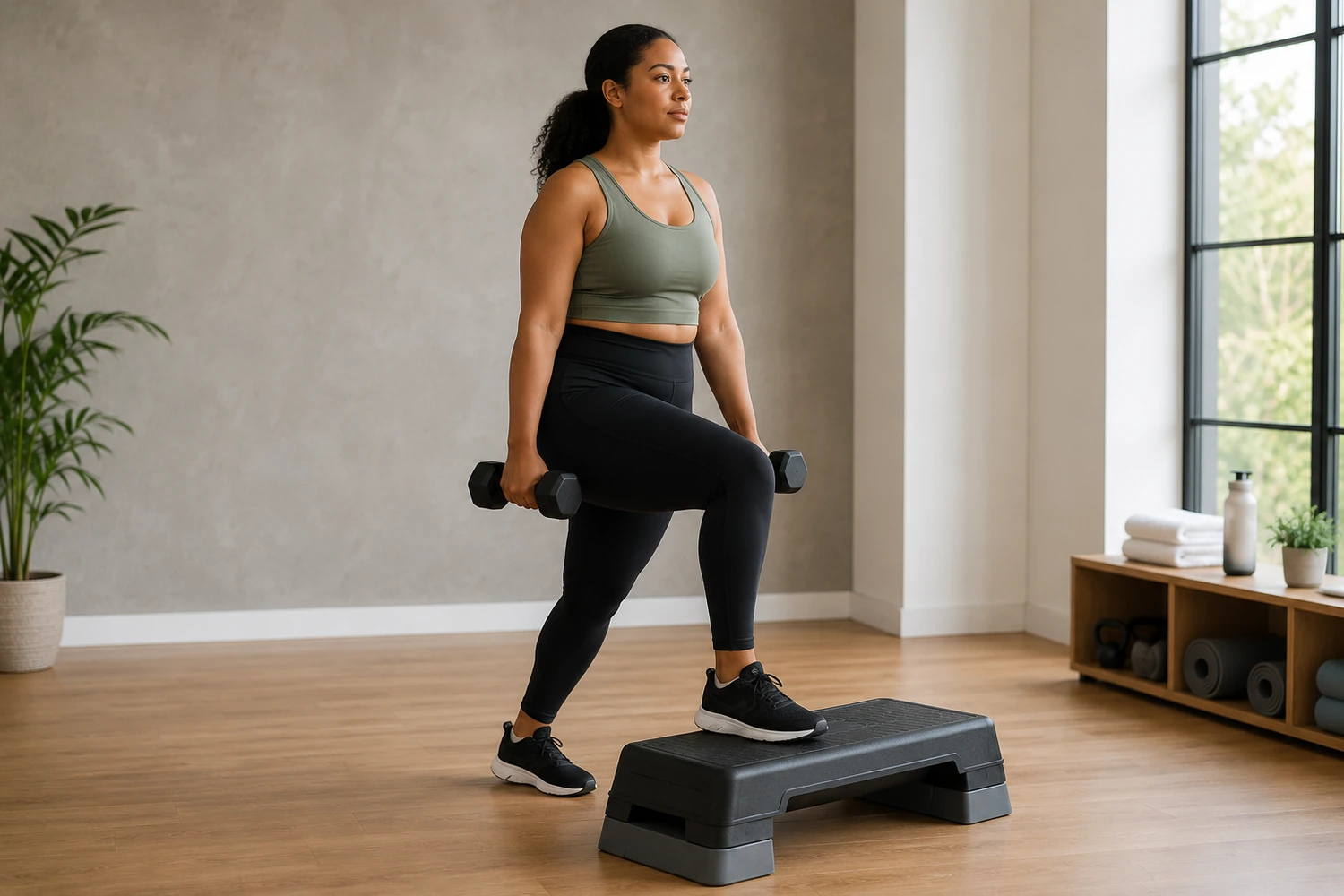
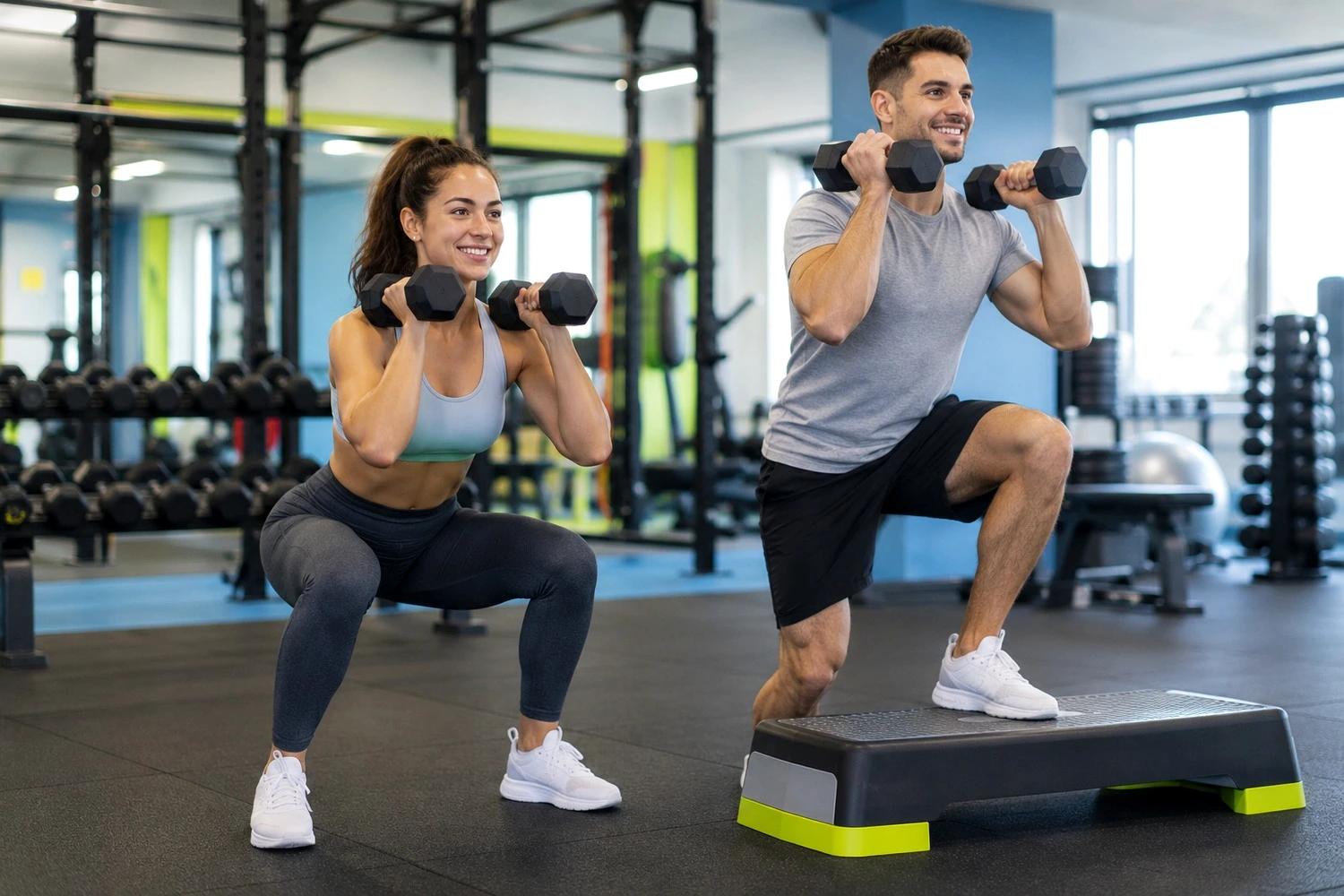
Workout B uses a supported split squat or low step-up to introduce single-leg strength. Hold a rail or machine frame lightly if balance limits the movement. The goal is a smooth descent and stable knee position, not a deep range at any cost. Follow with a lat pulldown, machine shoulder press, and cable or dumbbell hip hinge.
A cable Pallof press provides simple anti-rotation core work. Stand tall, press the handle away from the chest, and prevent the cable from turning the torso. Finish with ten to fifteen minutes of low-intensity cycling or treadmill walking. Cardio should remain conversational during the first six weeks.
Most exercises begin with two working sets of eight to twelve repetitions. Two sets are enough for learning while keeping sessions manageable. When both sets reach the top of the repetition range with consistent technique and two or three repetitions still available, increase the load by the smallest practical amount at the next session.
Sample Weekly Plan
In the gym workout plan for beginners schedule, use an easier day to maintain movement without adding fatigue before the next priority session. Before increasing the gym workout plan for beginners workload, review sleep, soreness, stress, and recent training demand.
| Day / Block | Focus | Plan | Time |
|---|---|---|---|
| Monday | Workout A | Leg press, chest press, seated row, Romanian deadlift, carry | 45–60 min |
| Tuesday | Recovery | Easy walking and mobility | 20–30 min |
| Wednesday | Workout B | Supported split squat, pulldown, shoulder press, hinge, Pallof press | 45–60 min |
| Thursday | Optional cardio | Walking, bike, or elliptical at conversational pace | 20–30 min |
| Friday | Alternating strength | Continue A/B sequence | 45–60 min |
| Weekend | Normal activity | Walking, recreation, and one full rest day | Flexible |
Exercise Guide
While following the gym workout plan for beginners, progress only one training variable at a time so the response remains easy to evaluate. Within the gym workout plan for beginners approach, treat better technique or a fuller comfortable range as valid progress when adding weight is not appropriate.
| Exercise | Sets | Target | Effort Guide |
|---|---|---|---|
| Leg press | 2–3 sets | 8–12 controlled reps | Stop with 2–3 good reps available |
| Machine chest press | 2–3 sets | 8–12 reps | Shoulders stay down and wrists stacked |
| Seated row | 2–3 sets | 8–12 reps | No torso swinging |
| Dumbbell Romanian deadlift | 2–3 sets | 8–10 reps | Hips move back; weights stay close |
| Supported split squat | 2 sets | 6–10 each side | Use support and control the descent |
| Pallof press | 2 sets | 8–12 each side | Resist rotation and breathe normally |
Workout B: Single-Leg Strength and Upper-Body Control
Avoid turning every set into a test. Repetitions should slow slightly near the end, but posture and range should remain recognizable. If technique changes dramatically, the set is finished. A beginner gains more from forty good repetitions across the week than from one impressive but uncontrolled set.
Weeks one and two are practice weeks. Use two sets for most exercises and stop well before failure. During weeks three and four, try to add one repetition to each set or a small amount of weight when the full range is comfortable. In weeks five and six, selected exercises may move to three sets if recovery, sleep, and motivation remain good.
Progress is not limited to heavier weight. A more stable split squat, a quieter machine repetition, a longer carry, or a lower perceived effort at the same load are meaningful improvements. Keep records so these changes are visible. Without notes, beginners often underestimate progress and change programs too soon.
Choosing Sets, Repetitions, and Starting Weight
Strength training supports fitness, but daily movement still matters. Begin with a realistic walking target based on the current baseline rather than an arbitrary number. Someone averaging four thousand steps may aim for forty-five hundred or five thousand before chasing ten thousand. Small increases are easier to maintain and less likely to create excessive soreness.
Add two optional cardio sessions of twenty to thirty minutes at an easy-to-moderate pace. Walking, cycling, swimming, and elliptical training are all suitable. Cardio should support health and recovery, not make the next strength workout feel impossible. Increase only one variable at a time: duration, frequency, or intensity.
Mild muscle soreness is common during the first two weeks, especially after unfamiliar leg exercises. Soreness should improve as you move and should not change normal walking or daily tasks. Sharp pain, swelling, numbness, dizziness, chest discomfort, or pain that worsens from session to session requires a different response and may need professional assessment. For the gym workout plan for beginners, when adjusting your weekly plan, you can also use the How to Stay Consistent With Workouts as a practical reference.
Progression, Cardio, and Daily Activity
Sleep, regular meals, hydration, and rest days influence progress. A difficult week at work may justify repeating the same weights instead of increasing them. Consistency is not the same as forcing the plan regardless of circumstances. The best beginner program is flexible enough to continue through normal life.
The most common mistake is changing exercises every session. Variety can be enjoyable, but constant change prevents skill development and makes progression difficult to measure. Another mistake is copying an advanced lifter’s volume. More sets are not automatically better when technique, recovery, and schedule are still developing.
Beginners also rush rest periods, ignore machine adjustments, or choose weights based on embarrassment rather than readiness. Set the seat correctly, control the full repetition, and use a load that matches the plan. A quiet, repeatable session produces better long-term results than a dramatic workout followed by a week away.
Recovery, Soreness, and Common Beginner Mistakes
Before advancing the gym workout plan for beginners, complete two controlled sessions and then make one small increase. To measure progress in the gym workout plan for beginners, keep the same core movement long enough to compare repetitions, load, range, and effort.
Arrive ten minutes early so the session does not begin in a rush. Bring water, comfortable clothing, stable shoes, a small towel if the gym requires one, and a simple note on your phone with the planned exercises. Check where bags are stored and whether machines need to be wiped before and after use. These small details reduce uncertainty and allow attention to stay on the workout.
Before the first working set, adjust the machine while it is unloaded. The joint should line up with the machine’s pivot when the design requires it, handles should be reachable without straining, and the starting position should not force the shoulders or knees into an uncomfortable angle. Ask staff for help when the adjustment is unclear. Learning how to set up equipment is part of the workout plan, not wasted time.
Confidence, Substitutions, and Busy-Week Adjustments
Choose a quiet area for the warm-up and avoid blocking walkways or equipment. During busy hours, keep one alternative for each movement. A leg press can become a box squat, a chest press can become an incline push-up, and a seated row can become a cable or band row. The session remains productive even when the preferred station is occupied.
A basic training log needs only the date, exercise, machine setting, weight, repetitions, and a brief comfort note. Record information immediately after the set rather than relying on memory. The log makes progression objective and prevents the common problem of guessing a different weight every visit.
Review the notes once per week. Look for stable technique, improved repetition quality, a lower effort rating, or a small load increase. Progress may also appear as shorter setup time, better confidence, or less soreness after the same work. These changes matter because they indicate adaptation even when the scale or mirror has not changed. Avoid turning the log into a source of pressure. Some sessions will match the previous week rather than exceed it. Sleep, stress, hydration, and schedule affect performance. The purpose of recording is to guide the next reasonable decision, not to demand a personal record every workout. If a deep knee bend feels uncomfortable, use a higher box, reduce the leg-press range, or select a low step-up. If gripping dumbbells is difficult, machines and cable handles may be easier. A sensitive lower back may tolerate a supported hip hinge, cable pull-through, or glute bridge better than a heavy free-weight deadlift. For shoulder discomfort, reduce the pressing range, use a neutral grip, or replace an overhead press with a landmine press or incline push-up. Pulling movements should not require the head to move forward or the shoulders to shrug. When an exercise repeatedly causes sharp or worsening symptoms, stop changing minor details and seek qualified assessment. Substitutions should preserve the role of the exercise. Replace a push with another push, a pull with another pull, and a knee-dominant movement with another knee-dominant option. This keeps the weekly structure balanced while respecting individual comfort. A disrupted week does not require restarting the entire six-week plan. When only one gym visit is possible, complete one full-body session using one exercise from each movement pattern. When no gym is available, use chair squats, incline push-ups, backpack rows, hip hinges, and loaded carries with household items. During mild illness, prioritize rest and hydration rather than forcing hard training. Fever, chest symptoms, significant fatigue, or clinician advice are clear reasons to pause. After several missed sessions, return with slightly lighter weights and fewer sets for the first workout. Skill returns quickly, but jumping directly to the previous workload may create unnecessary soreness. The long-term goal is to build a routine that survives imperfect weeks. A reduced session maintains the habit and preserves confidence. Consistency is measured across months, not by whether every calendar week looks identical.
Four-Week Implementation Roadmap
For the gym workout plan for beginners, use the log to confirm consistency and recovery, not as a demand for a record every day. For the gym workout plan for beginners, compare the same movement under similar conditions before deciding that progress has stalled. For the gym workout plan for beginners, for more closely related training ideas, browse our home workout guides.
Frequently Asked Questions
Most sessions in this plan take about forty-five to sixty minutes, including warm-up and optional cardio.
Nonconsecutive strength days are usually easier to recover from and provide better practice quality.
Increase the load after reaching the top of the repetition range with controlled technique and two or three repetitions still available.
Yes. Machines can provide a stable starting point. Dumbbells can be added gradually as coordination improves.
No. Protein powder is optional convenience food; ordinary meals can provide sufficient protein.
Keep one substitution for each movement pattern so the session can continue without waiting for a specific machine.
It can support a broader weight-management plan when combined with appropriate nutrition, daily movement, sleep, and consistency.
Safety and Scope
This article provides general educational fitness information and is not a medical diagnosis, treatment plan, or substitute for individualized advice. Stop exercise and seek appropriate care for sharp pain, chest discomfort, faintness, unusual shortness of breath, or symptoms that worsen.