Published by Best Fitness Routine. Editorial standards · Report a correction. Educational guidance; no individual clinical review is claimed unless a qualified reviewer is named.
What This Practice Should Accomplish
Chair yoga can make yoga more accessible without making it meaningless. A sturdy chair gives you a stable reference point for breathing, spinal movement, hip mobility, and gentle strength work. It can be useful for older adults, people who spend long periods sitting, beginners who are not comfortable getting down to the floor, or anyone who wants a lower-demand practice on a recovery day.
The chair should be stable, placed on a non-slip surface, and ideally have no wheels. Sit far enough forward that both feet can contact the floor. You do not need to pull yourself into large ranges. Small, controlled movements repeated with relaxed breathing are often more useful than a dramatic stretch.
A useful chair yoga practice should leave you with clearer movement options, not the feeling that you passed or failed a flexibility test. Choose poses that match the purpose of the session, use support before form breaks down, and keep enough energy in reserve that you can repeat the practice later in the week.
Before You Start
Clear a space where your hands and feet will not slide. A yoga mat (paid link) is helpful but not mandatory for every pose. A chair, wall, two blocks, or firm books can make floor and standing positions easier to control. Wear clothing that allows comfortable movement and keep water nearby if the room is warm.
Use an effort level that lets you breathe continuously. If a pose creates sharp pain, increasing numbness, dizziness, chest pain, or symptoms that feel medically concerning, stop. Yoga is generally considered safe for healthy people when practiced appropriately, but injuries can occur and some conditions require pose modifications.
Pose-by-Pose Guide
The following movements are selected for this specific guide. You do not need to perform every pose. Pick the options that suit your body today and treat the easier variation as a legitimate exercise, not a temporary failure.
Seated Mountain Pose
Sit toward the front of a sturdy chair with both feet grounded. Stack the ribs over the pelvis and let the shoulders relax away from the ears. For this chair yoga routine, move slowly enough that you can notice whether the position feels stable from one repetition or breath to the next.
Make it easier: Place a folded towel under the feet if they do not reach the floor.
Shoulder Rolls
Circle the shoulders slowly up, back, and down, then reverse direction. Keep the jaw relaxed and avoid turning the movement into a shrug. For this chair yoga routine, move slowly enough that you can notice whether the position feels stable from one repetition or breath to the next.
Make it easier: Make smaller circles if the shoulders are sensitive.
Seated Cat-Cow
With hands on the thighs, gently round the upper and lower back, then tip the pelvis forward and lift the chest. Move through a comfortable range rather than forcing extension. For this chair yoga routine, move slowly enough that you can notice whether the position feels stable from one repetition or breath to the next.
Make it easier: Use a smaller pelvic movement if the low back is sensitive.
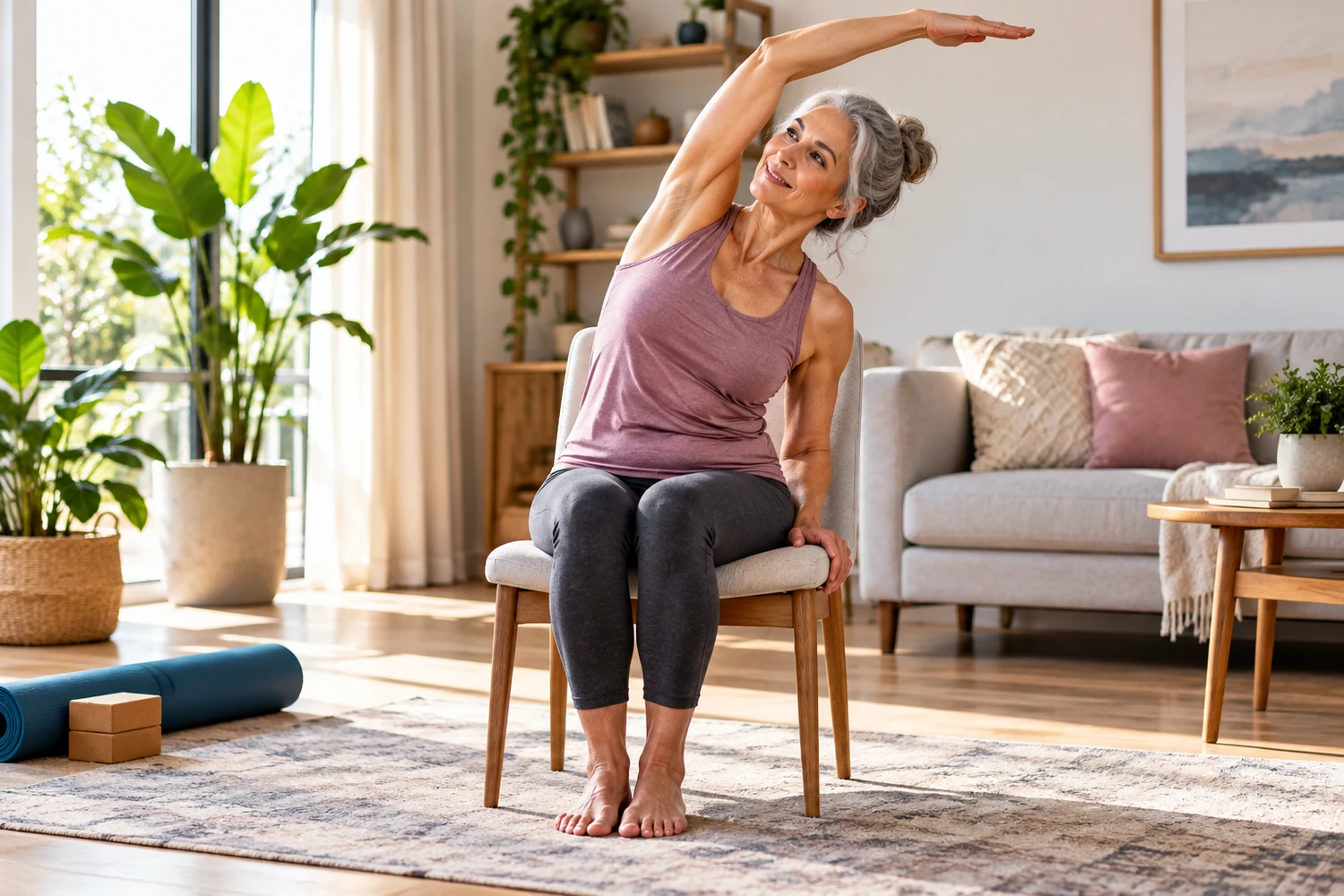
Seated Side Bend
Keep one hand on the chair and reach the other arm overhead, leaning slightly to the side. Keep both feet planted and avoid twisting forward. For this chair yoga routine, move slowly enough that you can notice whether the position feels stable from one repetition or breath to the next.
Make it easier: Keep the top hand on the shoulder if reaching overhead is difficult.
Seated Twist
Sit tall first, then rotate the rib cage gently without using the arms to force the range. Keep both sitting bones grounded when possible. For this chair yoga routine, move slowly enough that you can notice whether the position feels stable from one repetition or breath to the next.
Make it easier: Perform the twist from a chair with a very small range.
Seated Knee Extension
Sit tall and slowly straighten one knee until the leg is almost parallel with the floor, then lower with control. Keep the thigh supported by the chair. For this chair yoga routine, move slowly enough that you can notice whether the position feels stable from one repetition or breath to the next.
Make it easier: Use a smaller range or alternate heel slides instead.
Ankle Circles
Lift one foot slightly and draw slow circles from the ankle in both directions. Keep the knee still so the movement comes from the ankle. For this chair yoga routine, move slowly enough that you can notice whether the position feels stable from one repetition or breath to the next.
Make it easier: Keep the heel on the floor and move the forefoot if lifting the leg is difficult.
Chair-Supported Warrior II
Stand beside a chair and use one hand for light support while taking a shortened Warrior II stance. Bend the front knee only as far as you can control. For this chair yoga routine, move slowly enough that you can notice whether the position feels stable from one repetition or breath to the next.
Make it easier: Keep both knees straighter and shorten the stance further.
Supported Tree Pose
Stand next to a wall or chair and place one foot against the opposite ankle or lower calf. Keep one hand supported until balance is steady. For this chair yoga routine, move slowly enough that you can notice whether the position feels stable from one repetition or breath to the next.
Make it easier: Keep the toes of the lifted foot on the floor like a kickstand.
Chair Sit-to-Stand
Scoot toward the front of the chair, place the feet under the knees, lean forward slightly, and stand using the legs. Sit back down slowly instead of dropping. For this chair yoga routine, move slowly enough that you can notice whether the position feels stable from one repetition or breath to the next.
Make it easier: Use the hands on the chair arms if needed.
Sample Routine
Use the routine below as a starting framework rather than a strict prescription. If you are new to yoga, one round is enough. More experienced readers can repeat selected sections, but quality of movement is more important than adding time.
| Exercise or pose | Suggested time | Practical focus |
|---|---|---|
| Seated breathing | 2 minutes | Comfortable, controlled effort |
| Shoulder rolls | 1 minute | Comfortable, controlled effort |
| Seated Cat-Cow | 2 minutes | Comfortable, controlled effort |
| Side Bend | 45 seconds per side | Comfortable, controlled effort |
| Seated Twist | 45 seconds per side | Comfortable, controlled effort |
| Knee extensions | 8 per side | Comfortable, controlled effort |
| Ankle circles | 30 seconds per direction | Comfortable, controlled effort |
| Supported Warrior II | 45 seconds per side | Comfortable, controlled effort |
| Sit-to-stand | 6 to 10 controlled reps | Comfortable, controlled effort |
How to Progress Without Forcing Range
Progress can mean smoother breathing, a steadier balance position, less reliance on a chair, a slightly longer hold, or a transition that feels more controlled. Those changes often matter more than reaching farther. Change one variable at a time and give your body several sessions to adapt before making another change.
If you are also strength training, running, cycling, or doing Pilates, place harder yoga sessions where they do not interfere with recovery from your main training. A gentle mobility session can fit almost anywhere; a demanding strength-focused flow deserves the same recovery respect as other workouts.
How to Adapt This Practice for Different Ages and Abilities
Chair yoga is especially useful when floor access, balance, or fatigue is a barrier. Older adults should keep the chair close even during standing work and avoid turning the head rapidly if dizziness is an issue. Younger adults can also use this routine during a work break or after travel. The chair changes the setup, not the value of moving regularly.
Children and teens who practice yoga should use age-appropriate instruction rather than adult intensity targets. During pregnancy, certain positions and prolonged supine work may need modification. People with glaucoma, significant osteoporosis, recent surgery, uncontrolled blood pressure, joint replacements, or neurological symptoms should get individualized advice when necessary.
Common Mistakes and Better Replacements
- Using a rolling office chair that can move unexpectedly. Use a smaller range, more support, or a slower transition instead of treating discomfort as part of the goal.
- Sitting so far back that the feet do not reach the floor. Use a smaller range, more support, or a slower transition instead of treating discomfort as part of the goal.
- Pulling hard on the chair to force a twist. Use a smaller range, more support, or a slower transition instead of treating discomfort as part of the goal.
- Holding the breath during sit-to-stand work. Use a smaller range, more support, or a slower transition instead of treating discomfort as part of the goal.
- Moving the head quickly when prone to dizziness. Use a smaller range, more support, or a slower transition instead of treating discomfort as part of the goal.
- Assuming seated exercise cannot become tiring. Use a smaller range, more support, or a slower transition instead of treating discomfort as part of the goal.
How Often to Practice
For most beginners, two or three sessions per week is a realistic place to start. Shorter practices can be done more often when they are comfortable and do not create persistent soreness. Yoga can contribute to flexibility, balance and muscular work, but a complete weekly activity plan should also include aerobic and strengthening activity appropriate to your goals and abilities.
Consistency is easier when the routine has a clear role. A morning sequence can be brief and energizing. A desk routine can be used as a movement break. A recovery practice should genuinely reduce effort. A strength flow can be scheduled like a workout. Decide what the session is for before adding extra poses. Keep your session notes in a workout logbook (paid link) so you can compare the activity and recovery discussed here.
Frequently Asked Questions
No. It can be useful for beginners, desk workers, people with limited floor access, and recovery days.
Use a sturdy chair without wheels. A firm seat and stable legs are more important than appearance.
Chair-supported standing work can let you practice balance with a safer handhold, but progress gradually.
Ten to 30 minutes can work well. Shorter sessions are easier to fit into a daily routine.
Many people with arthritis use gentle movement, but painful or inflamed joints may need individualized modifications from a clinician or qualified instructor.
Safety and Scope
This guide provides general educational fitness information. It does not diagnose injuries or medical conditions and does not replace individualized care. Yoga can be modified for many people, but pregnancy, recent surgery, major joint problems, balance disorders, glaucoma, severe high blood pressure, neurological symptoms, or persistent pain may require professional guidance. Stop any pose that causes sharp or worsening symptoms.